Build efficient task assignment workflows in UK construction
Discover how to move away from fragile manual systems to digital task assignment workflows that improve accountability and reduce delays on UK construction sites.
By James Shorter ·
Build efficient task assignment workflows in UK construction
TL;DR:
- Manual and paper-based systems create fragile information flows leading to miscommunication and delays.
- Digital workflows with clear ownership, dependencies, and real-time updates improve accountability.
- Adopting collaborative planning and continuous monitoring reduces rework and streamlines UK construction projects.
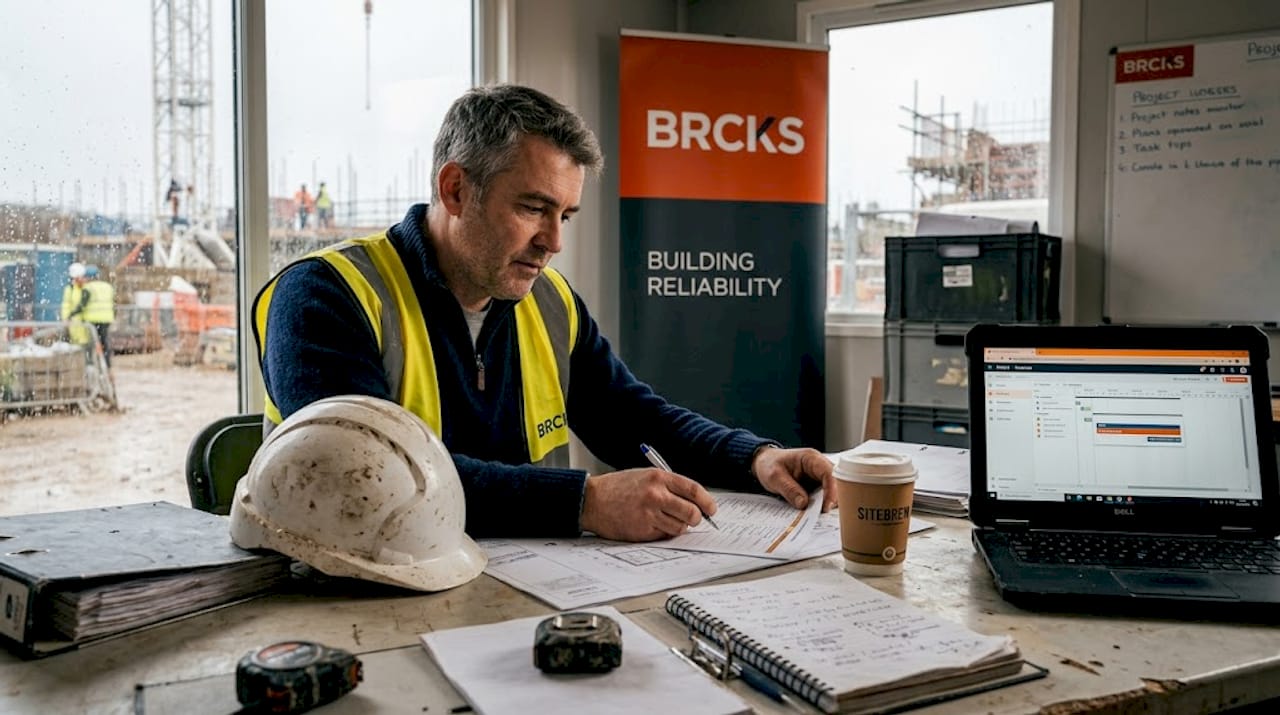
Picture this: it’s 7am on a busy UK construction site and nobody is quite sure who owns the groundworks sign-off. The groundworker thinks the site manager sorted it. The site manager assumed the subcontractor lead picked it up. By 9am, two hours of labour are wasted, a delivery is turned away, and the programme slips by a day. Multiply that scenario across a twelve-month project and the cost becomes significant. This guide walks you through the exact steps to build a task assignment workflow that keeps every team member clear on their responsibilities, reduces rework, and gives you the collaborative edge that modern UK construction demands.
Table of Contents
- Understanding the challenges of task assignment in construction
- Preparing your workflow: requirements and tools
- Step-by-step: assigning tasks for collaboration and clarity
- Monitoring and verifying your assignment workflow
- Our take: the future of task assignment workflows in UK construction
- Ready to streamline your construction task workflow?
- Frequently asked questions
Key Takeaways
| Point | Details |
|---|---|
| Avoid manual pitfalls | Moving away from paper processes helps prevent miscommunication and costly errors. |
| Link tasks to outcomes | Each assignment should clearly connect to budgets and project dependencies for greater clarity. |
| Prioritise digital tools | Modern digital workflows streamline task assignment, monitoring, and real-time adjustments. |
| Continuous monitoring matters | Regular checks and digital tracking make it easier to spot issues and improve workflows. |
Understanding the challenges of task assignment in construction
Before you can fix a workflow, you need to understand what is breaking it. Task assignment in construction is genuinely complex, and the problems that UK project managers face are not simply about effort or attitude. They are structural.
Manual and paper-based systems are the first major culprit. Many sites still rely on printed task sheets, whiteboard rosters, or verbal briefings at the morning toolbox talk. These methods are not inherently wrong, but they create a fragile chain of information. A task written on a whiteboard at 7am can be misread, forgotten, or overwritten by 10am. When a subcontractor calls in sick and their replacement arrives, nobody has a clear written record of what was agreed. The result is duplication, missed steps, and frustrated teams.
The second issue is the model of assignment itself. There is a meaningful difference between a top-down approach, where the project manager issues tasks to team leaders who cascade them downward, and a collaborative bottom-up model such as the Last Planner System. Traditional top-down assignment is fast to implement but often brittle. It assumes the person at the top has perfect information, which is rarely true on a live construction site. The Last Planner System, by contrast, involves the people doing the work in the planning process, which improves commitment and surfaces constraints early. Static work breakdown structures (WBS) work well for straightforward projects, but large UK projects with multiple phases and geographical spread often need hybrid or dynamic approaches to stay accurate.
“The biggest single cause of task assignment failure is not technology. It is the assumption that the person assigning the task and the person receiving it share the same understanding of what ‘done’ looks like.”
Communication confusion compounds both of the above. When task updates live in three different places, such as an email thread, a WhatsApp group, and a site diary, nobody has a single source of truth. Teams spend time reconciling versions rather than completing work. You can read more about how to address this through coordination best practices that are specifically designed for UK sites.
Common blockages that UK construction managers report include:
- Unclear task ownership across subcontractor boundaries
- No formal handover process between trades
- Dependencies not documented, so downstream tasks start before upstream ones are complete
- Progress updates that are subjective rather than evidence-based
- No audit trail when disputes arise about who agreed to what
Recognising these patterns in your own projects is the first step toward building something better.
Preparing your workflow: requirements and tools
Once you appreciate the obstacles, the next step is setting up your workflow with the right preparation and tools. Jumping straight to a new digital platform without doing this groundwork is one of the most common mistakes project managers make.
Start by auditing your current process honestly. Ask yourself: where do tasks currently get created? Where do they get communicated? Where do they get tracked? In most cases, the answers will be three different places, and that gap is where problems live. A good workflow management guide will help you map this out systematically.
What you need before you build a new workflow:
- A clear project breakdown with defined phases and dependencies
- Agreed budget lines that tasks can be linked to
- A single communication channel that all parties will actually use
- Role definitions that make task ownership unambiguous
- A method for capturing completions with evidence, not just verbal confirmation
Research from Heriot-Watt University found that 65 good practices for planning and monitoring emerged from UK construction surveys, and that digital rolling lists significantly reduce end-phase stress by keeping priorities visible and up to date throughout the project rather than only at milestone reviews.
| Feature | Manual assignment | Digital assignment |
|---|---|---|
| Task creation speed | Slow, paper or verbal | Fast, template-driven |
| Visibility for all parties | Limited | Real-time |
| Dependency tracking | Manual, error-prone | Automated |
| Audit trail | Weak or absent | Full history logged |
| Update notifications | None or ad hoc | Instant alerts |
| Integration with budgets | Separate process | Linked directly |
When evaluating tools, prioritise three things: integration with your existing systems, ease of use for trades who are not office-based, and adaptability as the project evolves. A tool that is powerful but requires a two-day training course will not get used on site. It is also worth reviewing the hidden cost guide before committing to any platform, because licence fees are rarely the only expense involved.
Pro Tip: Before choosing a digital tool, run a two-week pilot with your most sceptical team member. If they adopt it, the rest of the team will follow. If they don’t, you’ll learn exactly what needs to change before a full rollout.
The goal of this preparation phase is not to create a perfect system on paper. It is to remove the ambiguity that causes task assignment to break down in the first place.
Step-by-step: assigning tasks for collaboration and clarity
With the requirements in place, it is time to take decisive action. Here is how to assign tasks step by step, using a practical UK site scenario to illustrate each stage.
Scenario: A residential development in the Midlands, 24 units, with groundworks, frame, roofing, and fit-out phases running across 14 months. Three principal subcontractors and a directly employed site team.
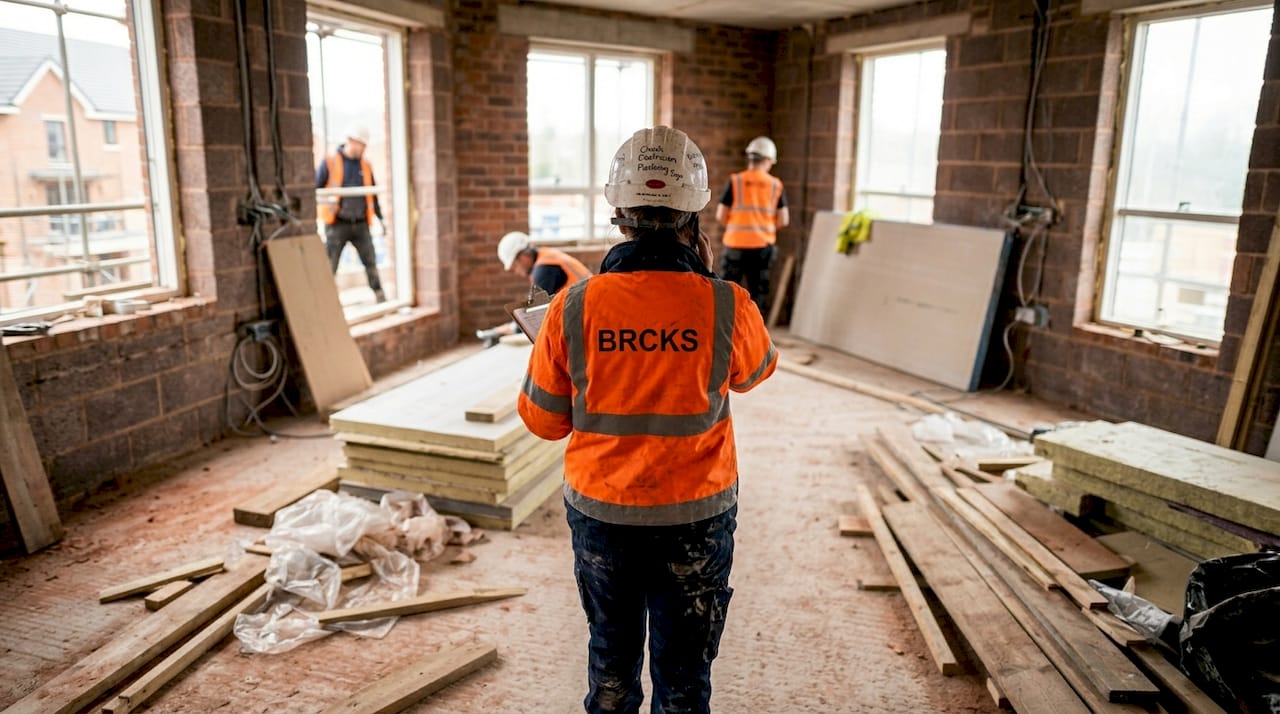
Step 1: Define the task clearly. Every task needs a title, a description of the expected output, an owner, a start date, a completion date, and a link to the relevant budget line. Vague assignments such as “sort the drainage” are the single biggest cause of confusion. Linking tasks to budgets and dependencies is not optional; it is the foundation of accountability.
Step 2: Map dependencies before you assign. Before a task goes to anyone, confirm what it depends on and what depends on it. On our Midlands site, the frame erection cannot begin until the groundworks sign-off is complete and the structural engineer has issued the foundation certificate. Assigning the frame task without confirming this creates false starts.
Step 3: Assign to a named individual, not a company or a role. “Subcontractor A” is not an owner. “Jamie, groundworks lead, Subcontractor A” is. Named ownership creates accountability and makes it clear who to contact when something changes.
Step 4: Communicate the assignment through a single channel. Whether you use a platform, a shared digital board, or a structured daily briefing, the assignment must exist in one place that everyone can access. Teams that reduce rework by 52% consistently cite single-channel communication as a key factor.
Step 5: Confirm receipt and understanding. Ask the assignee to acknowledge the task and confirm they understand the expected output. This takes thirty seconds and prevents days of rework.
Step 6: Set a check-in point before the deadline. A task due on Friday should have a progress check on Wednesday. This is not micromanagement; it is early warning. If a problem is surfaced on Wednesday, you have two days to resolve it. Surfaced on Friday, you have nothing.
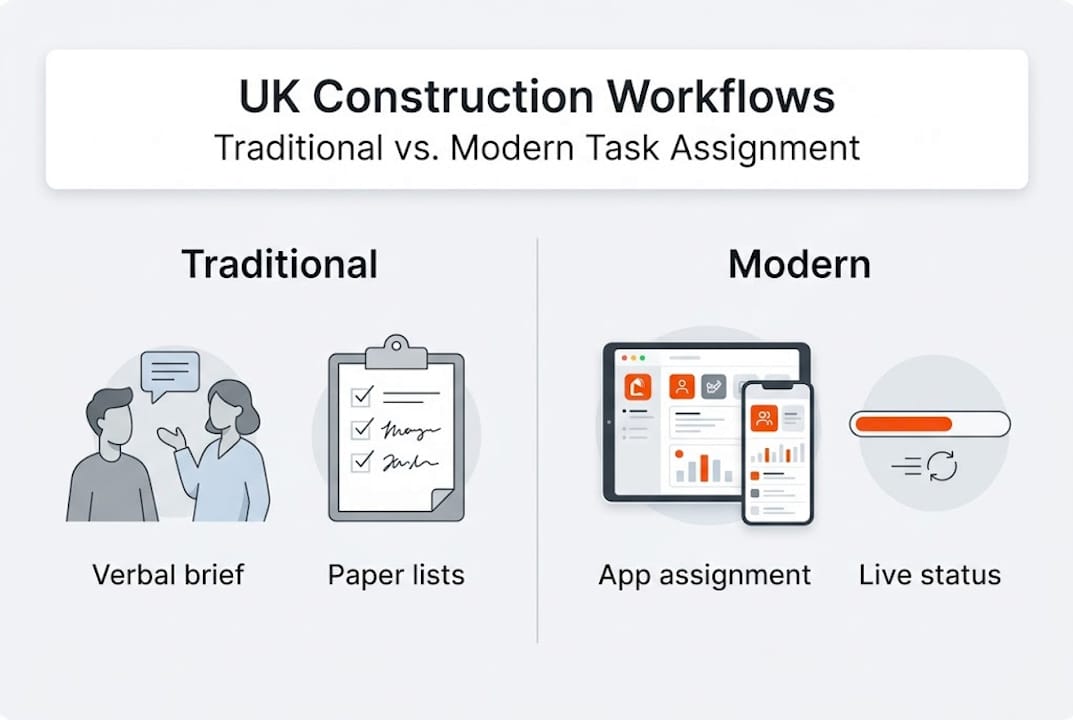
| Traditional process | Modern collaborative process |
|---|---|
| Manager assigns verbally at morning briefing | Task created digitally with full detail |
| No written record | Full audit trail from creation to completion |
| Dependencies assumed | Dependencies mapped and linked |
| Progress checked at end of day | Real-time status visible to all |
| Issues raised when it is too late | Blockers flagged early via platform alerts |
Pro Tip: When managing subcontractors, always include the expected evidence of completion in the task description. “Install first-fix electrics” should specify: “Photo of completed first-fix board, signed inspection sheet uploaded to platform.” This removes ambiguity at sign-off.
The discipline of following these steps consistently, even on straightforward tasks, is what separates high-performing UK construction teams from those that are constantly firefighting.
Monitoring and verifying your assignment workflow
After assigning tasks, you need effective monitoring and verification to ensure everything runs smoothly. Assigning a task is not the end of the process; it is the beginning.
Tracking progress and accountability requires a system that shows you the status of every active task without you needing to chase each person individually. Digital checklists are particularly effective here because they create a visible record that updates in real time. When a task moves from “in progress” to “awaiting sign-off,” everyone with access can see it immediately. This transparency reduces the number of status calls and site walks that consume project managers’ time.
Use your site monitoring guide to establish a rhythm of verification. Weekly reviews of open tasks, combined with daily stand-ups for active phases, give you two layers of oversight without creating bureaucratic overhead.
Key monitoring practices that UK construction surveys consistently recommend include:
- Daily task status updates from named owners, submitted digitally
- Photographic evidence attached to completion records, not just a tick in a box
- Automated alerts when tasks are approaching their deadline without a progress update
- Dependency flags that notify you when an upstream task is late and downstream work is at risk
- Regular variance reports that compare planned versus actual completion rates by trade
“Verification is not about distrust. It is about creating the conditions where problems surface early enough to be solved. A task that is 80% complete and stalled is not the same as a task that is 80% complete and on track. Only a structured verification process tells you which one you have.”
The 65 good practices identified in UK construction research emphasise that monitoring must be continuous, not just at phase gates. Projects that only review progress at milestone reviews consistently experience late surprises that could have been caught weeks earlier.
Document management is a critical part of verification. When a task is completed, the supporting documentation, whether that is an inspection certificate, a signed delivery note, or a photograph, should be stored in a location that is linked to the task record. Platforms that integrate document management solutions with task records make this seamless and reduce the risk of documents being lost or disputed.
Continuous improvement is the final element. After each project phase, review your task completion data. Which types of tasks consistently run late? Which subcontractors have the strongest completion rates? Which dependencies are most frequently missed? These patterns tell you where to focus your process improvements for the next phase or the next project.
Our take: the future of task assignment workflows in UK construction
The construction sector in the UK has a well-documented resistance to workflow change, and it is worth being honest about why. Top-down assignment models have persisted not because they work well, but because they are familiar and require no buy-in from the wider team. The uncomfortable truth is that many project managers hold on to centralised control because it feels safer, even when the evidence shows it produces worse outcomes on fast-moving projects.
The shift toward hybrid and AI-driven methods is not a trend; it is a structural change driven by the complexity of modern construction. Static schedules cannot keep pace with live site conditions. AI-integrated scheduling tools that adjust task priorities based on real-time data will become standard on UK sites within the next few years. The managers who build the habit of collaborative assignment now, using methods like the Last Planner System alongside digital platforms, will adapt to those tools far more easily than those who are still managing tasks on a whiteboard.
The practical nudge we would offer is this: start with one phase of your next project and run a genuinely collaborative planning session. Bring the trade leads into the room, map the tasks together, and assign ownership in front of everyone. The coordination breakthroughs that follow will make the case for you far better than any article can.
Ready to streamline your construction task workflow?
The steps in this guide give you a clear path from chaotic, verbal task assignment to a structured, transparent workflow that your whole team can trust. Putting these practices into action is significantly easier when you have a platform built specifically for construction.
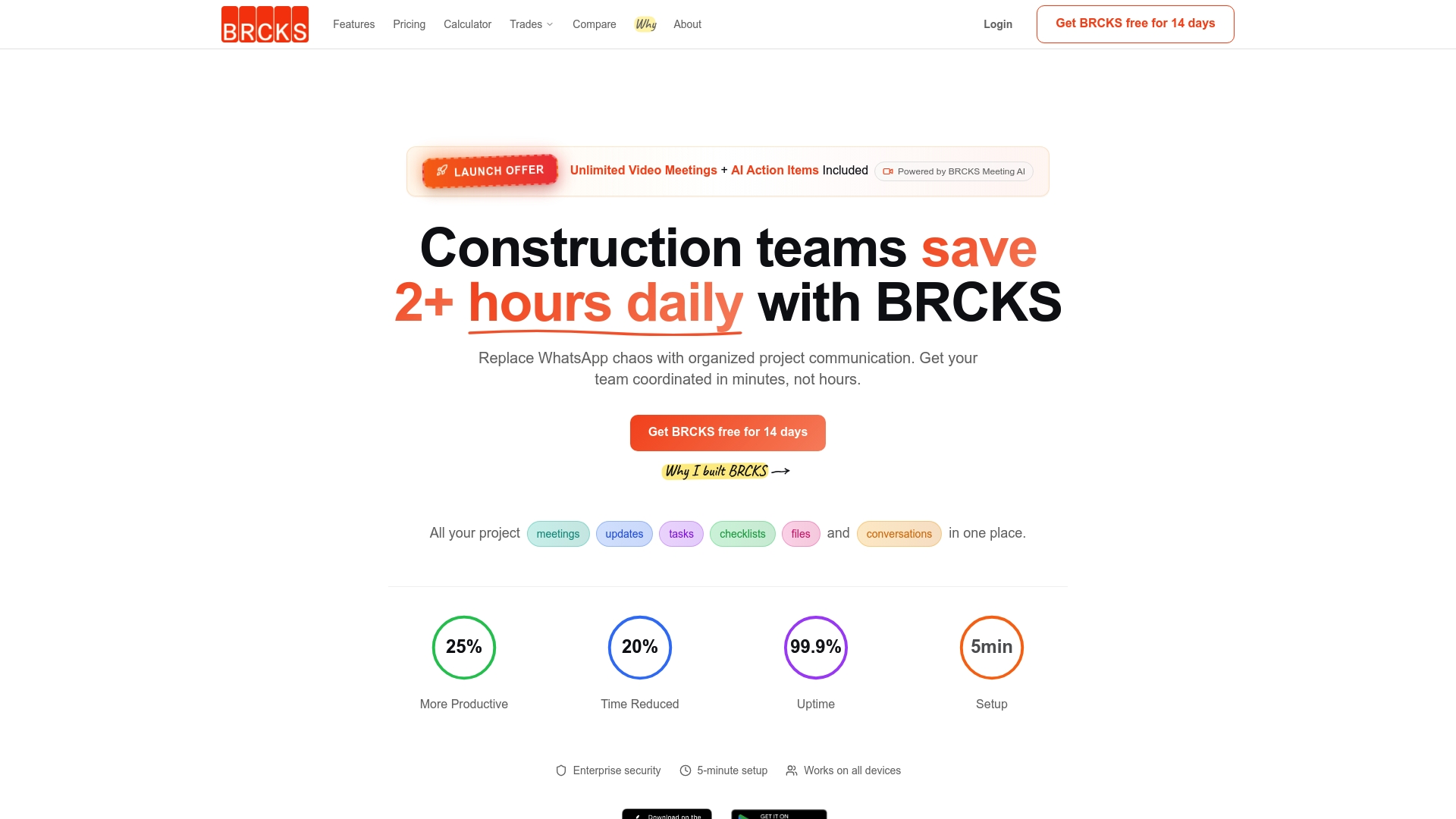
BRCKS brings task management, checklists, file sharing, and team communication into one place, so nothing gets lost between a morning briefing and a Friday deadline. It is designed for UK construction teams, from small builders to large enterprise operations, and includes free subcontractor access so your whole supply chain can stay aligned. Whether you need software for builders or purpose-built construction communication tools, BRCKS is ready to support your workflow from day one. Get BRCKS free for 14 days and see the difference a single, connected platform makes.
Frequently asked questions
What makes task assignment in UK construction projects especially complex?
Complex phasing, shifting schedules, and the mix of manual and digital systems all require careful coordination. Large UK projects often need hybrid or geographical work breakdown structures to stay accurate across multiple trades and locations.
How do digital rolling lists help reduce project stress?
They make dependencies and priorities visible in real time throughout the project, not just at milestone reviews. Digital rolling lists ease end-phase bottlenecks by surfacing issues early enough to resolve them without last-minute rushes.
What is a common mistake when assigning tasks?
Leaving assignments vague or failing to link them to budgets and dependencies is the most frequent error. Vague assignments consistently lead to confusion, duplicated effort, and cost overruns on UK sites.
Are hybrid assignment models suitable for large projects?
Yes. Hybrid or geographical approaches give project managers the flexibility to adapt task structures to site conditions, making workflows more effective on large, complex UK construction projects.
Recommended
- Top Construction Schedule Software for UK Builders 2025 | BRCKS
- UK Construction Project Coordination Best Practices 2026 | BRCKS
- BRCKS | Construction Project Communication Software
- BRCKS | Construction Project Communication Software
How BRCKS Can Help
Establishing efficient task assignment workflows is essential for keeping UK construction projects on track and within budget. By centralising communication and automating progress tracking, BRCKS removes the administrative burden often associated with site management. Our platform is specifically designed to streamline these processes, ensuring your team remains synchronised from the initial groundworks to the final handover. We invite you to discover how BRCKS can transform your operational efficiency by booking a demo or exploring our features today. Learn more at BRCKS and explore our full feature set.