Builders contract guide for UK contractors: 2026 edition
A comprehensive guide to UK building contracts in 2026, covering the transition to JCT 2024, NEC4 frameworks, and essential risk management for contractors.
By James Shorter ·
Builders contract guide for UK contractors: 2026 edition

TL;DR:
- A builders contract is a legally binding document that defines scope, price, and responsibilities before work begins. The UK primarily uses JCT 2024 and NEC4 contracts, with each suited to different project types and procurement methods. Using a clear, comprehensive contract and updating it to reflect new safety regulations helps contractors manage risks and avoid disputes.
A builders contract is a legally binding agreement that sets out the scope, price, responsibilities, and risk allocation between a contractor and a client before any work begins. In the UK, this document is the primary mechanism for preventing disputes, protecting payment rights, and meeting regulatory obligations under frameworks such as the JCT 2024 suite and the Building Safety Act 2022. Every construction project, from a kitchen extension to a multi-million-pound commercial fit-out, requires a properly drafted building contract. Without one, contractors expose themselves to payment disputes, scope creep, and liability claims that no amount of goodwill can resolve.
What types of builders contracts are used in UK construction?

The JCT suite remains the dominant standard for private sector building contracts in the UK. JCT Minor Works suits simple projects under £500,000, the Intermediate form covers projects between £500,000 and £2,000,000, and Design and Build contracts apply to larger or single-point responsibility schemes above £1.5 million. Choosing the wrong form for your project scale creates administrative problems and potential gaps in risk coverage.
NEC contracts have become the standard in the UK public sector. NEC4 promotes proactive project management and mutual trust between parties, contrasting with JCT’s more traditional risk-allocation approach. If you work on public infrastructure, highways, or government-funded schemes, NEC4 is the form you will encounter most often.
The procurement method also shapes which contract form fits best. Design and Build contracts offer single-point responsibility and cost certainty, making them suitable for repetitive or standard project types. Traditional procurement separates design from construction, which suits bespoke or complex builds where the client wants direct control over design quality. The trade-off is time: Design and Build is faster but can compromise quality if the Employer’s Requirements are poorly written.
The table below summarises the main contract types and their typical applications.
| Contract type | Typical project scale | Best suited for |
|---|---|---|
| JCT Minor Works | Under £500,000 | Simple domestic or commercial works |
| JCT Intermediate | £500,000 to £2,000,000 | Mid-scale projects with a contract administrator |
| JCT Design and Build | Over £1.5 million | Single-point responsibility, cost-certain schemes |
| NEC4 Engineering and Construction | Public sector, any scale | Infrastructure, government-funded projects |
| Home improvement contract | Small domestic works | Homeowner-facing residential projects |
Pro Tip: If you regularly work across both domestic and commercial sectors, keep a separate builder contract template for each. Domestic contracts must comply with the Consumer Rights Act 2015, which implies obligations of reasonable care, skill, time, and price that cannot be excluded by contract terms.
What essential clauses must every building contract include?
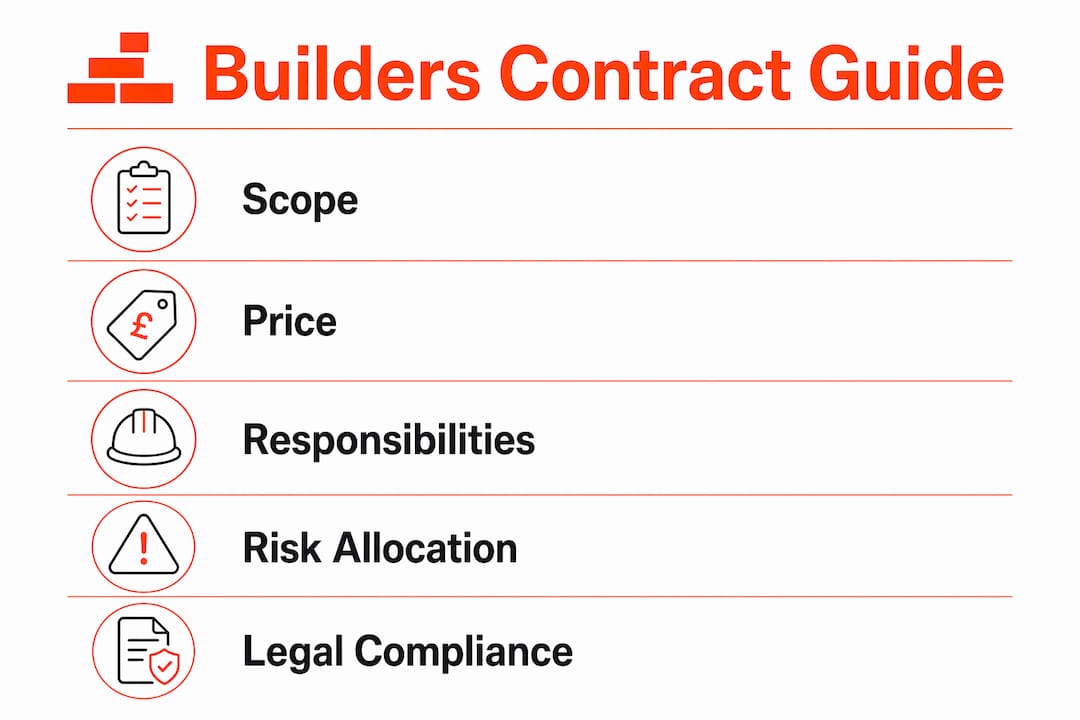
A well-drafted building contract must contain at least ten core clauses to protect both parties and prevent the most common sources of dispute. Each clause serves a specific purpose, and omitting even one creates a gap that clients or their solicitors will exploit.
- Scope of works. Define exactly what you will build, supply, and install. Attach a separate specification document listing materials, finishes, and product models. Vague scope descriptions are the single biggest cause of mid-project disputes.
- Contract price. State the agreed sum clearly, whether fixed, provisional, or cost-plus. Ambiguity here leads directly to payment disputes.
- Payment schedule. Set out interim payment dates, amounts, and the mechanism for issuing Payment Notices and Pay Less Notices under the Housing Grants, Construction and Regeneration Act 1996.
- Start and completion dates. Include the programme start date and the agreed practical completion date. Without these, extensions of time claims become impossible to manage.
- Variations. Define the process for instructing and valuing changes. Verbal instructions without a written variation order are unenforceable.
- Defects and snagging. Specify a defects reporting period of typically 14–28 days post-completion, during which the contractor must return to rectify notified defects.
- Retention. State the retention percentage, the conditions for its release, and the timeline for the final account.
- Insurance. Confirm which party carries contractor’s all-risk insurance, public liability cover, and professional indemnity where design is involved.
- Dispute resolution. Choose adjudication, mediation, or arbitration. Adjudication under the Scheme for Construction Contracts is the statutory default if the contract is silent.
- Termination. Set out the grounds and notice periods for either party to end the agreement. Without clear termination rights, exiting a failing project becomes legally complicated.
Plain-English contracts reduce disputes more effectively than dense legal documents. Clients who understand what they have signed are less likely to raise spurious claims, and courts look favourably on contracts where the intention of both parties is clear.
Pro Tip: Never rely on a verbal scope agreement. Attach a detailed specification as a numbered schedule to the contract. Reference specific product models, tile sizes, paint colours, and supplier names. This document becomes your primary defence if a client disputes the standard of work.
How have the JCT 2024 update and Building Safety Act changed contracts?
The regulatory position for building contracts changed materially on 31 March 2026. JCT 2016 was formally withdrawn from sale on that date, making JCT 2024 the required standard for all new contracts. This is not a recommendation. Any contractor still using JCT 2016 forms after that date is working with a withdrawn standard that does not reflect current legal obligations.
The JCT 2024 update integrates the duty holder regime introduced by the Building Safety Act 2022. Key changes contractors must understand include:
- Duty holder obligations. The Building Safety Act creates defined roles for Principal Designer and Principal Contractor on higher-risk buildings. These roles carry statutory duties that must be reflected in contract terms.
- Building Safety Regulator compliance. Projects involving higher-risk buildings now require gateway approvals from the Building Safety Regulator, an executive agency of the HSE. Contracts must account for the time and process requirements of these gateways.
- Golden thread documentation. The Act requires a continuous digital record of building information throughout design, construction, and occupation. Contract terms must assign responsibility for maintaining this record.
- Competence requirements. Contractors and designers must demonstrate competence under the Act. Contracts should include provisions confirming that all duty holders meet the required competence standards.
Using an outdated JCT 2016 form after 31 March 2026 creates a compliance gap. If a dispute arises, the absence of Building Safety Act provisions in the contract will complicate any adjudication or litigation. Updating your construction agreement template now is the most direct way to protect your business.
CDM regulations also shape contractor duties within the contract, particularly on notifiable projects where the Principal Contractor role carries specific health and safety planning obligations that must be documented and allocated clearly.
Contract negotiation tips that protect your interests
Negotiating a building contract is not about winning concessions. It is about removing ambiguity before work starts. The clauses that cause the most damage are rarely the ones that look dangerous. They are the ones that look fine until something goes wrong.
- Verify every contract particular before signing. Mistakes in contract particulars create ambiguity that triggers claims and delays. Check the project address, the contract sum, the programme dates, and the names of any contract administrator or employer’s agent. A single transposed figure in the contract sum has caused six-figure disputes.
- Attach a detailed scope specification. The scope of works clause in the main body should reference a numbered schedule. That schedule should specify materials by brand, finish, and model number where possible. Vague descriptions like “kitchen units to client’s choice” are an open invitation to dispute.
- Understand your payment notice obligations. Failure to serve valid Payment Notices or Pay Less Notices under the Housing Grants Act can cost you the right to withhold payment or contest a sum. Set a calendar reminder for every payment notice deadline in the contract programme.
- Document every variation in writing. Agree the value before the work starts where possible. If a client instructs a change verbally, follow up immediately with a written confirmation and request a signed variation order before proceeding.
- Watch for onerous amendments. Clients and their solicitors sometimes insert amendments that shift risk disproportionately onto the contractor. Pay particular attention to liquidated damages rates, fitness-for-purpose obligations, and any clause that removes your right to an extension of time for client-caused delays.
- Negotiate dispute resolution terms early. Adjudication is the statutory default and is generally the fastest route to resolution. If a client proposes arbitration instead, understand that arbitration is slower and more expensive before agreeing.
Pro Tip: Before signing any amended standard form, ask a construction solicitor to review the amendments only. A targeted review of non-standard clauses costs a fraction of the fee for a full contract review, and it focuses attention exactly where the risk sits.
Reviewing UK construction project management terminology before entering contract negotiations also helps. Knowing the precise meaning of terms like “practical completion,” “sectional completion,” and “substantial performance” prevents you from agreeing to obligations you did not intend to accept.
Key takeaways
A builders contract must be in writing, reference the correct JCT 2024 form, and include all ten essential clauses to protect payment rights and meet Building Safety Act obligations.
| Point | Details |
|---|---|
| Use JCT 2024 from March 2026 | JCT 2016 was withdrawn on 31 march 2026; all new contracts must use the updated standard. |
| Match contract type to project scale | JCT Minor Works suits projects under £500,000; Design and Build suits single-point responsibility schemes. |
| Include all ten essential clauses | Scope, price, payment schedule, variations, defects, retention, insurance, and dispute resolution are all required. |
| Serve payment notices correctly | Missing a Payment Notice or Pay Less Notice deadline can remove your right to contest a payment sum. |
| Write in plain English | Clear contract language reduces disputes and builds client trust more effectively than legal jargon. |
The contract is not the paperwork. It is the project.
I have reviewed hundreds of construction disputes over the years, and the pattern is almost always the same. The contract existed. It just was not read carefully enough before signing, or it was not administered properly once work started. The document sitting in a folder does nothing. The contract only works when both parties refer to it regularly, when variations are logged against it, and when payment notices go out on the dates it specifies.
The shift to JCT 2024 is a genuine opportunity. The new forms are better drafted, they reflect the Building Safety Act properly, and they give contractors clearer tools for managing duty holder obligations. Contractors who update their templates now and take the time to understand the new provisions will be in a stronger position than those who wait until a dispute forces the issue.
The other thing I would say plainly: do not be embarrassed to use a plain-English contract on domestic projects. Clients who understand what they have signed are easier to work with. They raise fewer spurious claims. They pay on time more often. A clear client communication approach starts with the contract itself, not with the first site meeting.
The contractors I have seen manage projects most successfully treat the contract as a live document. They refer to it when a variation comes up. They check the payment schedule before raising an invoice. They use the defects clause to manage snagging expectations at practical completion. That discipline, more than any single clause, is what keeps projects out of adjudication.
— James
How BRCKS supports contract compliance on site
Managing a building contract does not stop at signing. Every variation, payment notice, and snagging item needs to be documented, dated, and traceable. That is where the administration burden becomes real for most contractors.
BRCKS is built for exactly this stage of the project. Its site diary app captures daily records automatically, creating a timestamped audit trail that supports extension of time claims and defects disputes. The variation log tracks every instructed change against the original contract scope, and the snagging tools manage post-completion defects through to sign-off. For builders who want a single platform to handle construction project administration, BRCKS saves over two hours of manual effort daily. Try BRCKS free for 14 days and see how it fits your workflow.
FAQ
Does every building project need a written contract?
Yes. Any construction project carries financial and legal risk for both parties. A written building contract is the only reliable way to define scope, protect payment rights, and establish a clear dispute resolution process.
When should a builders contract be signed?
The contract must be signed before work starts on site. Signing after work has begun creates ambiguity about which terms apply and can undermine your right to enforce payment mechanisms under the Housing Grants Act.
What happens if a builder works without a signed contract?
Without a signed contract, payment disputes default to common law principles, which are slower and less predictable than statutory adjudication. The contractor also loses the protection of defined payment notice procedures under the Housing Grants, Construction and Regeneration Act 1996.
Is the JCT 2016 contract still valid for ongoing projects?
JCT 2016 was withdrawn from sale on 31 march 2026. Contracts already executed under JCT 2016 before that date remain valid for those projects, but all new contracts must use JCT 2024 to reflect current Building Safety Act obligations.
What is the defects liability period in a building contract?
The defects liability period is the time after practical completion during which the contractor must return to rectify notified defects. Standard snagging clauses typically set this period at 14–28 days, with retention released only after defects are resolved.
Recommended
- Best Construction Apps UK: 2026 Guide for Builders
- BRCKS | Construction Project Communication Software
- Construction Client Communication Guide for UK Projects
- Best UK Construction Software 2026
How BRCKS Can Help
Navigating the complexities of modern UK construction contracts requires both legal diligence and robust administrative oversight to ensure every project remains compliant and profitable. BRCKS simplifies this process by centralising your documentation and tracking obligations in real time, reducing the risk of costly disputes or missed deadlines. By integrating your contract management directly into your daily workflow, our platform empowers your team to focus on quality delivery rather than paperwork. We invite you to explore how BRCKS can strengthen your operational foundations and streamline your next project. Learn more at BRCKS and explore our full feature set.