Checklist for effective construction meetings
Transform site meetings from costly conversations into decision-making forums with our structured checklist for effective construction meetings and protocols.
By James Shorter ·
Checklist for effective construction meetings

TL;DR:
- Effective construction meetings require early agenda distribution, role definition, and disciplined follow-up to ensure decisions are made efficiently. Using formal documentation tools and assigning clear ownership reduces delays, mitigates risks, and streamlines project progress. Implementing a structured protocol with digital tools like BRCKS enhances consistency, accountability, and contractual compliance in site communication.
A checklist for effective construction meetings is a structured set of preparation, facilitation, and follow-up steps that transforms site meetings from costly conversations into decision-making forums with clear accountability. The industry term for this framework is a meeting protocol, and it covers everything from agenda circulation to action tracking. Without it, site meetings lack decision-making value and become expensive status updates. The core elements are a circulated agenda, defined roles, time-allocated items, disciplined minute-taking, and a live action log. Get these right and your meetings will drive projects forward rather than slow them down.
1. checklist for effective construction meetings: distribute the agenda 24–48 hours in advance

Distributing a standard agenda 24–48 hours in advance reduces average meeting duration by 30–40%. That time saving translates directly into fewer hours pulled from productive site work. An agenda circulated the morning of the meeting is not preparation. It is a courtesy notice, and it produces the same unfocused discussion you were trying to avoid.
Your agenda should number every item, allocate a time budget to each one, and identify who is responsible for leading that item. Supporting documents, including RFI logs, submittal status reports, and the current programme, must be attached or linked at the same time. Attendees who arrive prepared make decisions. Attendees who arrive uninformed ask questions that waste everyone’s time.
Pro Tip: Send the agenda via your construction project communication platform, not by WhatsApp or text. You need a timestamped record that the agenda was issued.
2. define meeting roles before anyone enters the room
Every construction meeting needs three named roles: a chairperson, a minute taker, and attendees with confirmed decision authority. The chairperson controls the agenda and the clock. The minute taker captures decisions, actions, and owners in real time. Attendees without decision authority should attend only if their input is required for a specific item.
Assigning these roles ad hoc at the start of a meeting wastes the first ten minutes and produces inconsistent records. Confirm roles in the agenda itself so everyone arrives knowing their responsibility. On larger projects, the project manager typically chairs progress meetings, while the site manager chairs weekly site coordination meetings.
3. apply the pre-meeting coordination lock
The pre-construction meeting agenda requires every agenda item to have a named owner, a formal sign-off process, and a hard deadline before the meeting starts. This confirms that each item is genuinely ready for discussion or decision, not just listed as a placeholder.
In practice, this means the person responsible for each agenda item must confirm their status in writing before the meeting. If they cannot confirm readiness, the item either drops off the agenda or is flagged as a blocker requiring immediate resolution. This discipline prevents meetings from stalling on items that should have been resolved beforehand.
4. submit written status updates 24 hours before the meeting
Written status updates submitted 24 hours in advance allow meetings to focus on solving blockers rather than verbal reporting. This is one of the highest-value habits a project team can build. When everyone reads the updates before arriving, the meeting skips the “where are we?” phase entirely and moves straight to decisions.
Ask each trade contractor, subcontractor lead, or package manager to submit a brief written update covering progress against programme, current blockers, and upcoming resource requirements. A simple shared form or a project management platform with a status update field works well. The site communication workflow you use for daily updates can handle this with minimal extra effort.
5. use a parking lot to protect agenda focus
The parking lot method keeps meetings on track by deferring off-topic discussion to a follow-up list. When a valid but unscheduled issue is raised mid-meeting, the chairperson acknowledges it, records it in the parking lot, and assigns a named owner to address it outside the meeting. The agenda continues without derailment.
This approach respects the time of everyone in the room while making sure no issue disappears. The parking lot is reviewed at the end of the meeting and each item is either scheduled for the next agenda or assigned as a standalone action. Without this discipline, a single unplanned topic can consume 20 minutes and push critical agenda items into overtime.
6. assign a named owner and deadline to every action
Every task that comes out of a construction meeting must have one named owner and one specific deadline. Not a team. Not a company. One person. This is the single most common failure point in construction meeting practice. Shared ownership produces no ownership.
Tracking outstanding actions and escalating non-performance are key indicators for avoiding project delays. Your action log should carry forward any incomplete items from the previous meeting and display their original deadline alongside the current status. When an item appears on the log for a second consecutive meeting without progress, it requires escalation, not another deadline extension.
Pro Tip: Use your project coordination platform to assign actions digitally during the meeting. Owners receive an immediate notification and the item enters the live action log without any manual transfer.
7. keep formal instructions off WhatsApp
Misusing WhatsApp for critical instructions leads to lost audit trails. This is not a preference. It is a contract compliance issue. Verbal instructions and informal messages are not enforceable records. When a dispute arises over a variation or a missed instruction, the question is always: where is the written record?
Formal communication must be documented in official registers, not informal apps. This applies to instructions issued during meetings and to follow-up communications after them. A dedicated construction communication app captures every instruction with a timestamp, a named sender, and a named recipient. That record is available to your QS, your contract administrator, and your legal team if needed.
8. distribute minutes within 24–48 hours
Meeting minutes must be distributed within 24–48 hours with a five-working-day grace period for corrections to be procedurally binding. Minutes issued a week later are not useful records. They are historical documents that no one reads carefully enough to challenge.
Your minutes format should be consistent across every meeting type. Number every item to match the agenda. Highlight actions in bold with the owner’s name and deadline clearly visible. Include a section at the top listing all actions from the previous meeting and their current status. Archive every set of minutes in your document control system immediately upon distribution.
Pro Tip: AI-assisted minute templates can draft a structured set of minutes from a voice recording or typed notes within minutes. Review, adjust, and distribute the same day the meeting ends.
9. structure agendas to prioritise decisions over reporting
An agenda that leads with status updates trains attendees to talk rather than decide. Restructure your agenda so that items requiring a decision appear first, when attention and energy are highest. Status reporting moves to a brief standing section at the end, or is replaced entirely by the pre-submitted written updates described in item 4.
Time-box every agenda item. A 90-minute meeting with eight items averages roughly ten minutes per item. Some items need more, some need less. Allocate time explicitly and the chairperson has a clear basis for moving the discussion on. Include one contingency slot of five to ten minutes for genuinely urgent items that arise on the day.
Set recurring meeting slots at the same time each week. Consistent scheduling builds attendance habits and reduces the coordination overhead of rescheduling. For UK construction project management, Monday morning progress meetings and Friday afternoon lookahead meetings are a widely used pattern that keeps the week structured.
10. use digital tools built for construction communication
Generic project management tools handle tasks and deadlines. Construction-specific platforms handle RFIs, submittals, variations, site diaries, and the audit trail that contracts require. The difference matters when a dispute reaches a solicitor’s desk.
The table below compares the key capabilities relevant to meeting management:
| Capability | Generic Tools | Construction-Specific Platforms |
|---|---|---|
| RFI and submittal tracking | Limited or manual | Built-in with status logs |
| Audit trail for instructions | Basic activity log | Timestamped, named records |
| Minute templates | None or generic | Construction-format templates |
| Action owner notifications | Email only | In-app, WhatsApp, or email |
| Site diary integration | Not available | Automated daily records |
BRCKS sits in the construction-specific category. It captures communications via WhatsApp integration, automates site diaries, tracks RFIs, and maintains a structured variation log. Teams using BRCKS report saving over two hours of manual effort daily. That time comes directly from reduced admin around meetings and follow-up communications.
Key takeaways
A structured meeting protocol covering preparation, roles, agenda design, and disciplined follow-up is the single most effective way to reduce wasted time and improve decision-making on construction projects.
| Point | Details |
|---|---|
| Circulate agendas early | Send the agenda 24–48 hours in advance to cut meeting duration by up to 40%. |
| Lock in named owners | Every action needs one person responsible, with a specific deadline, not a shared team. |
| Keep formal records off WhatsApp | Use a dedicated platform to maintain an audit trail that is contractually defensible. |
| Distribute minutes promptly | Issue minutes within 24–48 hours and archive them in your document control system. |
| Prioritise decisions on the agenda | Lead with items requiring a decision and move status reporting to pre-submitted written updates. |
What i have learned running construction meetings
The most common failure I see is not poor chairing or bad agendas. It is the gap between the meeting ending and the actions being tracked. Teams leave the room with good intentions and clear verbal agreements. Three days later, nobody has updated the action log and the minute taker is still drafting the minutes.
The coordination lock concept changed how I approach pre-meeting preparation. When every agenda item has a named owner who has confirmed readiness in writing before the meeting starts, the quality of discussion improves immediately. People stop using the meeting to think out loud and start using it to make decisions.
The other shift worth making is treating your communication platform as a legal record, not a convenience tool. I have seen disputes where the entire case turned on whether an instruction was issued formally or via a WhatsApp message that was later deleted. The risks of poor construction communication are not abstract. They show up in variation disputes, delay claims, and rework costs. Build the habit of formal documentation now, before a project goes wrong.
— James
How BRCKS supports your meeting protocol
BRCKS is built for exactly the workflow this article describes. It captures instructions and updates via WhatsApp and converts them into structured project records automatically. Your team keeps using the communication tools they already know, while BRCKS builds the audit trail in the background.
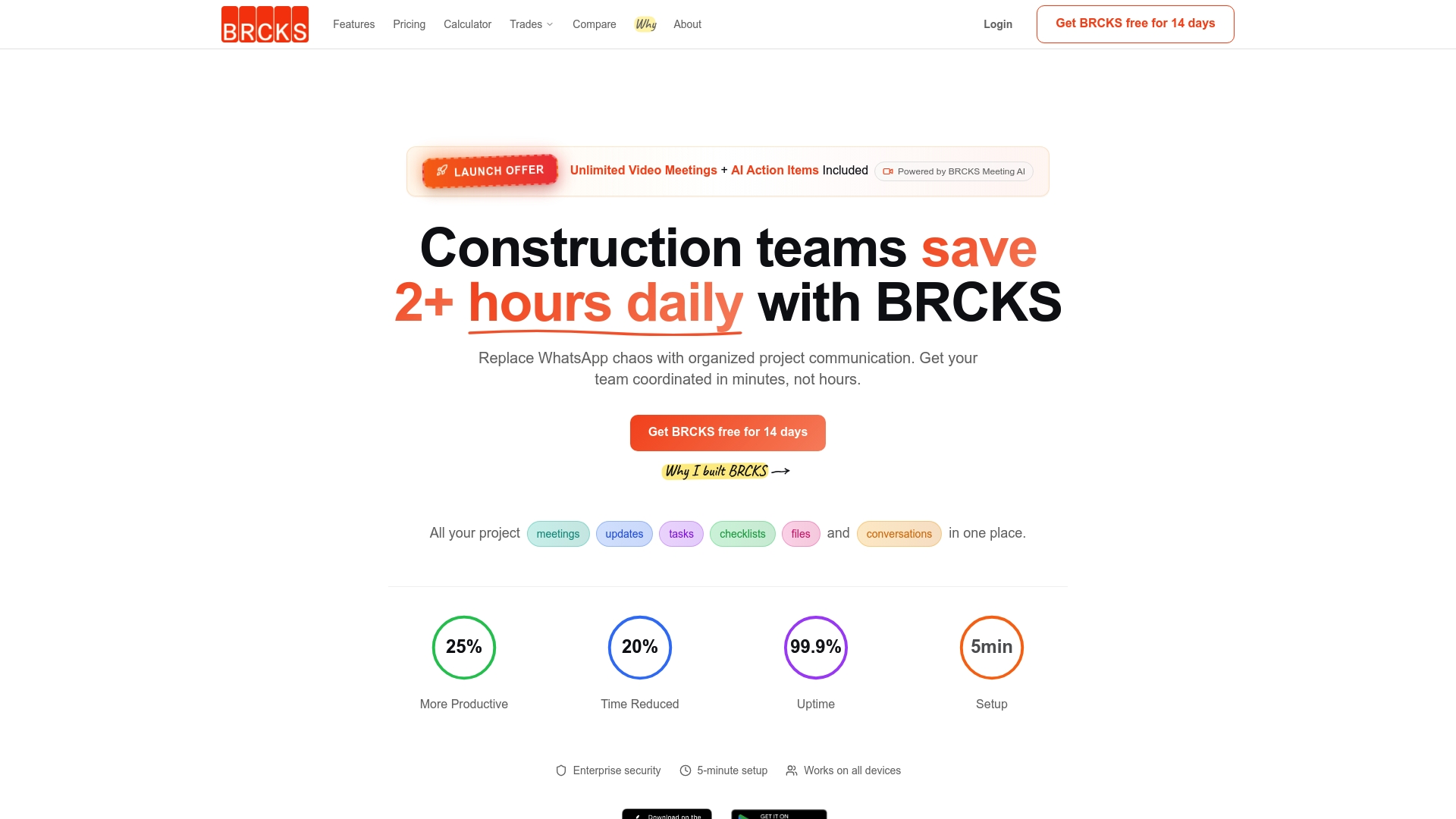
RFI tracking, variation logs, and automated site diaries are all included. Action items assigned during meetings are tracked in one place, with notifications sent directly to owners. Minutes and communications are archived and searchable. For UK builders and project managers who want to replace informal messaging with a proper construction communication app, BRCKS offers a 14-day free trial with no setup fee. See the full feature set at the BRCKS builders page.
FAQ
What should a construction meeting agenda include?
A construction meeting agenda should include numbered items with time allocations, named leads for each item, supporting documents such as RFI logs and the current programme, and a standing section for reviewing actions from the previous meeting. Circulate it 24–48 hours before the meeting.
How soon should meeting minutes be distributed?
Minutes should be distributed within 24–48 hours of the meeting ending, with a five-working-day window for attendees to submit corrections. Minutes issued later than this lose their procedural value and are harder to challenge or rely upon.
Why is WhatsApp unsuitable for construction instructions?
WhatsApp messages can be deleted, are not searchable in a structured way, and do not form part of an official project register. Using informal apps for critical instructions removes the audit trail needed for contract compliance and dispute resolution.
What is the parking lot method in construction meetings?
The parking lot method is a facilitation technique where off-topic items raised during a meeting are recorded separately and assigned to a named owner for follow-up outside the meeting. It prevents agenda overruns while making sure no valid issue is lost.
How do you track action items from construction meetings?
Assign every action a single named owner and a specific deadline at the point it is agreed. Carry outstanding actions forward in a live log that is reviewed at the start of every subsequent meeting. Escalate any item that misses its deadline rather than simply extending it.
Recommended
- Meeting Management Tips for UK Contractors | BRCKS
- Document Control in Construction: Streamline UK Projects | BRCKS
- Construction Handover Documentation: The Complete Guide for UK Project Managers | BRCKS
- BRCKS | Construction Project Communication Software
How BRCKS Can Help
Running productive meetings is essential for keeping projects on track, but having the right tools to action those decisions is what truly drives progress. BRCKS simplifies this transition by centralising your documentation and ensuring that every task identified in your checklist is assigned and monitored in real time. By integrating your meeting outcomes directly into your project management workflow, BRCKS helps your team maintain momentum and avoid costly miscommunications. We invite you to explore how BRCKS can transform your site coordination and streamline your next project. Learn more at BRCKS and explore our full feature set.