Cloud communication benefits for UK construction teams
Discover how cloud communication tools are transforming UK construction by improving real-time collaboration, project visibility, and accountability across site teams.
By James Shorter ·
Cloud communication benefits for UK construction teams
 A purpose-built construction snagging software keeps these items tracked through to sign-off.
TL;DR:
- Effective stakeholder alignment in UK construction projects requires real-time communication solutions that address site connectivity, system integration, and data security challenges. Cloud platforms enhance project visibility, structured communication, and scalability, reducing disputes and rework through proactive, auditable workflows. Successful adoption depends on fostering a cultural shift toward structured, accountable communication, supported by tailored training and reliable connectivity measures.
Keeping every stakeholder genuinely aligned on a UK construction project is harder than it sounds. Site conditions shift daily, subcontractors work to their own schedules, and clients expect updates that never quite arrive on time. A single miscommunication can cascade into a delay, a dispute, or worse, a costly rework order. Cloud communication tools are changing that reality, offering project managers a way to share real-time information, track decisions, and hold everyone accountable within a single system. This article examines the criteria, benefits, and practical challenges of adopting cloud communication for UK construction.
Table of Contents
- Criteria for choosing cloud communication in construction
- Top benefits: Improving collaboration and project visibility
- Connectivity challenges and practical workarounds
- Integration: Connecting communication tools with project platforms
- The real shift: Proactive visibility and culture change
- Try cloud communication tools built for UK construction
- Frequently asked questions
Key Takeaways
| Point | Details |
|---|---|
| Prioritise connectivity | Reliable site internet and offline modes are essential for cloud communication success. |
| Boost project visibility | Cloud tools enable real-time updates that reduce costly delays and disputes. |
| Prevent data silos | Mandate platform use across subcontractors to keep all project data centralised. |
| Maximise integration | Pair cloud communication with BIM and ERP systems for streamlined workflows. |
| Drive culture change | Cloud adoption encourages proactive teamwork and accountability across all project roles. |
Criteria for choosing cloud communication in construction
With the challenge established, identifying what matters most when picking a cloud communication solution for UK construction is the logical first step. Not all platforms are created equal, and the wrong choice will cost you time, money, and trust.
Site connectivity is the baseline requirement. Many UK construction sites, particularly in rural Scotland, Wales, or remote English counties, have patchy 4G coverage and no fixed broadband. A platform that only works online is a platform that will fail you at the worst possible moment. Stable site internet and offline modes are both essential, with VoIP or 4G solutions recommended for voice, and offline-first functionality critical for data entry when signal drops.

Integration capability is the next major criterion. Most UK project managers already use some combination of BIM software, ERP systems, or scheduling tools. A communication platform that sits in isolation creates more admin, not less. BIM integration examples show how connecting your communication layer with design and cost data allows teams to reference the same source of truth rather than chasing updates across disconnected systems. Platforms compatible with tools like Autodesk or Procore deliver a noticeably smoother daily workflow.
UK GDPR compliance is non-negotiable. Construction projects involve commercially sensitive drawings, personal subcontractor data, and client financial information. Any cloud platform you adopt must handle that data lawfully, with clear data residency policies and the ability to respond to subject access requests promptly.
User adoption is often underestimated. A feature-rich platform is useless if your site team refuses to log in. Prioritise solutions with clean, intuitive interfaces that require minimal training. Pairing a new platform with construction schedule tools that your team already understands will accelerate uptake. You can also review messaging app comparisons to shortlist options that fit how your team already communicates.
Key criteria to assess before committing to a platform:
- Offline-first functionality for remote or low-signal sites
- Native integration with BIM, ERP, and scheduling software
- UK GDPR compliance with clear data residency documentation
- Simple interface requiring minimal training
- Role-based access control for subcontractors, clients, and managers
- Audit trail capability for dispute resolution
Pro Tip: Before trialling any platform, conduct a site connectivity audit. Walk the full site and map where 4G drops. That data will tell you whether offline-first functionality is a nice-to-have or an absolute requirement for your specific project.
Top benefits: Improving collaboration and project visibility
Once you know what to look for, examining the leading benefits that make cloud communication genuinely impactful is the natural next step.
The most immediate benefit is real-time project visibility. When your site manager logs a task completion or flags a material shortage at 8am, your project manager and client can see it within seconds. That immediacy removes the guesswork and the end-of-day phone calls. Explore how real-time update benefits translate into fewer delays and better decision-making on active sites.
Structured communication is the second major gain. WhatsApp messages get buried, screenshots lose context, and verbal instructions are forgotten. Cloud platforms impose a structured format on every update, task, and approval. That structure creates an audit trail, which is invaluable when a subcontractor disputes an instruction or a client questions a variation. As highlighted in recent construction communication disputes research, cloud tools shift project culture from reactive late surprises to proactive real-time visibility, directly reducing the frequency and cost of disputes and rework. The hidden cost of poor communication on UK sites is significant, and structured platforms address it at the root.
“Cloud communication shifts culture from reactive ‘late surprises’ to proactive real-time visibility, reducing disputes and rework across the project lifecycle.”
Scalability is a benefit that becomes obvious as your project grows. A two-person team using WhatsApp can just about manage. Add fifteen subcontractors, a main contractor, a client, and a design team and the same approach collapses. Cloud platforms scale without friction, adding users, projects, and permissions without rebuilding your workflow from scratch. For a deeper breakdown of what these improvements look like in practice, the project communication benefits page outlines specific gains for construction firms.
Research into digital collaboration confirms that cloud tools excel in scalability for structured project work, while traditional tools like WhatsApp consistently fall short because they lack structured workflows and searchable audit trails.
Here is a direct comparison of the most common options:
| Feature | Generic cloud tool | BRCKS | |
|---|---|---|---|
| Real-time project updates | Limited | Yes | Yes |
| Audit trail | No | Partial | Yes |
| Offline access | Yes | Varies | Yes |
| BIM/ERP integration | No | Varies | Yes |
| Client portal | No | No | Yes |
| Free subcontractor access | No | No | Yes |
| UK GDPR compliance | Partial | Varies | Yes |
The table makes the gap between consumer apps and purpose-built tools very clear. WhatsApp works for quick messages. It does not work for managing a £2 million commercial fit-out with six subcontractors and a demanding client.
Connectivity challenges and practical workarounds
Now that you have seen the benefits, acknowledging and overcoming the connectivity and coordination barriers that can hinder cloud adoption is equally important.
Remote UK sites remain a genuine challenge. Areas across the Scottish Highlands, parts of Wales, and many rural English locations still have inconsistent 4G coverage and no realistic prospect of fixed broadband in the short term. Offline-first applications allow your team to log updates, complete checklists, and attach photos even without signal, then sync automatically when connectivity returns. For sites where even offline workarounds feel insufficient, satellite connectivity solutions such as Starlink are increasingly viable and cost-effective for longer projects. As Clarus Site Solutions notes, poor connectivity on remote sites can be mitigated by combining offline-first apps with satellite internet, while high-security projects should specifically seek UK-hosted data solutions to satisfy procurement requirements.
High-security and government projects carry additional data requirements. If you are working on defence infrastructure or sensitive public sector projects, standard cloud hosting in European data centres may not meet contract requirements. Confirm data residency before signing any platform contract.
Multi-subcontractor coordination is another frequent pain point. When five different subcontractors each use their own preferred app or file-sharing tool, you end up managing five separate data streams. The only reliable fix is a single platform mandate enforced from project start. Every party, regardless of their size or preference, accesses the same system. This single source of truth prevents the data silos that cause version control issues and missed instructions. Combining this with best messaging tools that subcontractors can access for free removes the cost objection that often derails platform adoption.
Practical measures to address connectivity and coordination challenges:
- Adopt an offline-first platform as standard, not as a fallback
- Test Starlink or 4G boosters on remote sites before project kick-off
- Mandate a single platform in all subcontractor agreements from day one
- Confirm UK data residency requirements with your client before platform selection
- Build platform onboarding time into your project programme
- Use schedule software options that integrate with your communication platform to reduce double data entry
| Challenge | Impact | Practical solution |
|---|---|---|
| Poor 4G coverage | Lost updates, delayed decisions | Offline-first app plus Starlink |
| Data silos across subcontractors | Version conflicts, missed instructions | Single platform mandate |
| High-security data requirements | Procurement risk | UK-hosted cloud solution |
| Resistance to new tools | Low adoption | Free access tiers and simple UI |
Pro Tip: Run a full site connectivity check at least two weeks before your planned platform rollout. Use that window to arrange temporary satellite or 4G booster solutions if required. Launching a cloud platform on day one without adequate connectivity is a fast route to team scepticism that is hard to reverse.
Integration: Connecting communication tools with project platforms
Having tackled technical hurdles, exploring how cloud communication really shines when connected to your wider project platforms is the next logical step.
BIM and ERP platforms hold the most valuable project data: design intent, cost baselines, programme milestones, and procurement records. When your communication platform integrates with these systems, the result is a single environment where a site instruction references the correct BIM element, a variation is automatically costed against the ERP budget, and a delay is immediately visible on the programme. BIM usage examples illustrate how this connected approach reduces the manual effort of cross-referencing documents across separate platforms.
Integration with BIM and ERP tools like Autodesk or Procore maximises the value of cloud communication, but it does require upfront training and configuration. The investment is worth making. Teams that connect their communication platform to their design and cost systems consistently report fewer manual errors and faster decision cycles.
The key benefits of integration are:
- Single source of truth: Every stakeholder references the same data, reducing version control disputes
- Reduced manual entry: Updates logged in the communication platform automatically populate programme or cost records
- Faster approvals: Variation requests include relevant BIM references, enabling clients to approve quickly and with confidence
- Accountability at every stage: Decisions are timestamped and linked to the relevant project element
Mandating a single integrated platform also solves the subcontractor data silo problem identified in the previous section. If you want to understand where generic messaging tools fall short in this context, the WhatsApp limitations analysis is worth reading. For a broader view of how to address fragmented communication across your business, the fixing project communication guide covers the most common failure points and their solutions.
The real shift: Proactive visibility and culture change
There is a pattern we observe consistently in UK construction firms that move from WhatsApp and spreadsheets to cloud communication platforms. The technology change is straightforward. The culture change is where the real work happens.
Cloud tools create conditions for accountability that did not exist before. When every instruction is logged, every photo is time-stamped, and every decision has a digital trail, the dynamics of a project conversation shift. Subcontractors know that a verbal instruction no longer protects anyone. Clients know that their approval of a variation is recorded. Project managers know that a missed update is visible to everyone, not buried in a message thread.
The research is clear on this point. Proactive real-time visibility is what genuinely reduces disputes and rework, not just having a better app. The tool enables the behaviour, but only if your team actually changes how they work.
This is where most implementation efforts fail. A firm installs a new platform, spends a day training the team, and then watches adoption drop to zero within three weeks because the project manager still sends WhatsApp messages for urgent issues and old habits reassert themselves. The project communication challenges facing UK construction are partly technical, but mostly behavioural.
Our view is that the competitive advantage in UK construction over the next decade will belong to firms that build a culture of proactive visibility. That means communicating in structured platforms as a default, not as a compliance exercise. It means training subcontractors and clients, not just internal staff. It means enforcing platform use even when it feels slower in the first week.
Pro Tip: Invest in short, role-specific training sessions rather than a single whole-team briefing. A site operative needs to know how to log a task update. A client needs to know how to view their portal. Keep each session focused, practical, and under thirty minutes. That format drives lasting behaviour change far more effectively than a one-off workshop.
Try cloud communication tools built for UK construction
If this article has confirmed that your current approach to site communication is holding you back, the next step is straightforward. BRCKS is built specifically for construction teams, with the workflows, integrations, and compliance features that UK project managers actually need.
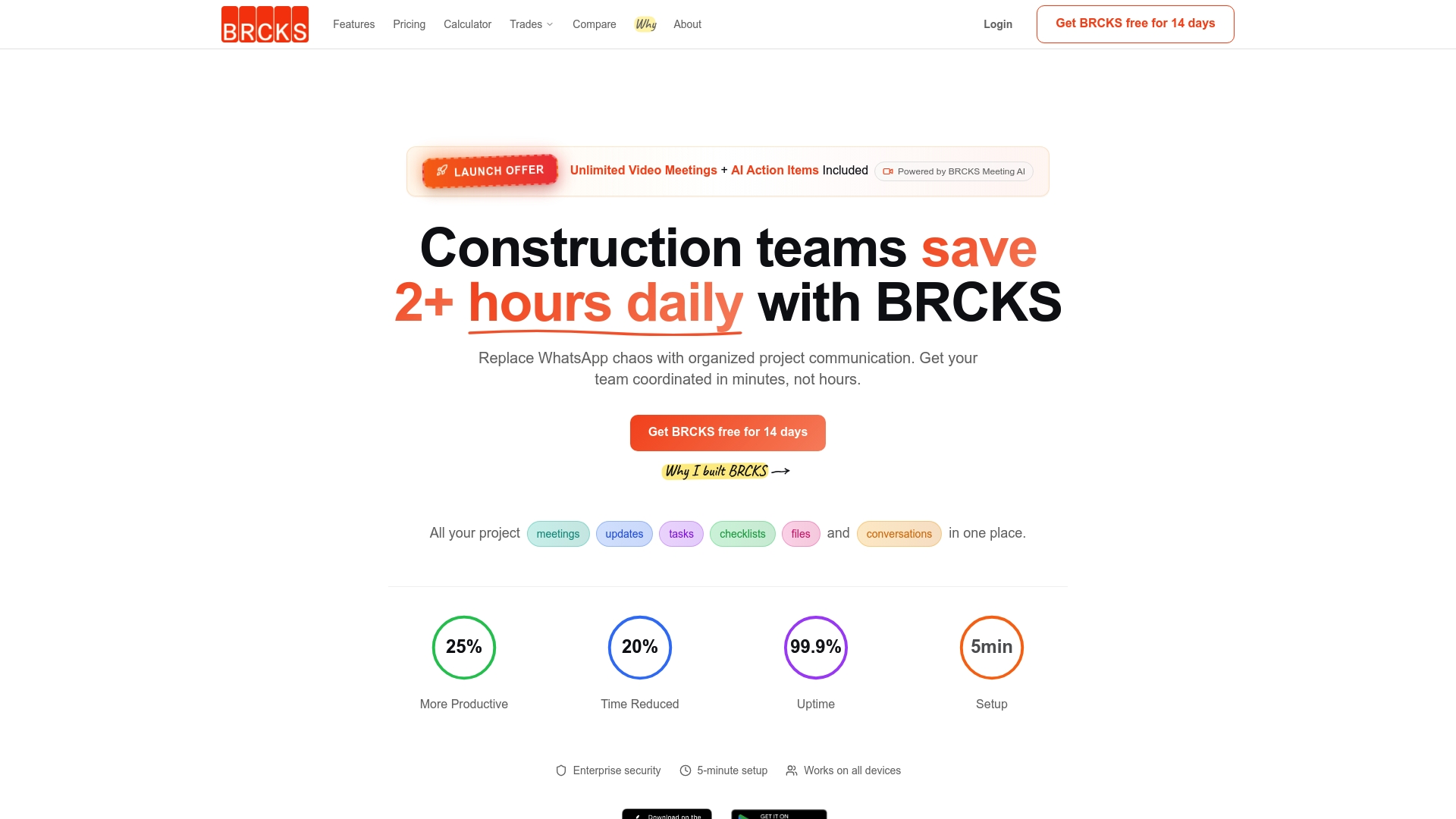
Whether you manage a small trades team or a multi-site enterprise programme, BRCKS consolidates your updates, tasks, files, and client communications into one platform. BRCKS for builders shows how the platform adapts to your specific role and team size. If your team is already using WhatsApp for site communication, WhatsApp project clarity explains how BRCKS integrates with it rather than replacing it overnight. You can also explore the snag list software functionality to see how structured punch-list management reduces the back-and-forth that typically delays project close-out. Start a free 14-day trial and see the difference structured communication makes.
Frequently asked questions
What makes cloud communication more effective than traditional tools in construction?
Cloud platforms provide structured workflows, a full audit trail, and real-time project visibility that consumer tools like WhatsApp simply cannot replicate. Traditional tools lack audit trails and structured workflows, which makes resolving disputes and tracking decisions significantly harder.
How can UK construction sites handle poor internet connectivity when using cloud communication?
Offline-first applications allow teams to log updates without signal and sync when connectivity returns. For very remote sites, satellite solutions like Starlink provide a reliable connectivity layer when 4G is unavailable.
Do cloud communication tools comply with UK construction data regulations?
Any cloud platform used on UK construction projects must meet UK GDPR compliance requirements, and high-security projects should specifically require UK-hosted data to satisfy procurement conditions.
Can cloud communication tools integrate with platforms like BIM or ERP?
Yes, most purpose-built construction platforms offer BIM and ERP integration. However, as confirmed by BIM and ERP integration guidance, maximising that value requires proper configuration and team training before go-live.
Is switching to cloud communication a cultural shift for construction firms?
Absolutely. The technology itself is straightforward to adopt, but the real transformation comes from shifting to proactive visibility where teams communicate in structured platforms by default, creating accountability across the entire project.
Recommended
- The Hidden £13 Billion Cost: How Construction Communication Problems Are Crippling UK Projects | BRCKS
- Top Construction Schedule Software for UK Builders 2025 | BRCKS
- BRCKS | Construction Project Communication Software
- Digital Solutions in UK Construction: 5 Key Gains | BRCKS
- Integrare workflow BIM e droni: vantaggi e soluzioni
- Cloud Network Advantages 2025 | Re-Solution
How BRCKS Can Help
Adopting cloud communication is no longer just a luxury but a vital step towards ensuring UK construction projects remain on track and within budget. By centralising site updates and documentation, BRCKS provides the digital infrastructure needed to bridge the gap between the office and the field seamlessly. Our platform simplifies these complex workflows, allowing your team to focus on quality delivery rather than chasing paperwork. We invite you to see how BRCKS can transform your project connectivity by booking a demo or starting a free trial today. Learn more at BRCKS and explore our full feature set.