Construction claims: a practical guide for UK contractors
A practical guide for UK contractors on navigating construction claims, managing variations, and protecting commercial interests under JCT and NEC contracts.
By James Shorter ·
Construction claims: a practical guide for UK contractors

TL;DR:
- Construction claims are formal requests for extra time or payment caused by project deviations. Proper notice, documentation, and early legal advice are essential for managing and preventing disputes effectively.
Construction claims are formal requests made under a contract for additional time, payment, or both, arising when project conditions deviate from what was originally agreed. For UK contractors, project managers, and subcontractors, understanding how to manage these requests is not optional. Design-related issues alone affect around 31% of distressed projects across Europe, and the financial impact of claims rose from 35.5% to 43.9% of contract value after 2020. The Construction Act 1996 and standard forms such as JCT and NEC set the procedural rules. Getting them wrong costs money, time, and working relationships.
What are the common types of construction claims?
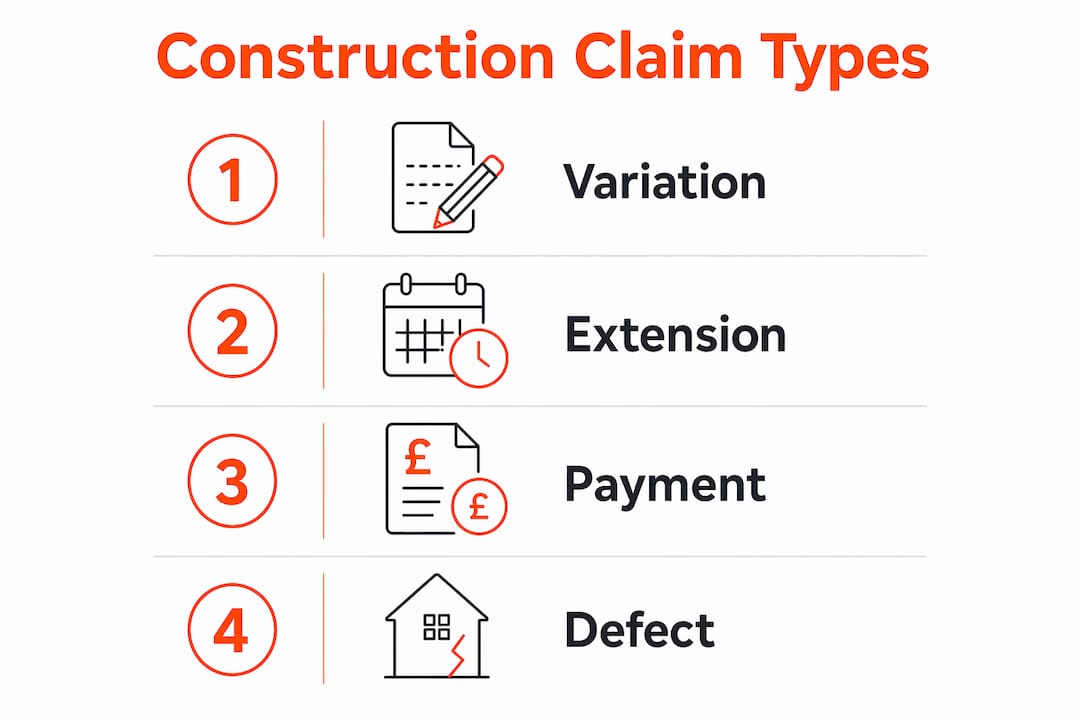
Construction contract claims fall into four main categories, each with distinct causes and contractual implications.
Variation claims arise when the scope of work changes after the contract is signed. An employer might instruct additional groundworks, alter a specification, or omit a section of work entirely. Every instruction that changes the original scope should be captured in a variation log and confirmed in writing before work proceeds.
Extension of time claims cover delays caused by events outside the contractor’s control. Typical triggers include late design information, employer-caused delays, exceptionally adverse weather, and statutory undertaker interference. These claims protect the contractor from liquidated damages and, under some contracts, open the door to loss and expense recovery.
Payment claims are the most frequent source of dispute. The UK construction sector has led UK insolvencies for three consecutive years through 2026, with small firms routinely waiting 60–90 days for payment despite carrying upfront costs. Late payment often masks deeper valuation disagreements that were never resolved during interim applications.
Defect-related claims cover both patent defects, which are visible during the works, and latent defects, which emerge after practical completion. Workmanship deficiencies and design errors are the two leading drivers. Addressing defects promptly and in writing limits liability and prevents minor snags from becoming formal disputes. A structured snag list process reduces the risk of defect claims escalating.
| Claim type | Typical cause | Contractual mechanism |
|---|---|---|
| Variation | Scope change or employer instruction | Variation order under JCT or compensation event under NEC |
| Extension of time | Employer delay, late information, weather | Relevant event notification |
| Payment | Interim valuation dispute, late certification | Payment notice, pay-less notice |
| Defect | Workmanship or design failure | Defects liability period, rectification notice |
How does the construction claims process work under UK contracts?
The claims process under JCT and NEC contracts follows a defined sequence. Missing any step can permanently extinguish an entitlement, regardless of how strong the underlying case is.
Notice requirements
Contract notice provisions are strict conditions precedent. Missing a notice deadline does not simply weaken a claim. It can forfeit the right to any remedy entirely. Under NEC contracts, early warning notices must be issued as soon as a contractor becomes aware of a matter that could affect time or cost. Under JCT, written notices of delay must be given forthwith upon the cause becoming apparent.
Documentation
Contemporaneous records carry far greater evidential weight than documents reconstructed during claim preparation. That means site diaries written on the day, photographs timestamped at the time of the event, and meeting minutes circulated within 24 hours. Integrating this discipline into daily site routines is the single most effective step a contractor can take to protect a future claim.
The claims process step by step
- Identify the trigger event. Recognise when a delay, instruction, or unforeseen condition creates a potential entitlement.
- Issue the notice. Submit the required contractual notice within the specified timeframe. Do not wait to quantify the full impact first.
- Gather contemporaneous evidence. Compile site diary entries, photographs, correspondence, and programme updates from the date of the event.
- Prepare the claim submission. Set out the contractual basis, the factual narrative, and the quantification of time and cost.
- Submit to the contract administrator or employer. Allow the prescribed response period and follow up in writing if no response is received.
- Escalate if unresolved. If the claim is rejected or ignored, move to the dispute resolution ladder set out in the contract.
Pro Tip: Set a calendar reminder the moment a potential claim event occurs. Issuing a holding notice within 24 hours preserves your rights while you gather the full picture.
What are the key strategies to prevent and manage disputes?
Preventing a dispute is always cheaper than resolving one. The most effective approach combines proactive contract management with clear communication at every level of the project.
Use early warnings and variation logs actively
JCT and NEC contracts include early warning and variation log mechanisms that only work when used actively. Ignoring them during a busy delivery phase creates a backlog of unresolved issues that become expensive claims later. A variation log updated weekly, shared with the employer, and signed off promptly removes ambiguity about what has been instructed and at what cost.
Adopt open-book monthly valuations
Adversarial culture and defensive contracting increase claim complexity. Open-book monthly reviews, where both parties walk through the valuation together, address disagreements before they harden into formal disputes. This approach is particularly effective on larger projects where interim payment cycles run over several months.
Maintain clear communication channels
Reducing project miscommunication is one of the most direct ways to cut claims frequency. Verbal instructions must be confirmed in writing. WhatsApp messages and informal calls must be followed up with a written record. Every agreement reached on site should appear in the next meeting minutes.
Seek legal advice early
Early specialist legal advice before commercial relationships break down is the most cost-effective form of dispute management. A solicitor experienced in construction contracts can identify procedural risks, draft protective notices, and advise on negotiation strategy before positions become entrenched. Waiting until a formal claim is rejected before taking advice is a common and costly mistake.
The UK construction dispute resolution escalation ladder runs from negotiation through mediation, adjudication, arbitration, and finally Technology and Construction Court litigation. Each step increases cost and formality. The goal is to resolve disputes as early on that ladder as possible.
- Negotiate directly. Raise the issue formally in writing and request a without-prejudice meeting to discuss resolution.
- Attempt mediation. A neutral mediator helps both parties reach a commercial settlement without binding decisions.
- Refer to adjudication. A fast, binding process under the Construction Act 1996 that delivers a decision within 28 days.
- Proceed to arbitration. A private, binding process suited to complex technical disputes requiring expert determination.
- Litigate in the Technology and Construction Court. The formal court route, reserved for high-value or legally complex matters.
Pro Tip: Keep a dedicated claims register from day one of the project. Log every potential entitlement, the notice issued, and the current status. This single document will save weeks of preparation if a dispute escalates.
How are construction claims disputes typically resolved in the UK?
When a claim cannot be resolved through direct negotiation, the UK dispute resolution ladder provides a structured escalation path. Each method carries different cost, speed, and formality implications.
Adjudication under the Construction Act 1996 is the most widely used route for payment disputes. Decisions are typically delivered within 28 days, making it the fastest binding resolution available. The decision is temporarily binding, meaning either party can refer the matter to arbitration or litigation for a final determination, but in practice most adjudication decisions are accepted and paid.
Before issuing proceedings in the Technology and Construction Court, parties must comply with the Pre-Action Protocol for Construction and Engineering Disputes. This requires a letter of claim, a formal response, and a without-prejudice meeting before proceedings can begin. The protocol is designed to encourage settlement and reduce the volume of cases reaching trial.
Mediation sits between negotiation and adjudication on the ladder. It is non-binding, confidential, and typically resolves disputes in a single day. The ideal outcome is an amicable settlement that preserves the commercial relationship, even after formal proceedings have begun.
| Method | Typical duration | Binding | Relative cost | Best suited to |
|---|---|---|---|---|
| Negotiation | Days to weeks | No | Low | All disputes, first step |
| Mediation | 1–2 days | No | Low to medium | Relationship-sensitive disputes |
| Adjudication | 28 days | Temporarily | Medium | Payment and delay claims |
| Arbitration | Months | Yes | High | Complex technical disputes |
| TCC litigation | 1–3 years | Yes | Very high | High-value or legally complex matters |
Preserving the commercial relationship should remain a priority throughout any dispute process. Contractors who approach resolution with a clear factual record and a willingness to negotiate are far more likely to reach a settlement that works for both sides.
Key takeaways
Effective construction claims management depends on timely notices, contemporaneous records, and early legal advice, not on the strength of the claim alone.
| Point | Details |
|---|---|
| Notice deadlines are absolute | Missing a contractual notice deadline can forfeit all entitlement, regardless of the merits of the claim. |
| Contemporaneous records win claims | Site diary entries and photographs created at the time of an event carry far greater evidential weight than retrospective accounts. |
| Design errors drive most claims | Design-related issues affect around 31% of distressed projects and have pushed claim values to 43.9% of contract value. |
| Adjudication is the fastest route | The Construction Act 1996 delivers binding adjudication decisions within 28 days, keeping cash flowing during disputes. |
| Early legal advice saves money | Seeking specialist advice before a claim is formally rejected reduces costs and preserves commercial relationships. |
What I have learned from years of watching claims go wrong
The most common reason a well-founded claim fails is not a weak case. It is a missed notice. I have seen contractors with clear entitlement to six-figure extensions of time walk away with nothing because the relevant event notice arrived three days late. The contract does not care how reasonable you are. It cares whether you followed the procedure.
The second pattern I see repeatedly is teams treating documentation as an afterthought. Site diaries written at the end of the week from memory, photographs without timestamps, meeting minutes circulated a fortnight after the meeting. None of that evidence will hold up when a claim is contested. The discipline of recording events on the day they happen is not bureaucracy. It is commercial self-protection.
What actually works is integrating contract compliance into the daily rhythm of the project. A five-minute site diary entry at the end of each shift, a variation log reviewed every Monday morning, a notice issued the same day a delay event is identified. These habits cost almost nothing. The absence of them can cost everything. Digital tools that capture communications and records automatically, such as BRCKS, make this discipline far easier to maintain consistently across a project team.
— James
How BRCKS supports your claims management on site
Managing construction claims effectively depends on having the right records at the right time. BRCKS is built for exactly that.

BRCKS captures site communications through WhatsApp and converts them into structured project records automatically. The site diary app creates contemporaneous entries without adding paperwork to your team’s day. The variation log tracks every instruction from issue to sign-off, giving you a clear audit trail if a claim is ever contested. For builders managing multiple projects, the BRCKS platform for builders brings site diaries, RFI tracking, and client communication into one place. Get BRCKS free for 14 days and see how much cleaner your claims record can be.
FAQ
What is a construction claim?
A construction claim is a formal request under a contract for additional time, payment, or both, arising when project conditions deviate from what was originally agreed.
What are the most common causes of construction claims?
Design errors, scope changes, employer-caused delays, and late payment are the leading causes. Design-related issues affect around 31% of distressed projects in Europe.
What happens if you miss a notice deadline under a JCT or NEC contract?
Missing a contractual notice deadline can permanently forfeit your entitlement to an extension of time or additional payment, regardless of the merits of the underlying claim.
How quickly can a construction dispute be resolved through adjudication?
Adjudication under the Construction Act 1996 delivers a binding decision within 28 days, making it the fastest formal resolution route for payment and delay disputes.
How can contractors reduce the risk of construction claims escalating into disputes?
Maintaining contemporaneous site records, issuing notices promptly, using variation logs actively, and seeking early legal advice are the most effective ways to prevent claims from escalating into formal disputes.
Recommended
- Construction Client Communication Guide for UK Projects
- BRCKS | Construction Project Communication Software
- BRCKS | Construction Project Communication Software
- Construction Document Management: Solving the £21bn Problem | BRCKS
How BRCKS Can Help
Navigating the complexities of construction claims requires meticulous record-keeping and proactive communication to protect your firm's margins. By centralising project data and automating site diaries, BRCKS provides the robust evidence trail necessary to substantiate or defend claims with confidence. Having all your documentation in one accessible place ensures you stay ahead of disputes and maintain clear oversight across every project. We invite you to explore how BRCKS can streamline your contract management and safeguard your business today. Learn more at BRCKS and explore our full feature set.