Construction project leads: your guide to winning more work in the UK
Unlock new opportunities with our guide to construction project leads in the UK. Discover how to leverage planning applications and regulatory changes to fill your order book.
By James Shorter ·
Construction project leads: your guide to winning more work in the UK

TL;DR:
- Construction project leads are early signals of upcoming work, such as planning applications and pipeline notices. Public bodies now publish notices over 18 months in advance, making lead generation more accessible. Firms that monitor planning apps and respond quickly gain a competitive edge in securing projects early.
Construction project leads are defined as any early signals or notices indicating upcoming construction work that a firm can pursue for new business. These signals range from planning applications submitted to local councils through to live tenders published on national procurement portals. For UK construction professionals, mastering the process of finding and converting these opportunities is the difference between a full order book and a quiet site. The Procurement Act 2023 now requires public bodies to publish pipeline notices for contracts over £2 million, giving contractors up to 18 months of advance visibility. That single regulatory change has made public sector lead generation more accessible than at any point in recent memory.
What are the main sources for construction project leads in the UK?
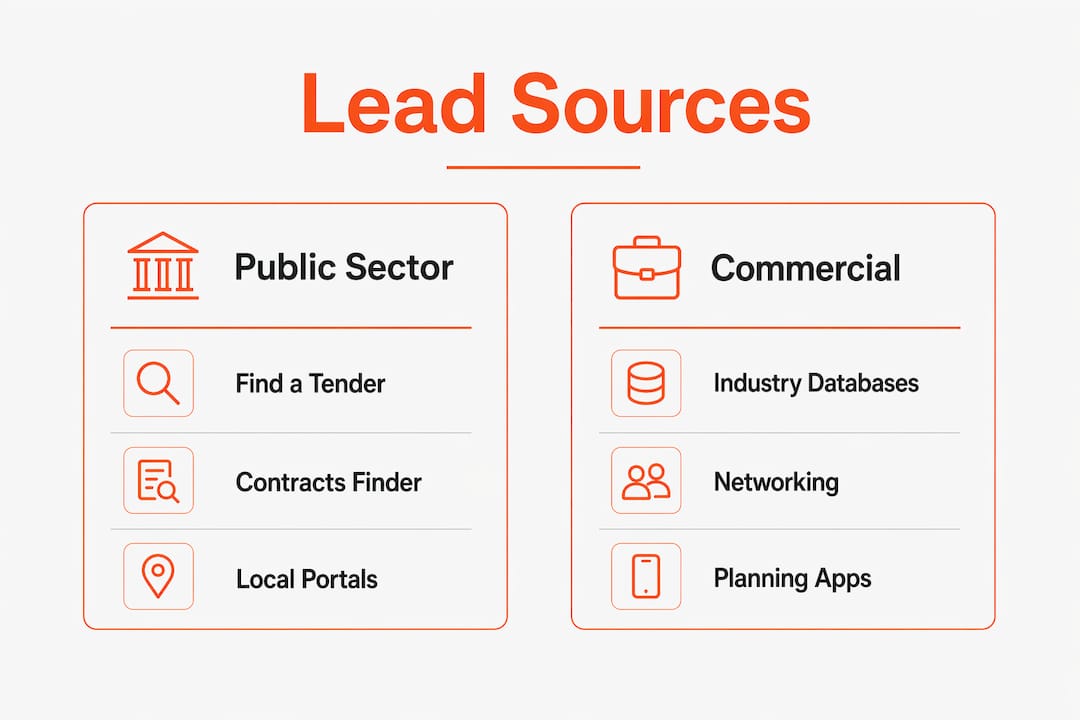
Construction leads fall into two broad categories: public sector and commercial. Each has distinct sources, timelines, and qualification criteria. Understanding both is the foundation of a reliable pipeline.
Public sector sources
The UK government’s Find a Tender and Contracts Finder portals are the starting points for public procurement. Find a Tender covers contracts above the relevant thresholds, while Contracts Finder captures lower-value public work. Under the Procurement Act 2023, public bodies must now publish pipeline notices for contracts over £2 million, offering up to 18 months of advance visibility. That lead time is significant. It lets you plan resource, build relationships with the client body, and prepare a stronger bid before the tender is even issued.
One critical point: tender documents often sit on buyer-specific portals rather than on national sites. A notice on Find a Tender points you to the opportunity, but the actual specification and submission system may live on a separate platform. Register with the relevant buyer portals for your target sectors before you need them.
Commercial and private sector sources
Commercial construction leads come from industry intelligence databases, relationship networks, and sector-specific publications. Trade bodies such as the Chartered Institute of Building and regional construction forums generate referral opportunities that never appear on any portal. Relationship intelligence, meaning knowing who is planning what before they go to market, is the most valuable and hardest to replicate lead source available.
Planning applications as early signals
Planning applications are the most underused lead source in UK construction. When a developer submits a planning application to a local authority, the project is typically 6–18 months from breaking ground. That window gives you time to approach the client, demonstrate capability, and position your firm before any formal procurement begins. Most of your competitors are waiting for the tender. You can be having a conversation with the client while they are still finalising their brief.
The distinction between a lead and a tender
A lead is a signal of intent. A tender is a formal invitation to bid. Conflating the two causes firms to miss the most valuable stage of the procurement lifecycle. The earlier you engage, the less competition you face and the more influence you have over the specification.
- Monitor Find a Tender and Contracts Finder for pipeline notices and contract notices
- Register with buyer-specific portals for your target public sector clients
- Set up alerts on local authority planning portals for relevant application types
- Build a database of commercial developers and track their planning activity
- Use industry databases to identify private sector projects at feasibility stage
Pro Tip: Set up automated email alerts on your target local authority planning portals filtered by application type (e.g. commercial, residential, industrial). Check them every Monday morning and log anything relevant into your CRM the same day.
How to monitor and qualify leads to build a strong pipeline
Volume is not the goal. A pipeline full of poorly qualified opportunities wastes bid resource and demoralises your team. The goal is a pipeline of leads that match your firm’s capacity, geography, and sector expertise.

Tracking lead outcomes from initial enquiry through quoting to signed contract is industry best practice, with a minimum 90-day tracking period recommended to judge channel effectiveness. That data tells you which sources produce the best conversion rates, not just the most enquiries. A referral that converts at 40% is worth far more than a tender portal that converts at 4%.
Qualify every lead against four criteria before committing bid resource:
- Value fit. Does the contract value match your firm’s capacity and margin requirements? Bidding for work that is too small or too large for your current resource is a common and costly mistake.
- Sector fit. Do you have demonstrable experience in this sector? Commercial buyers check references. If you cannot point to comparable completed work, your bid starts at a disadvantage.
- Geographic fit. Can you resource and supervise this project profitably given its location? Travel time and accommodation costs erode margin quickly on distant sites.
- Relationship position. Do you know anyone connected to this client or project? A warm relationship at the point of tender submission materially improves your win rate.
Speed of response is a separate but equally important variable. Only 37% of firms respond to new enquiries within an hour, yet prompt response is one of the strongest trust signals a potential client receives. Automating an acknowledgement message the moment an enquiry arrives costs nothing and immediately separates you from the majority of the market.
Pro Tip: Build a simple lead scoring sheet in a spreadsheet or CRM. Score each lead 1–5 on value fit, sector fit, geographic fit, and relationship position. Only commit full bid resource to leads scoring 14 or above out of 20.
Good digital communication strategies also support faster lead response. When your internal communications are organised, your team can act on new opportunities without chasing information across multiple channels.
What digital strategies improve lead generation for construction firms?
Digital marketing is now a primary channel for inbound construction leads, particularly for residential and commercial fit-out work. The firms that treat their website as a passive brochure are leaving enquiries on the table.
Local SEO and Google Business Profile
Local SEO targets searches like “commercial builder in Manchester” or “groundworks contractor Surrey.” Mid-competition keywords typically take 3–5 months to show measurable ranking improvements, while high-competition city-centre searches can take 6–12 months. That timeline means you need to start now, not when your pipeline gets thin. A fully optimised Google Business Profile with recent photos, client reviews, and accurate service categories is the fastest win available in local search.
Dedicated landing pages
Generic homepages do not convert well for high-intent commercial searches. Dedicated landing pages tailored to specific services or sectors achieve approximately 23% conversion rates, outperforming generic homepage funnels significantly. A page built specifically for “commercial office fit-out London” will outperform a homepage that mentions fit-out in passing. Each service line and each target geography deserves its own page.
Google Ads for construction leads
Paid search works for construction when the targeting is tight. Broad keywords and generic landing pages waste budget and reduce conversion. The correct approach is a tightly focused ad group targeting a specific service and location, linked to a matching landing page with a clear call to action. A campaign targeting “groundworks contractor Birmingham” with a dedicated Birmingham groundworks page will outperform a campaign targeting “construction company” linked to a homepage every time.
| Digital channel | Typical timeline to results | Key success factor | Local SEO (mid-competition) | 3–5 months | Consistent content and citation building |
|---|---|---|
| Local SEO (high-competition) | 6–12 months | Technical SEO and authority links |
| Google Ads | Immediate | Tight keyword and landing page match |
| Google Business Profile | 4–8 weeks | Reviews, photos, and category accuracy |
| Case study content | 3–6 months | Real project data and client outcomes |
Commercial buyers research extensively online before making contact. Detailed case studies demonstrating real project outcomes are the single most persuasive content type for this audience. A case study that shows project value, timeline, challenge, and measurable result builds credibility that a service page cannot.
How to use planning applications as a proactive lead source
Planning applications are public documents. Every application submitted to a local authority in England, Wales, Scotland, and Northern Ireland is visible on that authority’s planning portal. Most construction firms never look at them. That is a competitive advantage waiting to be taken.
Monitoring planning applications provides the earliest possible lead visibility, allowing firms to approach prospects months before formal procurement starts. The result is less competition and better conversion potential than any tender portal can offer. By the time a project appears on Find a Tender, dozens of firms have already been alerted. By the time you find it on a planning portal, most of your competitors have not even noticed it exists.
- Filter planning portals by application type: full planning permission, prior approval, and listed building consent are the most relevant for construction firms
- Identify the applicant and agent named on the application. The applicant is typically the client; the agent is often the architect or planning consultant
- Search Companies House and LinkedIn to find the decision-maker within the applicant organisation
- Make contact with a brief, relevant message that references the specific project and demonstrates your capability in that project type
- Follow up once after 10 days if you receive no response. Do not chase repeatedly
The timing of outreach matters. Contact made within two weeks of a planning application being validated is most effective. The client is actively thinking about the project at that moment. Contact made six months later, when they are deep into procurement, is far less welcome.
Pro Tip: Create a simple weekly routine: every Friday, check the planning portals for your three target local authorities. Log any relevant applications in your CRM with the applicant name, project type, estimated value, and a follow-up date two weeks out.
Building relationships with architects and planning consultants is a force multiplier here. They know which projects are coming before the application is even submitted. A strong relationship with three or four active architects in your target geography is worth more than any database subscription.
Key takeaways
Effective construction lead generation combines public procurement intelligence, planning application monitoring, digital marketing, and fast qualification to build a pipeline that converts consistently.
| Point | Details |
|---|---|
| Use the Procurement Act 2023 | Public bodies must publish pipeline notices for contracts over £2 million, giving up to 18 months of advance notice. |
| Monitor planning applications weekly | Planning portals reveal projects months before tenders are issued, with less competition at that stage. |
| Qualify before committing bid resource | Score leads on value, sector, geography, and relationship position to avoid wasting time on poor fits. |
| Respond within one hour | Only 37% of firms achieve this speed, making prompt response a genuine competitive differentiator. |
| Build dedicated landing pages | Service-specific pages achieve approximately 23% conversion rates, far outperforming generic homepages. |
Why I think most construction firms are generating leads the wrong way
The firms I see struggling with pipeline are almost always relying on one channel. They are either waiting for tenders to appear on a portal, or they are depending entirely on referrals from existing clients. Both approaches work until they stop working, and when they stop, they stop suddenly.
The firms with genuinely resilient pipelines treat multi-channel lead generation as a system, not an activity. They have someone monitoring planning portals every week. They have a Google Ads campaign running in the background. They have a CRM that tracks every lead from first contact to signed contract. They know their conversion rate by channel, by sector, and by project value. That data tells them where to invest next.
The planning application route is the one I find most underused and most valuable. The conversations you have at that stage are qualitatively different from a tender submission. You are talking to a client who is still forming their thinking. You can shape the brief, suggest approaches, and build a relationship before any formal process begins. That is a fundamentally different competitive position from submitting a bid alongside ten other firms.
Speed is the other variable that separates firms consistently. Responding to an enquiry within an hour is not about being pushy. It signals to the client that you are organised, that you take their project seriously, and that you will be responsive when you are on site. Those are exactly the qualities a client is trying to assess before they appoint a contractor.
The best construction apps available in 2026 make it far easier to stay on top of communications and follow-ups without adding administrative burden. The firms that adopt them have a structural advantage over those still managing everything manually.
— James
How BRCKS helps you convert leads into completed projects
Winning the lead is only the first step. Converting it into a signed contract, and then delivering the project without the communication breakdowns that damage client relationships, is where the real work happens.
BRCKS is built specifically for UK construction teams who need to keep projects moving without drowning in admin. Its WhatsApp integration captures site communications automatically, generating automated site diaries and RFI logs without anyone having to write them up manually. BRCKS saves teams over two hours of manual effort daily. That time goes back into following up leads, building client relationships, and winning the next project. The BRCKS builder platform gives you a free 14-day trial with no commitment required.
FAQ
What are construction project leads?
Construction project leads are early signals of upcoming construction work, ranging from planning applications and pipeline notices to live tender invitations. They represent opportunities for contractors to pursue new contracts before or during formal procurement.
Where can I find construction leads in the UK?
The main public sources are Find a Tender, Contracts Finder, and local authority planning portals. Commercial leads come from industry databases, referral networks, and direct monitoring of planning applications submitted to local councils.
How does the Procurement Act 2023 affect construction lead generation?
The Procurement Act 2023 requires public bodies to publish pipeline notices for contracts over £2 million, providing contractors with up to 18 months of advance visibility before a tender is formally issued.
How quickly should I respond to a new construction enquiry?
Responding within one hour of receiving an enquiry is the standard that converts best. Only 37% of construction firms currently achieve this speed, making it a straightforward way to stand out from competitors.
What is the difference between a construction lead and a tender?
A lead is a signal that a project is being planned. A tender is a formal invitation to submit a priced bid. Engaging at the lead stage, before the tender is issued, gives you more influence over the specification and less competition.
Recommended
- Construction Client Communication Guide for UK Projects
- Best Construction Apps UK: 2026 Guide for Builders
- BRCKS | Construction Project Communication Software
- UK Construction Project Coordination Best Practices 2026 | BRCKS
How BRCKS Can Help
Securing a consistent stream of high-quality leads is only half the battle; the real challenge lies in managing those opportunities efficiently to ensure no project slips through the cracks. BRCKS simplifies this process by centralising your lead tracking and project data, allowing your team to focus on building relationships rather than managing spreadsheets. By integrating these insights into a streamlined workflow, you can respond faster and win more work across the UK market. We invite you to discover how BRCKS can transform your business development by exploring our platform today. Learn more at BRCKS and explore our full feature set.