Construction team onboarding checklist: the 2026 UK guide
A comprehensive guide to structured employee integration in the UK construction sector, ensuring legal compliance and site safety from day one.
By James Shorter ·
Construction team onboarding checklist: the 2026 UK guide

TL;DR:
- A construction team onboarding checklist ensures new hires are prepared, compliant, and productive from their first day.
- It covers legal paperwork, safety, role-specific training, and performance goals, with structured activities over 30 days.
A construction team onboarding checklist is a structured process that ensures every new hire is prepared, compliant, and productive from day one. Without one, project managers face avoidable risks: missed safety inductions, incomplete paperwork, and workers who are unclear on site standards. In the UK construction sector, where Health and Safety Executive (HSE) regulations and site-specific compliance requirements are non-negotiable, a formal employee orientation process is not optional. This guide gives you a practical, field-tested checklist covering pre-start documentation, role-specific training, a 30-day ramp-up process, and the tools that hold it all together.
1. What must your construction team onboarding checklist include?

A construction team onboarding checklist must cover six core areas: paperwork, safety, role-specific training, tools, communication, and 30-day performance goals. Visible expectations reduce errors and improve quality across the board. That means the checklist is not a single form. It is a phased process that begins before the worker arrives on site and continues through their first month.
The industry term for this process is structured employee integration, though most project managers simply call it onboarding. Both terms are used throughout this guide. The key point is that informal onboarding increases liability risk. Proper documentation of training and equipment authorisation is required for legal due diligence.
2. What paperwork must be completed before day one?
Pre-start documentation is the legal foundation of any new hire checklist for builders. Industry best practices require the following documents to be completed before the worker sets foot on site:
- Offer letter and employment contract signed by both parties
- Tax and payroll forms including HMRC starter checklist (the UK equivalent of a W-4) and right-to-work verification (equivalent to I-9 checks)
- Workers’ compensation classification confirming the correct insurance category for the role
- Site-specific safety plan reviewed and acknowledged by the new hire
- Site access permissions including gate codes, induction card requirements, and CSCS card verification
- Equipment and tool policy covering what the company supplies, what the worker supplies, and liability for damage
- Uniform and PPE requirements with confirmation of issue
Each document must be signed and filed before day one. This is not administrative box-ticking. Signed records are required for liability protection during HSE inspections or incident investigations. A well-organised construction handover documentation process follows the same logic: everything in writing, everything traceable.
Pro Tip: Create a pre-start document pack sent digitally at least five working days before the start date. This gives the new hire time to complete forms without eating into their first productive day on site.
3. How should role-specific training and safety induction be structured?
Safety induction is a primary control measure against accidents. It requires module sign-offs to verify understanding and compliance. Generic safety talks do not meet this standard. Every induction must cover site-specific hazards, emergency protocols, muster points, and the reporting procedure for near-misses.
Role-specific training goes further. Tailored onboarding maps technical, safety, and platform training directly to the worker’s day-to-day responsibilities. A groundworker and a site manager face different hazards and use different tools. Their training must reflect that.
A well-structured construction team training guide for each role should include:
- Site hazard briefing specific to the current project, not a generic site
- Emergency procedure walkthrough including fire exits, first aid stations, and accident reporting
- Technical skills assessment to confirm the worker can perform their role safely
- Digital platform training covering any project management apps, site diary tools, or communication systems in use. Construction operators must complete digital platform training averaging 30 minutes before their first shift, with completion logged for compliance
- Mentorship pairing with an experienced team member for the first two weeks
- Module sign-off sheet for each training element, signed by both the trainer and the new hire
Combining classroom or digital coursework with hands-on shadowing and mentorship produces the most consistent results. One without the other leaves gaps.
Pro Tip: Make all training materials mobile-accessible. Workers on site cannot carry folders, but they can check a phone. Mobile-ready documents also support ongoing reference, not just first-day learning.
4. What does a structured 30-day ramp-up process look like?
Effective onboarding spans the first 30 days with structured objectives and coaching. The goal is for the new hire to operate independently, meeting company standards without constant manager intervention, by the end of that period. This is a phased process, not a single event.
A practical 30-day ramp-up for building site employee integration works as follows:
- Days 1–3: Orientation and site familiarisation. The new hire completes all induction modules, meets key team members, and shadows their mentor on live tasks. No solo work yet.
- Days 4–7: Supervised task completion. The worker begins performing their core responsibilities under direct supervision. The mentor observes and gives real-time feedback.
- Days 8–14: Increasing autonomy. The worker takes on tasks independently but checks in with the mentor at the start and end of each shift. Any quality issues are addressed immediately.
- Days 15–21: Performance objectives set. The project manager sets measurable targets linked to project deliverables. These might include zero rework on a specific task type, or completing daily site diary entries without prompting.
- Days 22–28: Coaching and adjustment. A mid-ramp review identifies any gaps. Training modules are revisited if needed. Communication standards, including how to log variations and raise RFIs, are confirmed.
- Days 29–30: Competency sign-off. The project manager and mentor confirm the worker meets the required standard. Any outstanding items are documented and scheduled.
Setting clear performance objectives linked to project deliverables is the step most managers skip. Without measurable targets, the ramp-up period becomes vague, and quality problems surface later as costly rework. A structured task tracking process keeps the ramp-up on schedule and creates a record of progress.
5. What tools and technologies support effective onboarding?
Digital platforms that log training, certifications, and compliance records are now standard in well-run construction businesses. Mobile-accessible training materials support ongoing learning and compliance, not just initial orientation. The right tool depends on the size of the project and the complexity of the team.
| Tool category | Best suited for | Key onboarding function |
|---|---|---|
| Field apps (entry-level) | Small sites, sole traders | Digital checklists, photo logs, basic sign-offs |
| Mid-range project apps | SME contractors, multi-trade sites | Training tracking, document storage, task assignment |
| Enterprise platforms | Large contractors, multi-site projects | Full compliance management, automated reminders, analytics |
| Document management systems | Any size | Centralised storage of signed induction records and certifications |
| Integrated communication tools | Any size | Real-time updates, RFI logging, variation tracking |
The most practical choice for most UK project managers is a mid-range tool that integrates with existing site communication workflows. Switching tools mid-project creates confusion. Choose a platform before the project starts and include it in the onboarding process from day one.
BRCKS integrates directly with WhatsApp, which most site teams already use. This means onboarding communications, document sharing, and compliance updates happen inside a familiar channel, with automated logging so nothing is lost.
Pro Tip: Select tools that integrate with your existing project management software. A standalone onboarding app that does not connect to your site diary or RFI log creates duplicate work and increases the chance of records falling out of sync.
6. How can managers improve the onboarding process over time?
The checklist for onboarding workers is not a static document. It must be reviewed and updated regularly to stay relevant and compliant. The most effective approach combines feedback from new hires with data from digital onboarding tools.
- Collect feedback at day 30. Ask new hires what was unclear, what was missing, and what slowed them down. This is the most direct source of improvement data.
- Review quality metrics. Track rework rates, callback frequency, and safety incidents for workers in their first 90 days. Patterns point to gaps in the onboarding process.
- Update for regulatory changes. HSE guidance and site-specific requirements change. Review the checklist at the start of each project and after any regulatory update.
- Analyse digital platform data. Tools that log training completion and task performance generate data you can act on. Low completion rates on a specific module signal a training design problem, not a worker problem.
- Share learnings across the team. A culture of safety and knowledge sharing means experienced workers contribute to improving the process, not just following it.
Following project coordination best practices means treating onboarding as a live process, not a one-off task. The best project managers review their onboarding checklist after every major hire and update it before the next one.
Key takeaways
A construction team onboarding checklist works because it combines legal compliance, role-specific training, and a structured 30-day ramp-up to bring new hires to full competency without costly errors.
| Point | Details |
|---|---|
| Pre-start paperwork is non-negotiable | Complete contracts, tax forms, and site safety plans before day one to protect against liability. |
| Safety induction requires sign-offs | Module sign-offs verify understanding and satisfy HSE compliance requirements. |
| Role-specific training outperforms generic | Map technical and safety training to each worker’s actual responsibilities for better results. |
| 30-day ramp-up builds real competency | Phased objectives and mentorship bring new hires to full autonomy within a month. |
| Digital tools must integrate | Choose platforms that connect with your site diary and communication tools to avoid duplicate records. |
What I have learned from running onboarding on live construction sites
The biggest mistake I see project managers make is treating onboarding as a day-one event. You hand someone a folder, walk them round the site, and assume they are ready. They are not. The paperwork is done, but the competency is not there yet.
The hybrid model, combining digital coursework with hands-on mentorship, is the only approach I have seen work consistently. Digital materials give workers something to refer back to. Mentorship gives them someone to ask when the manual does not cover the situation in front of them. Neither works well without the other.
Standardisation matters, but so does adaptability. A checklist built for a groundworker will not serve a site manager. The best onboarding programmes I have worked with use a core checklist with role-specific modules attached. That way, the compliance baseline is consistent, but the training is relevant.
The 30-day ramp-up is where most programmes fall apart. Managers set it up, then get pulled onto other priorities. The new hire drifts. Quality slips. By the time the problem surfaces, it has cost more to fix than a proper ramp-up would have. Schedule the check-ins in advance and treat them as fixed appointments.
— James
How BRCKS supports construction team onboarding and compliance
Keeping onboarding records, training logs, and site communications in separate places creates gaps. BRCKS brings them together through WhatsApp integration, so every update, document share, and sign-off is captured automatically in real time.
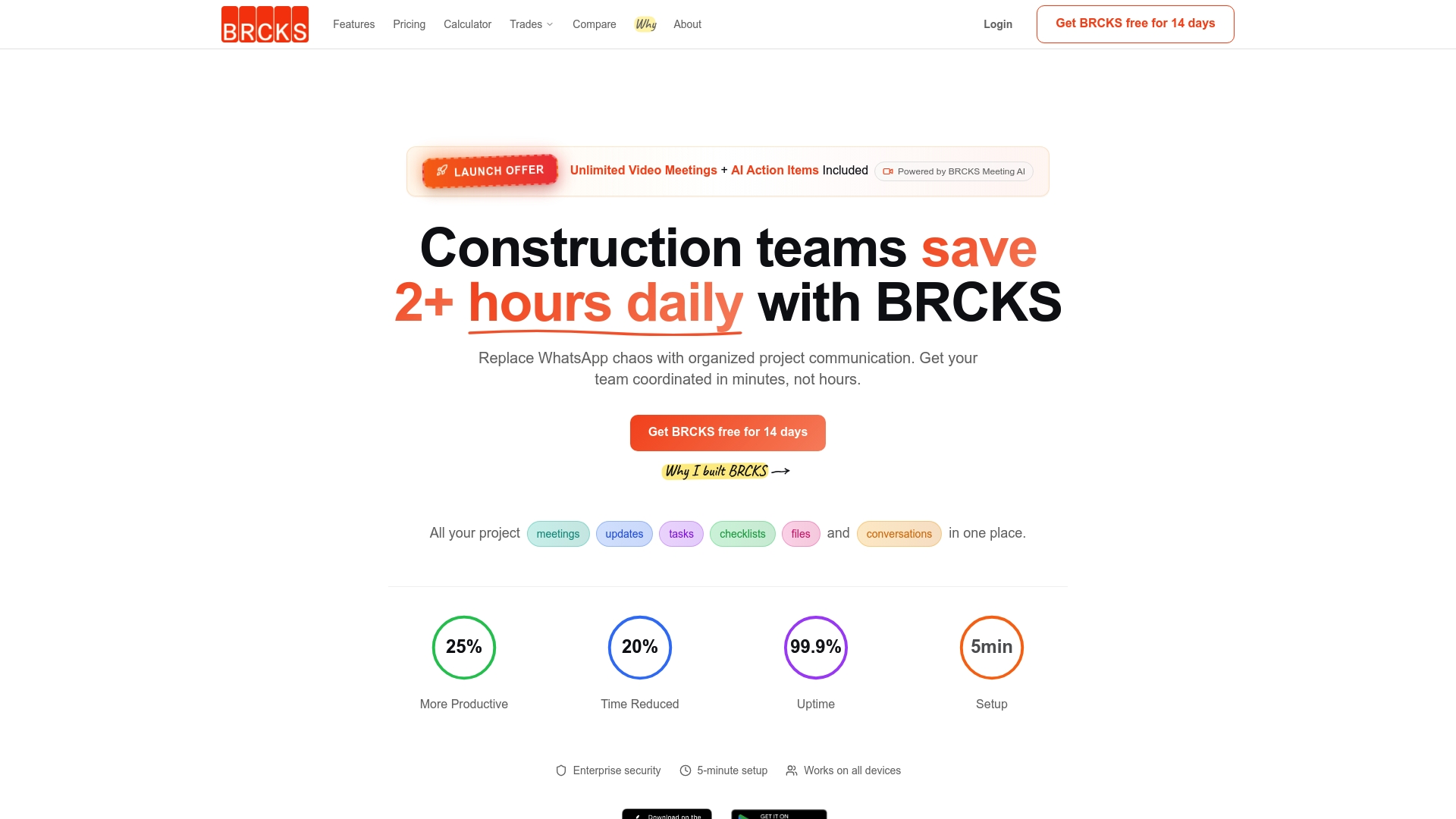
BRCKS saves project managers over two hours of manual effort daily through automated site diary entries, RFI tracking, and variation logs. For onboarding specifically, that means less time chasing paperwork and more time on site. The BRCKS platform for builders is built for UK construction teams who need compliance records that hold up under inspection, without the administrative overhead. Try BRCKS free for 14 days and see how much time your team gets back.
FAQ
What should a construction onboarding checklist include?
A construction onboarding checklist must cover pre-start paperwork, site-specific safety induction, role-specific technical training, digital platform training, mentorship pairing, and 30-day performance objectives. Each element requires a signed record for compliance purposes.
How long does construction site induction take?
Safety and digital platform induction for construction operators averages 30 minutes to meet compliance requirements, though full role-specific training typically spans the first two weeks of employment.
Why is role-specific onboarding better than a generic induction?
Role-specific onboarding maps training directly to a worker’s daily responsibilities, which improves both competency and compliance. Generic inductions cover the minimum but leave workers unprepared for the specific hazards and tools of their role.
What is the 30-day ramp-up in construction onboarding?
The 30-day ramp-up is a phased integration process where new hires move from supervised orientation to full autonomy within their first month. It includes structured objectives, regular coaching, and a final competency sign-off before the worker operates independently.
How do digital tools improve the onboarding process for construction teams?
Digital platforms with mobile access simplify training tracking, certify compliance, and give field workers on-demand access to site documents and checklists. Tools that integrate with existing construction safety guidance and project workflows reduce duplicate records and keep compliance data in one place.
Recommended
- UK Construction Project Coordination Best Practices 2026 | BRCKS
- Best Construction Apps UK: 2026 Guide for Builders
- Construction Handover Documentation: The Complete Guide for UK Project Managers | BRCKS
- Meeting Management Tips for UK Contractors | BRCKS
How BRCKS Can Help
Implementing a robust onboarding process is essential for maintaining safety and productivity on modern UK sites, but managing the associated paperwork shouldn't be a burden. BRCKS simplifies this transition by centralising documentation and automating workflows, ensuring your new hires are integrated seamlessly from day one. By leveraging our purpose-built platform, you can move away from manual tracking and focus on delivering high-quality projects. We invite you to explore how BRCKS can transform your team management and streamline your operational efficiency. Learn more at BRCKS and explore our full feature set.