UK construction trends in 2026: what you need to know
An in-depth analysis of the structural shifts defining UK construction in 2026, from the deepening labour crisis to the rapid adoption of automation and digitisation.
By James Shorter ·
UK construction trends in 2026: what you need to know

The dominant construction trends shaping the UK in 2026 are cautious market growth, a deepening labour shortage, accelerating digitisation, and tightening sustainability requirements. The Construction Products Association forecasts a 4.4% rise in construction output for 2026, driven by government housing targets and infrastructure investment. But that headline figure masks a fragile pipeline, renewed cost pressures, and a workforce crisis that no hiring campaign alone will solve.
The key themes defining 2026:
- Labour shortfall: a 250,000 worker shortfall expected by 2027, with 35% of the current workforce aged over 50
- Digitisation: AI and automation moving from pilot schemes into live project workflows
- Sustainability: retrofitting and circular economy practices gaining regulatory and commercial traction
- Compliance: the Building Safety Act 2022 and Golden Thread requirements intensifying documentation demands
- Cost pressure: tender price inflation forecast at 3.5% for 2026, driven by energy and materials volatility
What does the UK construction market outlook look like for 2026?
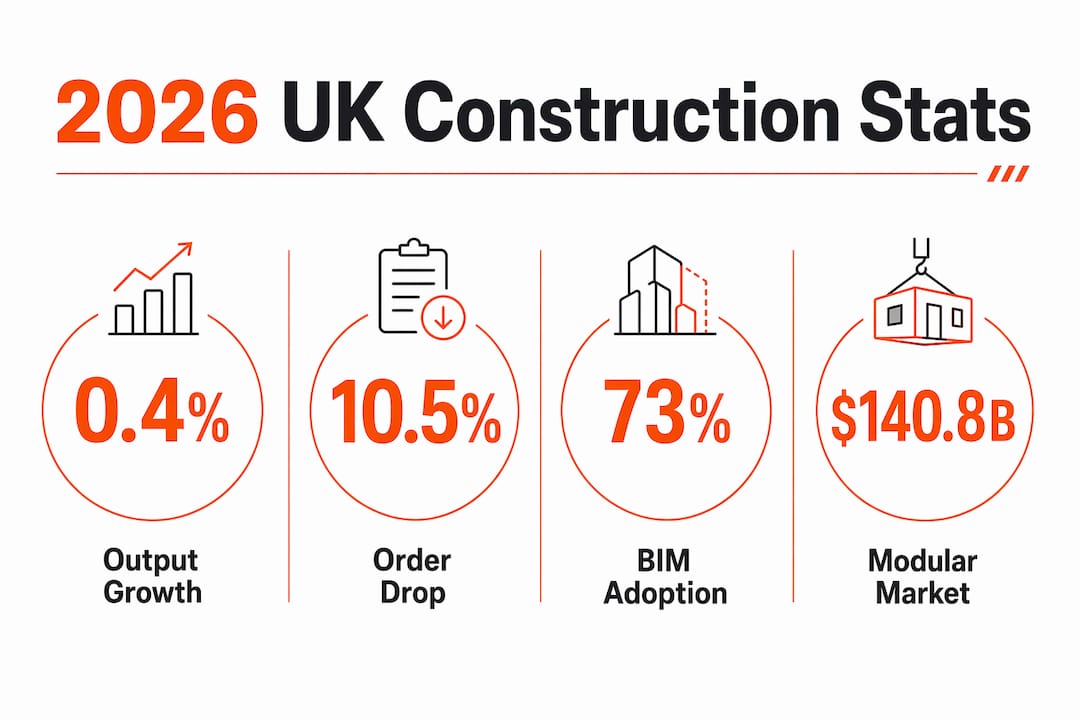
Output stabilised in Q1 2026, but the recovery is narrow. ONS data shows 0.4% output growth quarter-on-quarter, partially reversing a sharp 2.8% fall in Q4 2025. Output remains below Q1 2025 levels. That is a floor, not a rebound.
The forward pipeline is the more telling signal. Total construction new orders fell 10.5% in Q1 2026, dropping from £11.8bn in Q4 2025 to £10.6bn, and were 11.9% lower than Q1 2025. Weaker private commercial and infrastructure orders are driving that decline, reflecting delayed approvals, funding constraints, and investor caution.
| Indicator | Value | Source |
|---|---|---|
| Construction output growth Q1 2026 | +0.4% q-on-q | ONS / Gardiner & Theobald |
| Output vs Q1 2025 | — | ONS / Gardiner & Theobald |
| New orders Q1 2026 | £10.6bn | ONS / Gardiner & Theobald |
| New orders change vs Q4 2025 | -10.5% | ONS / Gardiner & Theobald |
| 2026 tender price inflation forecast | 3.5% | Gardiner & Theobald |
| CPA output forecast 2026 | — | CPA |
Repair and maintenance is holding up better than new build, with private housing R&M and non-housing R&M both growing in Q1. New work fell quarter-on-quarter, with private commercial being one of the few sectors with growth. Infrastructure, housing, and industrial new build all contracted. The sectors with the clearest near-term opportunity are data centres, regulated infrastructure, and public-sector programmes, where long-term pipelines remain intact even as private development stalls.
Key construction industry trends to watch in 2026
The trends reshaping UK construction this year are not isolated. They interact: labour shortages accelerate automation adoption; tighter compliance requirements drive digitisation; sustainability targets reshape material choices and procurement.
Labour and demographics
35% of the UK construction workforce is over 50. Government training targets cover less than 25% of the projected shortfall. The industry cannot recruit its way out of this.
BIM adoption versus utilisation

73% of UK construction firms have adopted BIM, but most only pull 2D plans from 3D models. Advanced functions such as 4D scheduling, 5D cost simulation, and sustainability modelling remain largely untapped.
Modular and offsite construction
The global modular construction market is projected to reach $140.8 billion by 2029, with offsite methods capable of cutting delivery times by up to 50%. The UK track record is mixed, but circular economy approaches such as retrofitting, designing for disassembly, and material reuse offer more immediately actionable gains, particularly in the North West, Yorkshire, and Wales.
Sustainability and retrofitting
Retrofitting older building stock is gaining momentum as both a regulatory requirement and a commercial opportunity. Circular economy practices, including material reuse and designing for disassembly, are moving from aspiration to procurement criteria on public-sector contracts.
Brexit and supply chains
Post-Brexit trade friction continues to affect material costs and lead times. Changes to steel tariffs taking effect in July 2026 include large reductions in quotas across many steel product categories and significant increases in tariffs, which are likely to raise the floor price of fabricated steel in the UK.
AI and compliance technology
Over 40% of projects above £50m are now using AI workflows, reporting ROI in 6–9 months and up to 27% reduction in site safety incidents.
Key figure: Government training targets cover only a fraction of the projected workforce shortfall by 2027, making automation adoption a practical necessity rather than an optional upgrade.
How are labour shortages reshaping the role of automation?
The framing that matters here is not replacement but multiplication. AI and robotics are increasingly positioned as force multipliers that enable smaller, highly skilled teams to deliver at the pace previously requiring larger workforces. That shift is already visible on higher-value projects.
The workforce picture is stark. Around 35% of current workers are over 50, retirement attrition is accelerating, and 70% of Gen Z workers say they would switch jobs for better technology. Firms that cannot demonstrate modern working practices will struggle to attract the next generation of site talent.
Practical automation gains are appearing in three areas:
- Document intelligence: AI tools interrogating specifications, RAMS, and NEC clauses, with site managers saving 1–3 hours daily on compliance document management
- Automated reporting: voice-to-text site diaries and reality-capture systems reducing admin pressure on lean delivery teams
- Computer vision safety: PPE monitoring and exclusion-zone alerts now appearing on major commercial and infrastructure projects
Training and upskilling remain the weak link. The government’s target of 60,000 new construction workers by 2029 addresses less than 25% of the projected gap. Firms investing in digital literacy alongside technical skills are better placed to retain staff and extract value from the tools they deploy.
Pro Tip: Start automation with document intelligence before robotics. Contractors deploying AI for specification search and compliance tracking report the fastest ROI, typically within 6–9 months, because the underlying data environment is simpler to stabilise.
How is digitisation changing construction project management?
The biggest shift in construction project management is not the technology itself but where it is being deployed. AI is moving from innovation demonstrations into live operational workflows tied to compliance, reporting, and site visibility.
WhatsApp is already the de facto coordination channel on most UK sites. The legal risk is real: the 2025 case Jaevee Homes Ltd v Fincham confirmed that WhatsApp messages can create binding contracts, even when the language is informal. A message reading “Are we saying it’s my job mate” was found sufficient to form a valid contract. Using WhatsApp for day-to-day coordination while routing contractual notices through a formal portal is the practical answer.
BRCKS addresses this directly. By integrating WhatsApp into a structured project management workflow, BRCKS captures site communications, automates site diaries, and maintains a traceable variation log, without asking teams to abandon the tools they already use. The result is over two hours of admin saved per day, with every update date-stamped and auditable.
Key digitisation gains on live projects:
- Automated site diaries replacing manual end-of-day write-ups
- RFI tracking with version control, removing the risk of lost instructions
- Client portals keeping stakeholders informed without disrupting site teams
- AI-assisted compliance monitoring aligned to Building Safety Act Golden Thread requirements
Pro Tip: Mandate a formal portal for all contractual notices and variation instructions. Keep WhatsApp for daily coordination. That separation protects you legally and keeps communication fast where speed matters.
Understanding why digital workflows matter is one thing; embedding them into daily site practice is where the productivity gains actually appear. Teams using construction communication software consistently report fewer rework incidents and faster decision cycles.
How are urbanisation and infrastructure driving construction demand?
Infrastructure and public-sector programmes are the most resilient parts of the UK construction market in 2026. Projects including HS2, Hinkley Point C, and offshore wind are underpinned by a £28 billion annual investment envelope, providing a stable pipeline even as private development slows.

Data centres are the standout near-term opportunity. The UK accounts for around 20% of all data investment in Europe, with 94 new data centre builds in the pipeline worth more than £36 billion. Power demand for those facilities is expected to increase more than thirtyfold by 2035. For contractors with the right capability, this is a concrete, bankable workload rather than a speculative forecast.
Urban regeneration and connected transport infrastructure are also generating activity, particularly in cities where planning reform is accelerating site release. Fire safety compliance requirements under the Building Safety Act are adding scope to residential retrofit and remediation projects across urban areas, creating sustained demand for specialist contractors.
Where is investment and funding flowing in 2026?
Public and regulated sectors are attracting the most reliable investment. Healthcare, defence, utilities, and major public programmes continue to progress despite the broader market slowdown. Private-sector recovery is gradual: lower interest rates are helping, but developers and investors remain cautious given ongoing uncertainty around inflation and energy costs.
Sectors attracting private investment include data centres, logistics, hospitality, and premium commercial developments. Broader residential and commercial recovery is likely to remain uneven through the rest of 2026. The government’s 1.5 million homes target by 2029 requires a 12% workforce increase, roughly 61,000 additional workers per year, but delivery gaps are widening rather than closing.
For construction firms, the funding picture points toward public-sector frameworks, regulated infrastructure, and specialist retrofit work as the most dependable revenue streams this year. Digital tools in residential construction are also helping firms demonstrate compliance and quality assurance to funders who increasingly require auditable delivery records.

BRCKS turns your existing WhatsApp workflow into a fully auditable project management system. Automated site diaries, RFI tracking, and a structured variation log, all without changing how your team communicates on site. Try BRCKS for builders free for 14 days.
Key takeaways
The UK construction market in 2026 is defined by a fragile pipeline, a structural labour shortage, and accelerating digitisation, with firms that control their data and compliance workflows best placed to maintain margins.
| Point | Details |
|---|---|
| Market growth is cautious | CPA forecasts 4.4% output growth in 2026, but new orders fell 10.5% in Q1. |
| Labour shortage is structural | 250,000 workers needed by 2027; government training covers less than 25% of the gap. |
| AI ROI is fastest in document work | Site managers save 1–3 hours daily using AI for compliance and specification management. |
| WhatsApp carries legal risk | Jaevee Homes Ltd v Fincham (2025) confirmed informal WhatsApp messages can form binding contracts. |
| BIM is underused | 73% of firms have adopted BIM, but most only use basic functions. |
FAQ
What are the current construction trends in the UK?
The dominant trends in 2026 are a structural labour shortage, AI adoption for compliance and reporting, underutilised BIM, growth in modular and offsite construction, and tightening sustainability regulation. Data centre construction is also creating strong near-term demand.
Will construction pick up in 2026?
Output stabilised in Q1 2026 with 0.4% growth quarter-on-quarter, but new orders fell 10.5% in the same period. Recovery is uneven: public-sector and infrastructure work is holding up, while private residential and commercial remain under pressure.
What are the mega trends in construction?
The structural mega trends are the labour shortage and demographic ageing of the workforce, digitisation and AI adoption, sustainability and circular economy requirements, and the shift toward offsite and modular construction methods.
How is AI being used on UK construction sites?
AI is being deployed primarily for document intelligence, automated reporting, and computer vision safety monitoring. Over 40% of projects above £50m now use AI workflows, with reported ROI windows of 6–9 months.
Recommended
- BRCKS | Construction Project Communication Software
- Best Construction Apps UK: 2026 Guide for Builders
- UK Construction Project Coordination Best Practices 2026 | BRCKS
- Construction Project Leads UK: Guide to Winning More Work
How BRCKS Can Help
As the UK construction landscape evolves towards 2026, staying ahead of these shifts requires more than just foresight; it demands the right digital infrastructure. BRCKS is designed to help firms navigate these emerging trends by streamlining project management and ensuring data-driven decisions remain at the heart of every build. By integrating our platform into your workflow today, you can future-proof your operations and maintain a competitive edge in an increasingly complex market. We invite you to discover how BRCKS can transform your project delivery by exploring our features and booking a demonstration. Learn more at BRCKS and explore our full feature set.