Project update reporting guide for construction teams
Learn how to master construction project update reporting using the RAG system and structured weekly cadences to drive better decision-making.
By James Shorter ·
Project update reporting guide for construction teams

TL;DR:
- Effective project reports clearly prioritise critical information using a structured format and a weekly cadence. They focus on a one-page summary with decision requests and audience-specific details to promote timely action and trust. Using tools like BRCKS can automate data collection and enhance structured reporting, reducing manual effort significantly.
A project status report is the structured communication of current progress, risks, budget, and decisions needed to keep a construction project aligned and moving forward. Used correctly, this project update reporting guide gives site managers, project managers, and clients a single source of truth at every stage of a build. The core technique is the RAG (Red/Amber/Green) status system, which front-loads critical information so decision-makers act immediately rather than read through pages of narrative. Poor reporting costs construction teams time, money, and trust. Getting it right is not complicated, but it does require discipline.
What are the essential components of a project update report?
Every effective project status update shares the same skeleton, regardless of project size. The structure forces clarity and prevents the most common failure mode: burying critical information in the middle of a long document.

The executive summary comes first. It carries the RAG status, a one-line summary of overall health, and any decisions needed this week. Reports readable in 10 seconds by executives are far more likely to drive timely decisions. That 10-second rule is not a target; it is a constraint that forces you to prioritise.
After the summary, the report moves through five core sections:
| Section | Purpose |
|---|---|
| Completed work | Confirms what was delivered against last week’s commitments |
| Upcoming tasks | Sets expectations for the next reporting period |
| Risks and issues | Flags threats with recommended actions and owners |
| Budget snapshot | Shows spend versus plan with a brief variance note |
| Decisions needed | Lists specific requests with deadlines and decision owners |
The “decisions needed” section is the most underused. Status reports drive action only when they contain clear decision requests rather than passive activity lists. Without it, a report is a summary. With it, a report is a leadership tool.
Pro Tip: Keep the entire report to one page where possible. Short, scannable reports with bullet points and tables are read by senior stakeholders far more reliably than long narrative documents.
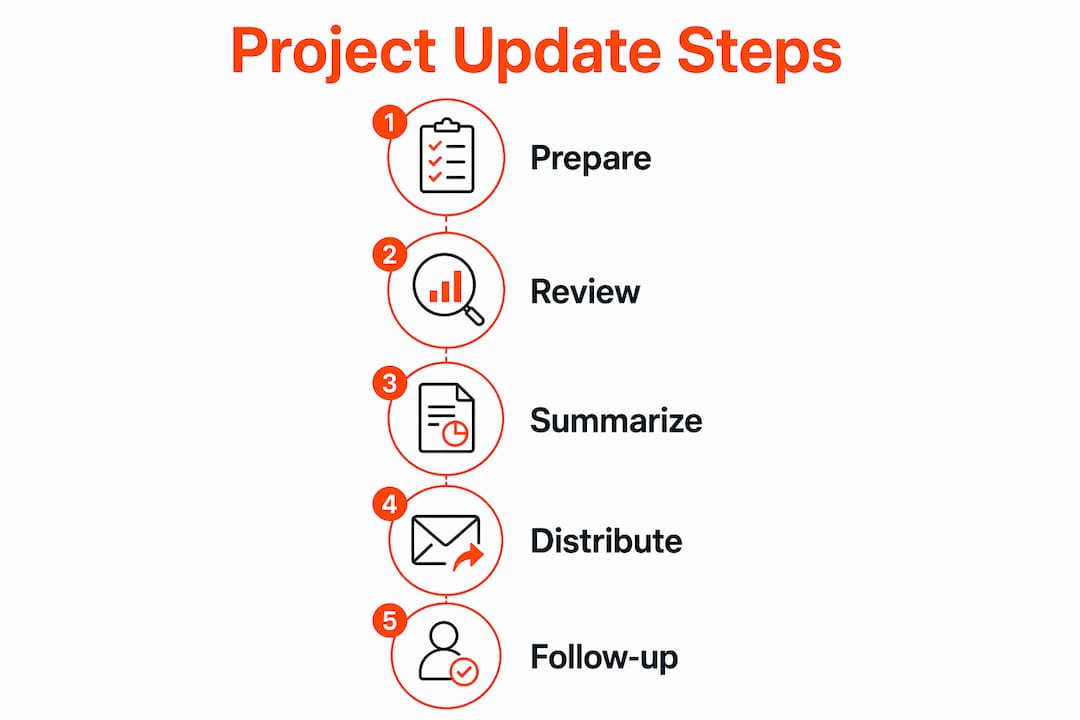
Avoid the metrics dump. Report only the one or two key health metrics that have changed since the last update. Stakeholders skip data that does not drive decisions, and excessive data erodes confidence in the author’s judgement.
How often should construction teams share project updates?
Reporting frequency is a balance between risk visibility and reporting fatigue. Too infrequent and problems compound before anyone acts. Too frequent and the reports become noise that teams stop reading.
weekly reporting is the industry standard for active construction projects. It provides enough granularity to catch schedule slippage early while keeping the administrative burden manageable. The optimal cadence for active projects is weekly, with monthly summaries for executive or client audiences.
The pros and cons of each frequency break down clearly:
- Daily: Useful for critical path phases or crisis management. Creates reporting fatigue quickly and rarely adds value on stable projects.
- Weekly: The standard for active builds. Catches risks early, aligns teams, and keeps stakeholders informed without overwhelming them.
- Fortnightly: Acceptable for projects in a steady phase with low risk. Risks compounding issues between updates.
- Monthly: Suitable for client-facing summaries or dormant project phases. Too infrequent for active site management.
Consistency matters as much as frequency. Scheduling a fixed 30-minute block at the same time each week reduces cognitive strain for both the author and the reader. Friday afternoon works well for most UK construction teams: the week’s work is complete, issues are fresh, and the report lands before the weekend so clients and stakeholders can review it over the weekend if needed.
Pro Tip: Set a recurring calendar block for report creation and distribution. Treat it as a site meeting, not an optional admin task. Teams that skip weeks lose stakeholder trust faster than teams that report bad news promptly.
The site communication workflow for a UK project manager should treat the weekly update as a non-negotiable rhythm, not a reactive task triggered by problems.
What tools and templates help with project update reporting?
The right template removes the cognitive work of deciding what to include each week. When the structure is fixed, the author focuses on the content, not the format. Consistent report templates help stakeholders locate risks, budget data, and timelines without searching, which increases engagement and reduces follow-up questions.
Construction reporting tools should support the following features as a minimum:
- RAG status entry at the top of every report
- A dedicated risk and issues log with owner and deadline fields
- A budget snapshot with variance flagging
- A decisions needed section that is separate from the general update
- Mobile-friendly input for site teams who are not desk-based
The table below compares the three main template categories used across UK construction projects:
| Template type | Best for | Key limitation |
|---|---|---|
| Executive summary format | Client and board reporting | Lacks technical detail for site teams |
| Detailed risk log format | Complex or high-risk projects | Too long for weekly stakeholder updates |
| Milestone tracking format | Programme-driven projects | Misses budget and risk visibility |
Most construction teams need a hybrid: a one-page executive summary backed by a detailed risk log that stakeholders can access on request. The detailed task lists belong in the project management tool; the status update summarises clearly and briefly.
BRCKS addresses this directly. Its WhatsApp integration captures site communications in real time, automatically populating site diaries and variation logs without requiring a separate reporting session. Teams using BRCKS report saving over two hours of manual effort daily. For construction professionals comparing reporting tools for UK sites, the ability to generate structured updates from existing WhatsApp conversations is a significant practical advantage.
How can teams avoid common mistakes in project update reports?
The five most common reporting mistakes in UK construction projects are consistent and avoidable.
- The metrics dump. Listing every KPI regardless of whether it has changed. Fix: report only metrics that have moved and explain why.
- Vague blockers. Writing “waiting on client decision” without a deadline or owner. Fix: define every blocker as a specific decision or resource request required by a firm date. A true blocker names the decision, the owner, and the date it is needed.
- Delayed bad news. Holding a Red status until a problem is unrecoverable. Fix: declare Red as soon as the criteria are met. Stakeholders forgive early bad news far more readily than surprises.
- No recommended actions. Listing risks without suggesting what to do about them. Fix: every risk entry carries a recommended action and an owner.
- Mixing routine updates with critical alerts. Burying urgent issues in the weekly report. Fix: send a separate, brief alert for anything requiring a decision within 24 hours. Reserve the weekly update for structured progress reporting.
Pro Tip: Treat the report as a decision tool, not a cover-your-assets document. Every report must ask the reader to act on something specific. If it does not, it is a diary entry, not a management tool.
Poor communication on site compounds these mistakes. When the reporting process is disconnected from day-to-day site communications, critical information gets lost between WhatsApp threads and formal reports.
How to tailor project update reports for different stakeholders
One report format does not serve all audiences. The solution is a single core data source with multiple audience-specific outputs. Maintaining one data source but customised formats reduces workload and increases clarity for every reader.
The three primary audiences in construction projects each need a different emphasis:
- Executives and clients: Focus on business impact, milestone progress, budget variance, and decisions needed. One page maximum. RAG status prominent at the top.
- Site teams: Technical detail on upcoming tasks, resource requirements, and specific risk actions. Practical and task-oriented.
- Project managers and contract administrators: Full risk log, RFI status, variation log, and programme updates. Detailed but structured.
The practical approach is to write the full weekly update for the project management team, then extract the executive summary section as a standalone client-facing report. This takes ten minutes once the core report is complete and prevents the common trap of trying to please all audiences with one document.
Tailored reporting also speeds up decisions. When an executive receives a one-page summary with a clear “decision needed by Friday” flag, the response time drops compared to a 12-page technical report where the decision request is buried on page nine. Effective project reporting for UK construction teams recognises that audience-specific formats are not extra work. They are the mechanism that makes reporting worthwhile.
Key takeaways
Effective project update reporting requires a fixed structure, a consistent weekly cadence, and audience-specific formats built from a single core data source.
| Point | Details |
|---|---|
| Front-load critical information | Place RAG status and decisions needed at the top of every report. |
| Report weekly on active projects | Weekly cadence catches risks early without creating reporting fatigue. |
| Define blockers precisely | Every blocker must name the decision, the owner, and the deadline required. |
| Declare Red status early | Early honesty builds stakeholder trust and prevents unrecoverable surprises. |
| Customise by audience | Use one core data source to produce separate formats for executives, site teams, and clients. |
Why most construction reports fail before they are even read
I have reviewed hundreds of project updates from UK construction teams over the years, and the pattern is almost always the same. The report is thorough, detailed, and completely ignored. The problem is not the content. It is the structure.
Most project managers write reports the way they think about projects: chronologically, from the beginning of the week to the end. That is the wrong order for a reader who has 90 seconds and needs to know whether to worry. The inverted pyramid approach, front-loading the RAG status and the decisions needed, changes the dynamic entirely. Stakeholders start responding to reports rather than filing them.
The other thing I have observed consistently is the fear of declaring Red. Project managers worry it reflects badly on them. The opposite is true. Stakeholders remember who told them early and who let a problem compound into a crisis. Honesty in status reporting is not a vulnerability. It is the fastest way to build the kind of trust that gives you more autonomy on the next project.
The discipline of a fixed weekly schedule also matters more than most teams realise. When reports arrive at the same time every week, stakeholders build a habit of reading them. When they arrive irregularly, stakeholders stop expecting them and stop acting on them. The schedule is not administrative tidiness. It is the mechanism that keeps reporting credible.
— James
How BRCKS supports structured project reporting
Construction teams that already use WhatsApp for site communications face a specific challenge: critical project information lives in chat threads rather than structured reports. BRCKS resolves this by capturing WhatsApp communications in real time and converting them into structured site diaries, variation logs, and RFI records automatically.
The result is that your weekly project update draws from a complete, organised record rather than a manual trawl through message threads. BRCKS saves teams over two hours of daily admin, and its client portal keeps stakeholders informed without disrupting site workflows. For builders and contractors looking for a practical reporting solution, the construction software for builders page covers the full feature set. You can get BRCKS free for 14 days and see the difference in your first weekly report.
FAQ
What is a RAG status in project reporting?
RAG stands for Red, Amber, and Green. It is a traffic-light system that signals overall project health at a glance: Green means on track, Amber means at risk, and Red means a significant issue requires immediate action.
How long should a project status update be?
One page is the standard for weekly stakeholder reports. Short reports with bullet points and tables are read more reliably by senior stakeholders than long narrative documents.
What should a “decisions needed” section include?
Each entry should name the specific decision required, the person who must make it, and the date it is needed by. Vague requests without deadlines are rarely acted upon.
How do I report bad news without damaging stakeholder confidence?
Declare Red or Amber status as soon as the criteria are met and include a recommended action alongside the issue. Stakeholders respond better to early bad news than to surprises discovered late.
Can one report format work for all stakeholders?
No. The best practice is to maintain one core data source and produce audience-specific formats from it. Executives need a one-page summary; site teams need technical detail; clients need milestone progress.
Recommended
- Project Updates for UK Construction Teams | Brcks Guide
- Top Construction Reporting Tools for UK Sites Compared | BRCKS
- Construction Task Tracking: A UK Project Manager’s Guide
- Electrical Project Update Workflow: UK Contractor Guide
How BRCKS Can Help
Effective project update reporting is the cornerstone of a successful build, ensuring every stakeholder remains informed and aligned. By centralising your data and automating workflows, BRCKS removes the administrative burden of manual reporting, allowing your team to focus on delivery rather than spreadsheets. Our platform provides the real-time visibility needed to spot risks early and keep projects on track. We invite you to explore how BRCKS can transform your reporting process and bring greater clarity to your construction management today. Learn more at BRCKS and explore our full feature set.