Residential construction contracts: a practical UK guide
A practical guide to navigating UK residential construction contracts, covering essential clauses, payment schedules, and legal frameworks to protect your project.
By James Shorter ·
Residential construction contracts: a practical UK guide

TL;DR:
- A residential construction contract is a legally binding agreement that defines the scope, price, and responsibilities for building projects. To be effective, it must include clear scope, milestone-based payments, and dispute resolution procedures. Using plain-English contracts and managing milestone payments help homeowners avoid common disputes and ensure legal protection.
A residential construction contract is a legally binding agreement between a homeowner or developer and a building contractor that defines the scope of work, price, payment terms, and responsibilities for a domestic building project. Without one, disputes over cost, quality, and timescales become almost impossible to resolve fairly. Industry professionals recommend a written contract for any residential project over £1,000 in value, and the threshold most commonly cited for formal contracts is £20,000. Key UK legislation including the Consumer Rights Act 2015 and the Housing Grants, Construction and Regeneration Act 1996 (HGCRA 1996) underpins your rights, but only a signed contract lets you enforce them.
What must residential construction contracts include to be effective?
A contract without a precise scope of work is not worth the paper it is printed on. Clarity in scope is the single most important element, defining exactly what the contractor will do, what materials they will use, and what falls outside the agreement. Vague language like “general building works” creates the conditions for scope creep and costly arguments mid-project.
Beyond scope, every effective home construction contract must address the following:
- Pricing type. A fixed-price (lump sum) contract gives you cost certainty. A cost-plus arrangement means you pay actual costs plus an agreed margin, which suits projects where the full design is not yet finalised.
- Payment schedule. Payments must be tied to defined milestones, not calendar dates. Progress-linked milestones give you control and incentivise the contractor to perform.
- Start and completion dates. Include a longstop date and provisions for what happens if the contractor overruns, such as liquidated damages.
- Variation process. Any change to the agreed scope must be documented in writing before work begins. A verbal agreement to add a bathroom or move a wall is not enforceable.
- Defects liability and retention. A 2.5% retention held for 6–12 months after completion is standard practice. This sum is released once defects identified during the snagging process are rectified.
- Insurance and warranties. The contractor must hold public liability insurance. For larger projects, an Independent Building Guarantee costs approximately 1–2% of the build cost and protects you if the builder defaults.
- Dispute resolution. Specify negotiation first, then mediation, then adjudication under HGCRA 1996. Litigation should be the last resort.
Pro Tip: Ask your contractor for proof of insurance before signing. A contractor who cannot produce a current public liability certificate is a contractor worth walking away from.
What types of residential building contracts are used in the UK?

The home construction industry in the UK offers several recognised forms of construction contracts, each suited to different project sizes and risk profiles.
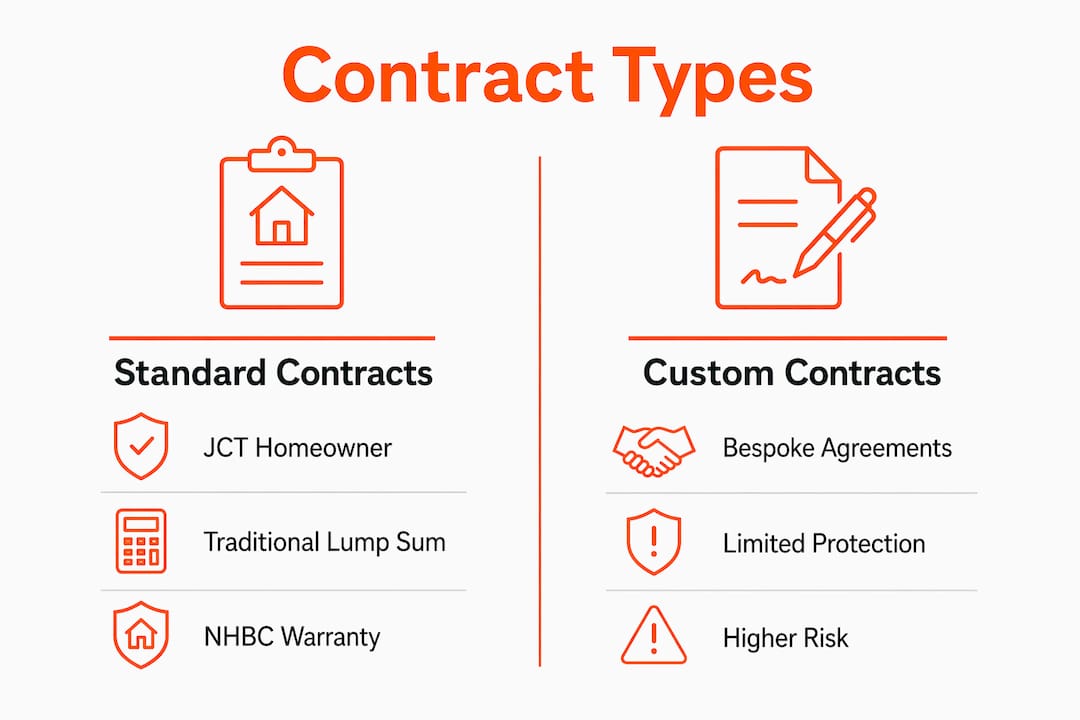
| Contract type | Best suited to | Key feature |
|---|---|---|
| JCT Homeowner Contract | Extensions, renovations under ~£150,000 | Plain English, widely recognised, costs approximately £30 |
| FMB Member Builder contract | Smaller domestic works | Free to FMB members, straightforward terms |
| Bespoke builder’s contract | Any size, contractor-drafted | Higher risk; always have a solicitor review |
| Lump sum (traditional) | Projects with full design complete | Fixed price, homeowner retains design control |
| Design and Build | Fast-track projects | Contractor takes on design risk, speeds delivery |
The JCT Homeowner Contract is the most widely recognised domestic contract in the UK. It is written in plain English, covers the essential clauses, and is available directly from the Joint Contracts Tribunal. For smaller jobs, Federation of Master Builders (FMB) members may provide free contract templates as part of their membership.
Bespoke contracts drafted by builders carry the highest risk for homeowners. They often exclude retention clauses, limit liability, and contain payment terms that favour the contractor. If a builder insists on their own contract, have a solicitor review it before signing.
Traditional lump sum contracts require a complete design before work starts, which gives you cost certainty but demands more preparation upfront. Design and Build contracts shift design responsibility to the contractor, which can speed up the project but reduces your direct control over specification decisions.
How should payment stages be structured to protect homeowners?
Payment structure is where most homeowners lose money. The principle is simple: pay for work completed, not work promised.
A well-structured payment schedule for a typical extension or renovation follows these stages:
- Deposit. Pay no more than 10–25% upfront, and only to cover materials already ordered. Never pay a large deposit before work begins on site.
- Foundations complete. A further payment once groundworks are verified and signed off.
- Structure complete. Payment when the walls are up and the roof structure is in place.
- Roof watertight. A key milestone confirming the building is weatherproof.
- First fix complete. Electrics, plumbing, and joinery first fix inspected and approved.
- Second fix and decoration complete. Payment on practical completion.
- Retention release. The final 2.5% held back for 6–12 months, released after the snagging process is complete and defects are rectified.
Milestone-based payments protect homeowners far better than calendar-based payments. A contractor paid on the first of every month has no financial incentive to hit weekly targets.
The HGCRA 1996 requires contracts to specify clear payment notice procedures. Missing a Pay Less Notice legally obligates you to pay the full invoice, even if you dispute the amount. Understand this clause before you sign.
Pro Tip: Pay your deposit by credit card where possible. Deposits paid by credit card trigger Section 75 of the Consumer Credit Act 1974, giving you financial protection if the builder fails to deliver.
What risks and disputes arise in residential construction contracts?
Scope creep is the most common cause of disputes in the home construction industry. It happens when small verbal agreements accumulate into significant extra costs, with no written record to establish who agreed to what and at what price.
The most frequent problem areas in residential building contracts include:
- Undocumented variations. A contractor adds work without a written change order, then invoices for it at completion. Always insist on a signed variation order before any additional work begins.
- Defective work. The defects liability period, typically 6–12 months, gives you the right to call the contractor back to fix issues at no extra cost. Document every defect in writing.
- Payment disputes. A written payment notice referencing the contract is the first step when a contractor disputes a payment. Verbal conversations do not create a legal record.
- Delays. Without a longstop date and delay provisions in the contract, you have limited recourse when a project runs months over schedule.
“A well-drafted contract does not prevent disputes. It makes them far easier and cheaper to resolve when they arise. The contract is your evidence, your procedure, and your remedy all in one document.”
When a dispute cannot be resolved through direct negotiation, mediation is the next step. It is faster and cheaper than litigation and preserves the working relationship. Adjudication under HGCRA 1996 is available for most construction contracts and produces a binding decision within 28 days. Litigation is a last resort and rarely cost-effective for domestic projects under £50,000.
Practical contract management during the build matters as much as the document itself. Keep a written record of every site visit, photograph progress at each milestone, and confirm any verbal instructions by email the same day. BRCKS supports this process with automated site diary tools that capture daily progress, communications, and variation records in one place.
Key takeaways
A signed, plain-English residential construction contract covering scope, milestone payments, retention, and dispute resolution is the single most effective protection a homeowner or developer can have.
| Point | Details |
|---|---|
| Written contract is non-negotiable | Use a contract for any project over £1,000; the JCT Homeowner Contract is the standard choice. |
| Scope of work must be precise | Define inclusions and exclusions in detail to prevent scope creep and costly disputes. |
| Pay on milestones, not dates | Link every payment to verified on-site progress, not calendar dates. |
| Retention protects your final payment | Hold back 2.5% for 6–12 months and release only after snagging is complete. |
| Know your HGCRA rights | Understand Pay Less Notice rules; missing one can force full payment of a disputed invoice. |
Why plain-English contracts are the ones that actually get used
Most homeowners I speak with have either signed a contract they did not fully read, or started a project with nothing more than a quote and a handshake. Both are avoidable mistakes, and both are far more common than they should be.
The legal industry has done domestic clients a disservice by making contracts feel intimidating. A 40-page document full of defined terms and cross-references does not protect a homeowner better than a clear, four-page agreement written in plain English. What matters is that the document is signed, specific, and understood by both parties. Plain-English building contracts are not a compromise on legal protection. They are more likely to be read, followed, and enforced.
My strongest advice is this: insist on milestone payments, hold your retention, and never allow a variation to proceed without a signed change order. These three habits alone will prevent the majority of disputes I see homeowners face. Reserve a solicitor’s review for projects over £100,000 or where the contractor insists on a bespoke contract with unusual terms. For a standard extension or renovation using the JCT Homeowner Contract, a careful read and a few targeted questions to your architect or project manager are sufficient.
The deposit-by-credit-card tip is one most homeowners have never heard, yet it costs nothing and provides meaningful protection under Section 75. Use it every time.
— James
How BRCKS helps you manage contracts and milestones in one place
Managing a building project means tracking milestone payments, variation orders, snagging lists, and daily site communications at the same time. Most homeowners and developers do this across a mix of emails, WhatsApp threads, and spreadsheets, which means things get missed.

BRCKS brings all of that into one place. The platform captures site communications in real time, generates automated site diaries, and maintains a structured variation log so every change order is documented and dated. For homeowners managing milestone payments, BRCKS gives you a clear view of what has been completed, what has been approved, and what is still outstanding. Explore how BRCKS for builders supports contract and project management from first fix to final snagging, and try it free for 14 days.
FAQ
What is a residential construction contract?
A residential construction contract is a legally binding agreement between a homeowner or developer and a contractor that sets out the scope of work, price, payment terms, and responsibilities for a domestic building project.
Which contract is best for a UK home extension?
The JCT Homeowner Contract is the most widely recognised option for UK domestic projects. It costs approximately £30, is written in plain English, and covers the key clauses needed for extensions and renovations.
What is a retention clause in a building contract?
A retention clause allows the homeowner to withhold a percentage of the contract value, typically 2.5%, for 6–12 months after completion. The sum is released once the contractor has rectified any defects identified during the snagging period.
What happens if I miss a Pay Less Notice?
Under the HGCRA 1996, failing to issue a valid Pay Less Notice before the deadline legally obligates you to pay the contractor’s full invoice, even if you dispute the amount. Always check the payment notice deadlines in your contract.
Do I need a solicitor to draft a building contract?
For standard domestic projects using the JCT Homeowner Contract or an FMB template, a solicitor is not required. Reserve legal review for projects over £100,000 or where the contractor insists on a bespoke contract with unusual terms.
Recommended
- Construction Client Communication Guide for UK Projects
- BRCKS | Construction Project Communication Software
- Construction Project Leads UK: Guide to Winning More Work
- Best Construction Apps UK: 2026 Guide for Builders
How BRCKS Can Help
Navigating the complexities of UK residential contracts is far simpler when your project documentation and communication are unified in one place. BRCKS streamlines this process by ensuring that every variation, payment milestone, and site update is tracked against your contractual obligations in real time. By reducing administrative friction, our platform helps you mitigate risk and maintain clear transparency with your clients from start to finish. We invite you to discover how BRCKS can transform your project management by exploring our features today. Learn more at BRCKS and explore our full feature set.