Residential construction management: a UK guide for 2026
A comprehensive guide for UK SME developers on navigating planning delays, RICS regulatory standards, and disciplined project oversight in 2026.
By James Shorter ·
Residential construction management: a UK guide for 2026

TL;DR:
- Residential construction management involves coordinating planning, scheduling, budgeting, and site oversight for UK housing projects.
- Early-stage site requirements, cashflow discipline, and compliance with 2026 RICS standards are crucial for project success.
Residential construction management is the structured coordination of planning, scheduling, budgeting, and site oversight for UK housing projects. It is the discipline that separates projects delivered on time and within budget from those that haemorrhage money in delays and disputes. For SME developers and construction professionals in 2026, the stakes are higher than ever. Supply chain credit demands, cashflow stress, and updated RICS regulatory standards have made disciplined project oversight not a luxury but a requirement. This guide covers the core stages, financial realities, site prerequisites, and compliance frameworks that define effective home building project management in the UK today.
What are the key stages in residential construction management?
Residential construction management follows a defined sequence of phases. Skipping or compressing any phase creates compounding problems downstream.

1. Pre-construction and due diligence
Pre-construction is where projects are won or lost before a single brick is laid. This phase covers site acquisition checks, planning application preparation, legal due diligence, and utility assessments. SMEs commonly experience delays of 1.5 to 2 years between planning consent and breaking ground, with Section 106 legal fees reaching up to £20,000. Those delays translate directly into holding costs that erode project viability before construction even begins.
2. Planning approvals and pre-commencement conditions
Planning consent rarely arrives without conditions attached. Pre-commencement conditions, such as archaeological surveys, drainage strategies, and ecology reports, must be discharged before work starts. Treating these as administrative formalities rather than critical path items is a common and costly mistake. Each unresolved condition can halt groundworks and trigger penalty clauses in contractor agreements.
3. Construction phase coordination
The construction phase demands active scheduling, resource allocation, and quality control running in parallel. Inspection and Test Plans (ITPs) are the standard tool for quality assurance during this phase. ITPs with hold points ensure work is signed off phase by phase, rather than relying on a final snagging sweep to catch defects. That approach prevents the expensive rework that end-stage snagging alone cannot avoid.
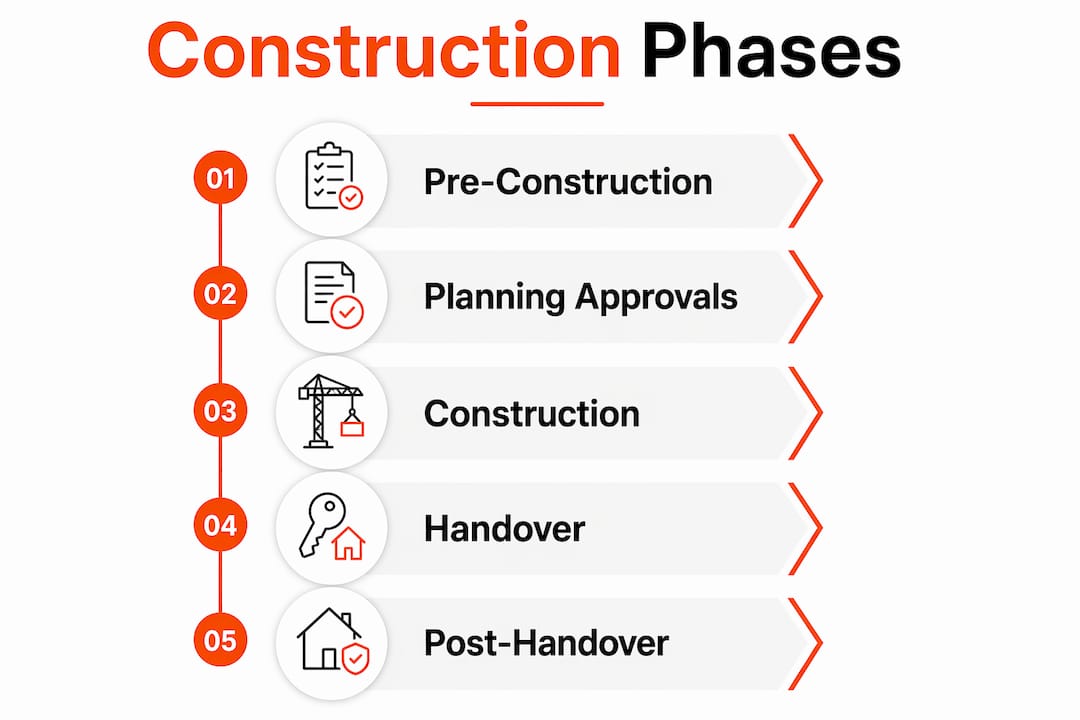
4. Handover and snagging
Handover is a formal process, not a casual walkthrough. A structured snag list captures outstanding defects and incomplete items before the client takes possession. Building Control inspections require scheduling buffers of 1–2 days at key construction stages, so these must be built into the programme from the outset.
Pro Tip: Build your ITP hold points and Building Control inspection buffers into the master programme at the start of the project. Retrofitting them later creates scheduling conflicts that cascade across the entire build.
How do supply chain and cashflow challenges affect UK residential projects?
Cashflow is the single biggest operational threat to SME housebuilders in 2026. The financial pressure is structural, not incidental.
- Specialist contractors provide 60–78 days credit to developers as standard practice. That means developers are effectively borrowing from their supply chain for two months on every order.
- 41% of companies report frequent cashflow issues as of March 2026. Nearly half the industry is operating under financial stress at any given time.
- Extended credit periods create a domino effect. When a developer’s cashflow tightens, specialist subcontractors absorb the impact first, which then affects their ability to procure materials and retain skilled labour.
The most effective mitigation is contract discipline combined with active communication. Managing subcontractors with clear payment schedules, retention terms, and early warning mechanisms reduces the risk of disputes escalating into project stoppages.
Proactive contract negotiation throughout the project lifecycle is more effective than one-off legal clearance at the start. Developers who treat legal and commercial management as ongoing disciplines rather than upfront formalities consistently outperform those who do not.
Pro Tip: Maintain a rolling four-week cashflow forecast updated every Friday. Share it with your quantity surveyor and main contractor. Early visibility of a shortfall gives you options; discovering it at payment deadline gives you none.
Construction payment processing solutions designed for high-value jobs can also reduce the friction and cost of managing large contractor payments, particularly where multiple subcontractors are involved.
Why are early-stage site requirements critical to project delivery?
Early-stage site requirements are the most underestimated category of risk in residential project oversight. They are not administrative tasks. They are critical path items that determine whether a project breaks ground on schedule or sits idle for months.
Utility upgrades and connections
Electric utility upgrades are a prime example of a task that looks minor on paper but carries serious consequences when delayed. Failure to manage utility upgrades early results in unexpected costs of £2,500 and delays of at minimum three weeks per occurrence. On a multi-plot scheme, that figure multiplies quickly. Gas, water, and telecoms connections carry similar lead times and must be commissioned well ahead of the stage at which they are needed on site.
Highways approvals and Section 278 agreements
Highways approvals are another category that developers consistently underestimate. Schemes acquired in 2021 have in some cases only broken ground in 2026 due to utilities and highways delays. A Section 278 agreement with the local highway authority can take six to twelve months to execute. Starting that process at planning stage rather than after consent is granted saves months of holding costs.
Integrating site requirements into the programme
| Requirement | Typical lead time | Risk if delayed |
|---|---|---|
| Electric utility upgrade | 8–16 weeks | £2,500+ cost, 3+ week delay |
| Highways Section 278 agreement | 24–52 weeks | Ground-breaking postponed |
| Building Control inspection buffer | 1–2 days per stage | Programme slippage, sign-off gaps |
| Pre-commencement condition discharge | 4–12 weeks | Planning breach, contractor standstill |
Pro Tip: Commission a utility and highways audit at the point of site acquisition, not after planning consent. The findings should inform your programme and your purchase price.
Effective site monitoring and preparation from the earliest stage of a project is the most reliable way to prevent utility and approval delays from becoming programme-critical events.
What are the 2026 RICS standards shaping residential project compliance?
Regulatory compliance in UK residential construction is not static. The 2026 RICS updates introduce specific requirements that affect how developers and project managers approach fire safety, cladding documentation, and professional competence.
Fire safety and EWS1 documentation
The November 2026 RICS standard requires a proportionate, risk-based approach to fire safety and cladding documentation. EWS1 forms are only mandated where the risk profile of a building justifies them. The guidance focuses on multi-storey, multi-occupancyresidential buildings and is designed to reduce unnecessary delays in secured lending. That is a meaningful shift from blanket requirements that previously caused widespread mortgage market disruption.
Developers working on higher-risk residential schemes should review their fire safety compliance processes against the updated RICS standard. The golden thread of documentation, from design through construction to occupation, is now an explicit expectation rather than a best practice recommendation.
Professional competence requirements
- RICS requires firms to accept only instructions they are competent to deliver, with competence defined against current UK standards.
- Ongoing professional development is not optional. Firms must demonstrate that their teams are current with evolving regulations.
- Project managers who have not updated their knowledge of the Building Safety Act 2022 and subsequent RICS guidance are operating at regulatory risk.
- The competence requirement applies to the firm as a whole, not just the named project manager. Sub-standard practice by any team member creates liability for the organisation.
The practical implication is clear. Residential construction task management in 2026 requires teams who are actively trained, not just experienced. Experience from five years ago does not satisfy the current RICS competence standard.
Key takeaways
Effective residential construction management requires integrating early-stage site requirements, cashflow discipline, quality control through ITPs, and current RICS compliance into a single, proactive project framework.
| Point | Details |
|---|---|
| Start site requirements at acquisition | Utility and highways audits must begin at purchase stage, not after planning consent. |
| Build ITP hold points into the programme | Phase-by-phase sign-off prevents costly rework that end-stage snagging cannot catch. |
| Treat cashflow as a live risk | With 41% of firms reporting frequent cashflow issues, a rolling four-week forecast is non-negotiable. |
| Apply 2026 RICS standards proportionately | EWS1 and fire safety documentation must follow a risk-based approach, not blanket application. |
| Maintain professional competence actively | RICS requires firms to accept only work they are currently competent to deliver under 2026 standards. |
What I have learned from watching UK residential projects fail
The projects I have seen go wrong share a common pattern. They did not fail because of bad luck or unusual circumstances. They failed because risks that were visible at the start were treated as someone else’s problem to solve later.
Utility approvals are the clearest example. Every experienced developer knows they take time. Yet the instinct to defer them until after planning consent is almost universal. The logic is understandable: why spend money on utility applications before you know the scheme is approved? The answer is that the cost of deferral, in holding charges, contractor standstill, and lost sales revenue, dwarfs the cost of parallel-tracking the applications.
The same pattern applies to cashflow. Integrated lifecycle risk management consistently outperforms reactive problem-solving. Developers who build contingency into their cashflow models from day one absorb shocks that destroy projects managed on optimistic assumptions.
Quality control is the third area where I see consistent underinvestment. ITPs are sometimes treated as a compliance formality rather than a genuine management tool. When hold points are bypassed to keep pace with programme pressure, the defects that result cost far more to fix than the time saved. The snagging list at handover is not a quality management system. It is the evidence that quality management failed earlier in the process.
Technology has changed what is possible in residential project oversight. Automated site diaries, real-time communication logs, and structured variation tracking remove the administrative drag that previously consumed hours of a project manager’s day. That time is better spent on the proactive risk management that actually determines project outcomes.
— James
How BRCKS supports residential construction management in the UK
Managing a residential project in the UK means coordinating dozens of moving parts across planning, procurement, construction, and handover. Communication failures and lost documentation are among the most common causes of delay and cost overrun.

BRCKS addresses this directly. Its WhatsApp integration captures site communications in real-time, automatically generating site diary records without manual input. RFI tracking, variation logs, and client portals keep every stakeholder informed without disrupting the site team’s workflow. BRCKS reports saving users over two hours of manual effort daily. For UK builders managing multiple plots or phases, that efficiency compounds across the life of a project. Explore BRCKS for builders and start a 14-day free trial.
FAQ
What is residential construction management?
Residential construction management is the structured coordination of planning, scheduling, budgeting, and site oversight for housing projects. It covers every phase from pre-construction due diligence through to handover and snagging.
How long does it take from planning consent to breaking ground in the UK?
SMEs commonly experience delays of 1.5 to 2 years between planning consent and breaking ground, driven by pre-commencement conditions, utilities approvals, and Section 106 agreements.
What are Inspection and Test Plans in residential construction?
Inspection and Test Plans (ITPs) are quality control documents that define hold points during construction phases. They require work to be signed off stage by stage, preventing defects from being carried forward and reducing costly rework at handover.
When is an EWS1 form required under 2026 RICS standards?
Under the November 2026 RICS standard, EWS1 forms are only required where a proportionate, risk-based assessment of a multi-storey, multi-occupancy residential building justifies them. They are not mandated as a blanket requirement.
How can SME developers manage cashflow pressure from subcontractors?
The most effective approach combines clear payment schedules in contracts, a rolling four-week cashflow forecast, and proactive communication with specialist subcontractors. With 41% of firms reporting frequent cashflow issues, early visibility of shortfalls is the only reliable way to avoid payment disputes.
Recommended
- Construction Client Communication Guide for UK Projects
- UK Construction Project Coordination Best Practices 2026 | BRCKS
- Best Construction Apps UK: 2026 Guide for Builders
- BRCKS | Construction Project Communication Software
How BRCKS Can Help
Navigating the evolving landscape of UK residential construction in 2026 requires a proactive approach to digital integration and project oversight. BRCKS simplifies this transition by providing a unified platform designed to streamline workflows, manage costs, and ensure compliance with the latest industry standards. By centralising your project data, our software empowers your team to deliver high-quality homes with greater efficiency and fewer delays. We invite you to explore how BRCKS can transform your management processes and help your business thrive in the years ahead. Learn more at BRCKS and explore our full feature set.