Site meeting best practices for UK construction teams
Discover essential site meeting best practices to enhance communication, boost project efficiency, and ensure timely completion in UK construction.
By James Shorter ·
Site meeting best practices for UK construction teams
TL;DR:
- Effective site meetings depend on thorough preparation, disciplined facilitation, and diligent follow-up to prevent delays. Utilising structured agendas, clear action ownership, and timely minutes fosters accountability and project progress. Digital tools like BRCKS streamline communication, tracking, and escalation processes, ensuring site teams operate efficiently.
Site meeting best practices are the systematic methods of organising and conducting construction site meetings to maximise communication efficiency, decision clarity, and project progress. For UK construction professionals, following these methods is not optional. Only 8.5% of projects finish on time and budget, and poor action item follow-up is a key contributing factor. The difference between a productive site meeting and a wasted hour comes down to preparation, structure, and accountability. This guide covers every stage, from agenda distribution to minute circulation, with practical strategies you can apply immediately.
What are the best practices for site meeting preparation?
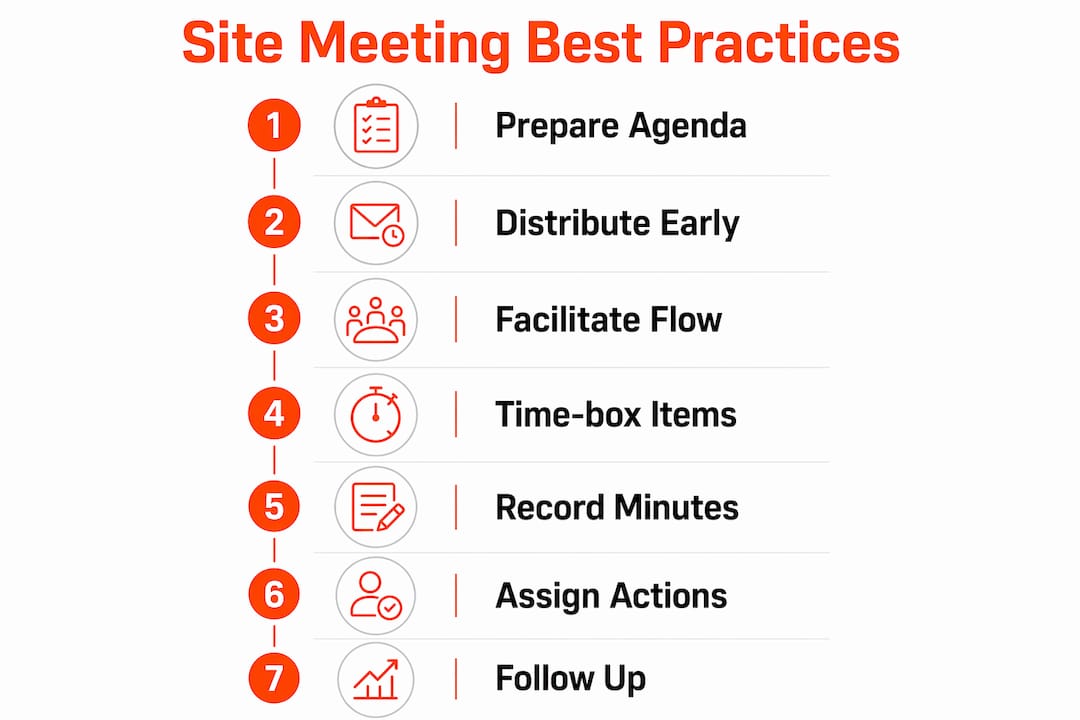
Preparation is where effective site meetings are won or lost. A meeting that starts without a distributed agenda is already behind. Numbered agendas must be issued at least 48 hours in advance to give attendees time to review documents, gather data, and arrive ready to make decisions rather than simply report status.
The agenda itself should be numbered, time-boxed, and accompanied by relevant supporting documents. Attaching drawings, RFI logs, or subcontractor updates to the agenda means attendees arrive informed. Without those attachments, the first twenty minutes of your meeting become a document-sharing exercise.
Confirming the attendee list is equally critical. Verify that all key attendees hold decision-making authority before the meeting begins. When a contractor’s representative arrives without authority to approve variations or confirm programme changes, every decision gets deferred to a follow-up call. That deferral costs time and erodes trust between parties.
Here is a pre-meeting preparation checklist for site managers and project managers:
- Issue a numbered, time-boxed agenda at least 48 hours before the meeting
- Attach all relevant documents: drawings, RFI logs, variation schedules, and progress reports
- Confirm each attendee’s name, role, and decision-making authority in writing
- Book the meeting room or set up the remote video link at least 24 hours in advance
- Request pre-meeting updates from subcontractors on outstanding actions
- Review the previous meeting’s minutes and flag any unresolved items
Pro Tip: If you are using WhatsApp groups to coordinate pre-meeting updates, you are creating an unstructured record that is difficult to audit. A dedicated site communication workflow captures those updates in a traceable format.
Photo documentation is another underused preparation tool. Taking 50–100 photos per site visit with timestamps and GPS metadata counters memory decay and gives you accurate, defensible records when disputes arise. This is standard practice on well-run sites and should be built into your pre-meeting routine.
How should you structure and facilitate a site meeting?
The structure of a site meeting determines whether it produces decisions or just discussion. The meeting facilitator’s role is defined clearly: act as organiser and timekeeper, not as a technical participant. Facilitators enforcing timeboxing and agenda adherence improve meeting outcomes consistently. When the facilitator gets drawn into technical debate, agenda discipline collapses.
A well-run site meeting follows this sequence:
- Open with attendance and apologies. Record who is present, who sent apologies, and confirm each attendee’s authority to make decisions.
- Review and agree the agenda. Confirm the order of items and time allocations. Adjust only if all parties agree.
- Review outstanding actions from the previous meeting. This takes priority over new business. Unresolved actions must be addressed before new items are introduced.
- Work through agenda items in order. Each item gets its allocated time. The facilitator calls time and moves on.
- Use a parking lot for off-topic issues. Physically write and visibly track off-topic items for follow-up. This keeps the current meeting on schedule without dismissing legitimate concerns.
- Confirm all new action items. Each action needs a named owner and a concrete deadline before the item closes.
- Agree the date, time, and location of the next meeting. Do this before anyone leaves the room.
- Close on time. Ending late signals that preparation was inadequate and disrespects attendees’ schedules.
Successful project managers prioritise controlling meeting flow rather than contributing to every technical discussion. This is a discipline that takes practice, particularly on complex projects where the site manager is also the most technically knowledgeable person in the room.
Pro Tip: Set a visible timer for each agenda item. When attendees can see time running down, discussions become more focused. A simple phone timer on the table works as well as any dedicated app.
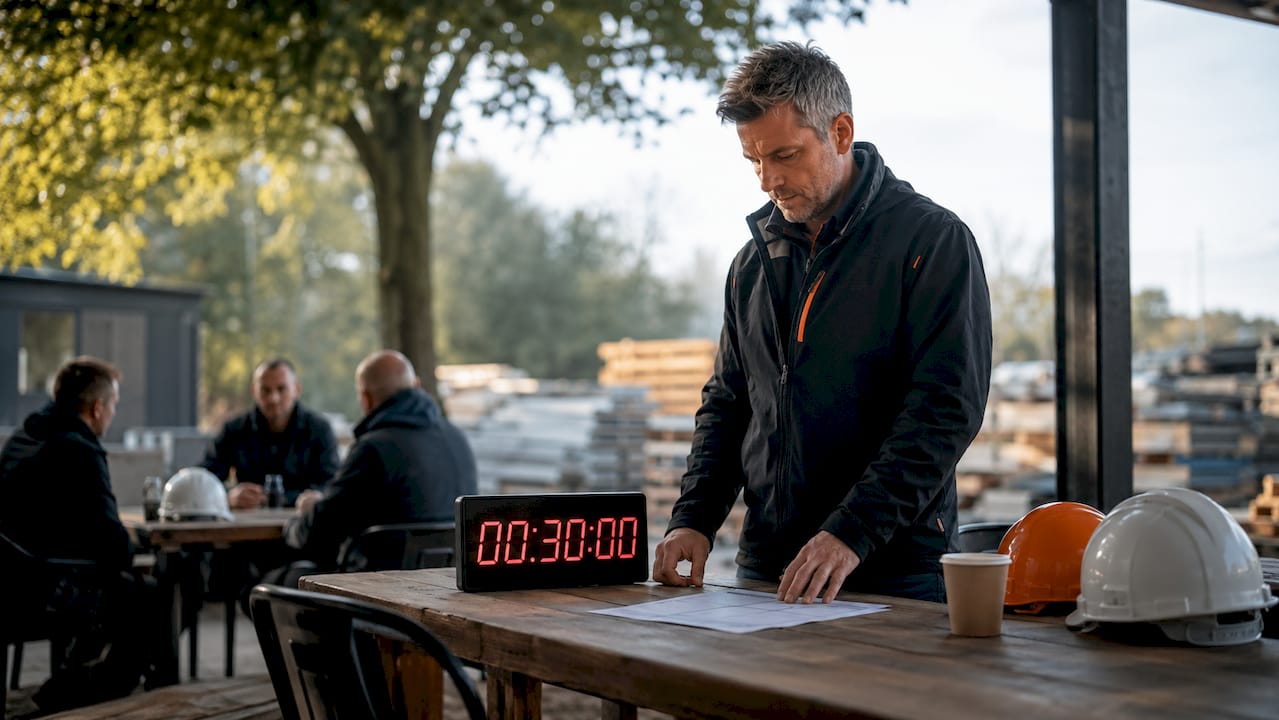
Time-boxing is not about cutting off important conversations. It is about surfacing them early enough to schedule proper resolution. If a structural issue needs forty-five minutes of discussion, that conversation belongs on the next agenda as a standalone item, not squeezed into a ten-minute slot.
What are best practices for meeting minutes and action items?
Minutes are legal and operational records. They are not a courtesy. Minutes must be circulated within 24 hours of the meeting, with a 48-hour comment window for attendees to raise corrections. After that window closes, the record becomes final. This process protects all parties in the event of a dispute.
The most common failure in site meeting management is not the meeting itself. It is what happens afterwards. Action items without named owners and concrete deadlines are aspirations, not commitments. Every action item must have a named owner and a concrete deadline, reviewed at the start of each subsequent meeting.
Here is how to structure your action item process:
- Assign every action to a single named individual, not a company or a team
- Set a specific deadline date, not “ASAP” or “before next meeting”
- Record the action in the minutes with the owner’s name and deadline clearly visible
- Review all outstanding actions at the start of the next meeting, before new business
- Use digital construction task tracking to send automated reminders to action owners
The escalation process matters as much as the initial assignment. Unresolved actions are the most reliable predictor of trouble on a project. When an action is missed once, note it. When it is missed twice, escalate within the meeting. When it is missed a third time, escalate to senior management. This process must be written into your meeting protocol, not left to the facilitator’s discretion.
| Stage | Action Required |
|---|---|
| First missed deadline | Record in minutes, reset deadline, confirm owner |
| Second missed deadline | Raise formally in meeting, note escalation risk |
| Third missed deadline | Escalate to senior management in writing |
| Persistent non-performance | Formal contract notice or programme review |
Poor documentation is one of the most common documentation mistakes causing site delays. Accurate, timely minutes close that gap.
How do you encourage genuine team engagement during site meetings?
Engagement is the difference between a meeting that generates real information and one that generates polite agreement. The standard closing question, “Any other business?”, produces almost nothing useful. Replacing it with scenario-based questions produces significantly better results.
Asking questions like “What would you do if…” or “Has anyone seen this go wrong before?” draws out practical site experience that generic questions never surface. This technique is particularly effective in toolbox talks and safety briefings, where crew members often stay silent unless directly prompted with a realistic scenario.
Practical techniques for improving engagement include:
- Rotate who presents each agenda item, rather than having the site manager present everything
- Invite subcontractor foremen to report directly on their own progress and risks
- Ask for specific examples from the previous week, not general status updates
- Keep formal site meetings to 60 minutes or less; use shorter toolbox talks for daily briefings
- Use digital collaboration tools to share drawings or photos in real time during the meeting
Pro Tip: Before your next meeting, replace one generic agenda item with a specific scenario question based on something that actually happened on site that week. The quality of discussion will be noticeably different.
Replacing generic closing questions with scenario-based queries significantly increases crew engagement and meaningful discussion. This is not a soft skill. It is a technique with a direct impact on safety awareness and risk identification.
Keeping meetings concise also drives engagement. A 90-minute meeting that could have been 50 minutes trains attendees to disengage. When people know your meetings end on time and cover only what matters, attendance and preparation both improve. You can learn more about meeting management for UK contractors to build this discipline across your project team.
What common mistakes undermine site meetings?
Most site meeting failures are predictable and preventable. Recognising the patterns early lets you correct them before they become project risks.
The most frequent mistakes on UK construction sites include:
- Late or missing agendas. Issuing an agenda on the morning of the meeting gives attendees no preparation time. Decisions get deferred and meetings become status updates.
- Wrong attendees in the room. Including people without decision-making authority wastes everyone’s time and delays resolution of key issues.
- Action items without owners. An action assigned to “the team” belongs to no one. It will not be completed.
- No timeboxing. One agenda item consuming the entire meeting is the most common cause of overruns. Without allocated times, the most vocal person in the room controls the agenda.
- Delayed minutes. Minutes circulated three days after a meeting are already partially obsolete. The 24-hour rule exists for a reason.
- No escalation process. Ignoring repeated non-performance on action items signals that accountability is optional. That signal spreads quickly across a project team.
Digital tools address several of these issues directly. Automated reminders to action owners, timestamped minute distribution, and structured agenda templates remove the administrative burden from the facilitator. BRCKS captures site communications in real time, reducing the risk that decisions made in meetings get lost in WhatsApp threads before they reach the minutes. Improving on-site communication is one of the fastest ways to improve meeting outcomes.
Key takeaways
Effective site meetings require structured preparation, disciplined facilitation, and rigorous follow-up on action items to prevent delays and miscommunication on UK construction projects.
| Point | Details |
|---|---|
| Distribute agendas early | Issue numbered, time-boxed agendas at least 48 hours before every meeting. |
| Verify decision-making authority | Confirm all attendees can make decisions before the meeting starts. |
| Circulate minutes within 24 hours | Allow a 48-hour comment window, then treat the record as final. |
| Assign named owners to every action | Each action item needs one person responsible and a specific deadline date. |
| Escalate persistent non-performance | Follow a written escalation process when action items are repeatedly missed. |
The discipline that separates good sites from struggling ones
After years of working with construction teams across the UK, the pattern is consistent. The sites that run well are not the ones with the most sophisticated software or the largest project management teams. They are the ones where the site manager treats the meeting as a formal process, not a chat.
The hardest part of running effective site meetings is not the preparation or the minutes. It is the moment when you have to tell a subcontractor foreman, in front of the group, that their action item is overdue for the second time. Most site managers avoid that conversation. The ones who do not avoid it build teams that take deadlines seriously.
Technology helps, but only if the discipline is already there. I have seen teams adopt digital action tracking tools and still miss every deadline because no one enforced the escalation process. BRCKS works well precisely because it removes the administrative friction, but the accountability still has to come from the people running the meeting.
The other thing I would push back on is the idea that longer meetings are more thorough. They are not. A 45-minute meeting with a tight agenda and prepared attendees produces better decisions than a 90-minute meeting where half the room is checking their phones. Brevity is a sign of preparation, not laziness.
If you want to see where your meetings are failing, record the time between when an action item is assigned and when it is completed. That number tells you more about your project’s health than any programme update.
— James
How BRCKS helps you run tighter site meetings
Running structured site meetings takes discipline. It also takes the right tools to handle the documentation without adding hours to your week.

BRCKS is built for UK construction teams who need to capture decisions, track action items, and distribute minutes without the administrative overhead. Its WhatsApp integration means updates from site are captured automatically, so your site diary app stays current without manual data entry. Agenda distribution, RFI tracking, and variation logs are all handled in one place. BRCKS saves users over two hours of manual effort daily. If your current process relies on email chains and WhatsApp threads to manage meeting follow-up, try BRCKS for builders free for 14 days and see the difference a structured system makes.
FAQ
What is the 48-hour rule for site meeting agendas?
The 48-hour rule requires that numbered agendas are distributed to all attendees at least 48 hours before the meeting. This gives participants time to prepare, gather relevant data, and arrive ready to make decisions rather than simply report status.
How quickly should site meeting minutes be circulated?
Minutes must be circulated within 24 hours of the meeting. Attendees then have a 48-hour comment window to raise corrections, after which the record becomes final and legally binding.
Who should facilitate a site meeting?
The facilitator should act as organiser and timekeeper, not as a technical participant. Their role is to enforce agenda discipline, manage time allocations, and maintain focus, not to contribute to every technical discussion.
What is a parking lot in a site meeting?
A parking lot is a visible list of off-topic issues raised during a meeting that are deferred for later discussion. Writing these items down and tracking them prevents derailment while acknowledging that the concern is legitimate.
How do you handle repeated missed action items?
Follow a written escalation process: note the first missed deadline in the minutes, raise the second miss formally in the meeting, and escalate the third miss to senior management in writing. Unresolved actions are the most reliable predictor of project trouble.
Recommended
- Site Communication Workflow: UK Project Manager’s Guide | BRCKS
- Top Construction Reporting Tools for UK Sites Compared | BRCKS
- UK Construction Project Coordination Best Practices 2026 | BRCKS
- Reduce Project Miscommunication on Site | BRCKS UK
How BRCKS Can Help
Effective site meetings are the backbone of any successful build, but their true value lies in how well you action the decisions made on the ground. By centralising your project data and communication, BRCKS ensures that meeting minutes and site updates are never lost in an email chain or a disorganised folder. Our platform streamlines the administrative burden, allowing your team to focus on quality delivery rather than chasing paperwork. We invite you to see how BRCKS can transform your project management by booking a demo or exploring our features today. Learn more at BRCKS and explore our full feature set.