Smart scheduling tips to boost UK subcontractor efficiency
Discover field-tested strategies for UK subcontractors to sharpen scheduling, ensure CDM compliance, and protect profit margins through better sequencing.
By James Shorter ·
Smart scheduling tips to boost UK subcontractor efficiency

TL;DR:
- Effective subcontractor scheduling relies on early planning, clear communication, and thorough documentation.
- Sequencing tasks with real-time data and confirming deliveries improve site efficiency and protect margins.
- Maintaining detailed records and timely updates safeguard against delays and support claims under UK contracts.
Missed handovers, last-minute programme changes, and project managers who assume you already know about a two-week delay. If any of this sounds familiar, you are not alone. Scheduling misalignment between subcontractors and principal contractors is one of the most persistent problems on UK construction sites, and it costs everyone time and money. This article walks you through practical, field-tested strategies to sharpen your scheduling approach, protect your position under UK contracts, and communicate more effectively with project managers from the moment you arrive on site.
Table of Contents
- Understand project requirements and health and safety duties
- Sequence tasks and resources for maximum efficiency
- Communicate roles and updates clearly from day one
- Monitor progress and document delays for claims protection
- Why most scheduling advice falls short, our take
- Take your scheduling to the next level with smart tools
- Frequently asked questions
Key Takeaways
| Point | Details |
|---|---|
| Clarify project requirements | Understanding site-specific compliance and RAMS is the foundation for smart scheduling. |
| Optimise sequencing | Strategic task and resource sequencing can double productivity on UK projects. |
| Prioritise clear roles | Define responsibilities early and communicate updates clearly to prevent delays. |
| Document for claims | Record daily progress and issues to support extension of time or dispute claims. |
| Use digital tools | Leverage technology for real-time scheduling and more reliable site coordination. |
Understand project requirements and health and safety duties
Once you recognise the baseline challenge, the first step is to clarify everyone’s requirements and compliance duties before a single task is scheduled.
Project requirements go well beyond a start date and a drawing pack. As a subcontractor, you need a clear picture of the scope of works, the construction phase programme, material lead times, and any specific sequencing constraints imposed by other trades. Alongside these, you must account for your legal duties under the Construction (Design and Management) Regulations 2015, commonly known as CDM 2015. Under HSE/CDM regulations, principal contractors are responsible for producing a construction phase plan that sets out health and safety arrangements and site rules, while subcontractors are required to submit Risk Assessments and Method Statements, often called RAMS, before work begins on site. This is not optional paperwork. It is a legal prerequisite that directly affects your scheduling.
Getting your RAMS submitted late is one of the most avoidable causes of programme delays. When your method statements are not approved in time, the principal contractor cannot formally authorise you to begin. That means idle workers and wasted mobilisation costs.
Here is what you should do before mobilising:
- Request the latest revision of the construction phase plan and confirm which activities your trade interfaces with
- Submit your RAMS as early as possible, ideally two weeks before your planned start date, to allow time for review and revisions
- Clarify with the project manager exactly which bar bending schedules or specialist shop drawings must be approved before your work proceeds
- Identify any supplier-specific method statements that need to be incorporated, such as those covering proprietary fixing systems or specialist plant
- Attend pre-start meetings and record any verbal instructions in writing
“Failing to plan is planning to fail. For subcontractors, that failure almost always shows up first in the programme, and last in your profit margin.”
Good preparation at this stage means your schedule reflects what can actually be delivered, rather than what everyone hopes will happen. Strong early communication with the project manager also signals professionalism, which matters enormously when disputes arise later. For a broader look at how these relationships work, the guide on managing subcontractors UK projects offers useful context on expectations from both sides.
Sequence tasks and resources for maximum efficiency
With project and compliance tasks in focus, the next critical move is scheduling tasks and allocating resources for peak efficiency.

Sequencing, in practical terms, means ordering your tasks and deploying your crew, plant, and materials in a way that minimises waiting time and maximises productive output. Poor sequencing is expensive. Workers standing idle because materials have not arrived, or plant sitting unused because the preceding trade has not finished, are direct hits to your margin.
The difference good sequencing makes is not theoretical. On the Timber Square project delivered by Mace, the team achieved a productivity rate of 0.53 square metres per worker hour, more than double the London average, by using data-driven task sequencing and crane telemetry. The crane operated at 65% utilisation with peak usage of 20 hours per day, despite 23 wind-affected days on site. That level of performance does not happen by accident. It is the result of detailed planning, real-time data, and the willingness to adapt when conditions change.
For most subcontractors, that level of digital infrastructure may not be available, but the underlying principles translate directly to your daily scheduling. Consider this framework when sequencing your work:
- Map your critical path. Identify which tasks must be completed before others can begin and prioritise those absolutely. Everything else is secondary.
- Match crew size to task duration. Overstaffing early tasks creates bottlenecks downstream. Understaffing them means you fall behind immediately.
- Confirm material deliveries before scheduling installation. Never schedule a task without a confirmed delivery slot for the materials it requires.
- Communicate plant availability clearly. Whether you are hiring a cherry picker or relying on a tower crane shared with other trades, confirm booking windows in writing.
The table below gives a simple comparison of sequencing approaches and their typical outcomes:
| Approach | Typical outcome | Risk level |
|---|---|---|
| Ad hoc, reactive scheduling | Frequent delays, rework | High |
| Static programme, no updates | Drift from reality over time | Medium |
| Weekly review with site data | Improved alignment | Medium-Low |
| Digital tools with real-time tracking | Maximum productivity | Low |
Technology is increasingly accessible for subcontractors of all sizes. Scheduling apps that integrate with site communications mean your team always works from the latest programme. For a practical look at how to structure your workflows, the workflow management guide covers proven approaches for UK construction teams. You can also find specific coordination advice in the project coordination best practices article, which is worth reading alongside this one.
Pro Tip: If you have access to plant telemetry data through your hire company or principal contractor, use it. Equipment utilisation data tells you exactly when plant is available, sitting idle, or being over-demanded, and that information is gold when you are trying to tighten a programme. Even basic GPS tracking on hired plant can reveal scheduling inefficiencies you would otherwise miss. Robotics and automation are also beginning to influence how sequencing decisions are made, and you can read more about robotics in construction if you want to understand where the industry is heading.
Communicate roles and updates clearly from day one
However, even the best plan fails without clear communication, and this is where many subcontractors lose ground they have worked hard to gain.
Communication failures on construction sites are rarely about people not talking. They are about the wrong people talking at the wrong time, with no documented record of what was agreed. Integrating yourself into the project’s communication structure from day one is not just courteous. It directly protects your programme and your commercial position.
Early integration of subcontractors in the planning process leads to more realistic timelines and fewer disputes. Using a RACI matrix, which stands for Responsible, Accountable, Consulted, and Informed, is a practical way to assign communication roles and avoid the all-too-common “I thought you were handling that” scenario on site.
A RACI matrix does not need to be complex. For a subcontractor, it might simply clarify who receives daily progress updates, who must sign off variations, who is consulted on programme changes, and who is simply kept informed. Setting this up in week one prevents enormous amounts of confusion later.
Here is a recommended approach to communication from the moment you mobilise:
- Agree a weekly update schedule with the project manager and confirm the format, whether that is a written report, a progress photo pack, or a shared digital log.
- Document every instruction that deviates from the original programme. A brief written record sent by email or through a shared platform is sufficient. The key is that it exists and is timestamped.
- Flag delays immediately, even if you are not sure of the commercial implications. Telling the project manager about a problem on Tuesday is always better than reporting it on Friday when the programme has already shifted.
- Confirm verbal agreements in writing within 24 hours. Construction sites are noisy, busy places, and memories differ. A short follow-up message, “Just to confirm what we discussed this morning regarding the revised ceiling installation sequence,” is professional and protective.
- Use a shared platform where all parties can see the same information in real time. Fragmented communication across phone calls, texts, and emails is how critical updates get missed.
Pro Tip: Automated notifications through a project management platform eliminate the risk of someone not receiving an update because it was sent to an old email address or a phone that was switched off. Set up automated alerts for programme changes, approval requests, and overdue tasks as a baseline. It saves more project hours than you might expect.
For more detail on how real-time communication strategies transform site performance, the article on real-time update strategies is directly relevant.
Monitor progress and document delays for claims protection
Finally, smart scheduling includes keeping your position protected, and that means maintaining thorough records throughout the project, not just when somehing goes wrong.
Subcontractors in the UK frequently find themselves in delay situations that are outside their control, whether caused by late information from the design team, supply chain disruptions, or slow clearance by the principal contractor. Understanding how these delays affect your entitlements is essential.
Under UK standard forms of contract such as JCT and NEC, concurrent delays are a particularly important concept. A concurrent delay occurs when both a contractor-caused delay and an employer-caused delay occur at the same time. The general position under UK contracts is that concurrent delays entitle the subcontractor to a time extension but not to additional costs. This distinction matters enormously. It means you can protect your programme and avoid liquidated damages, but recovering prolongation costs requires clear evidence that the delay was caused by others, without any concurrent subcontractor fault.
Here is what effective monitoring and documentation looks like in practice:
- Maintain a daily site diary for every working day. Record weather conditions, resources on site, activities completed, and any issues encountered. This is your primary evidence in any dispute.
- Update your critical path method, or CPM, programme weekly. A programme that has not been updated in three weeks is not useful in a claims context. Project managers and adjudicators expect to see contemporaneous records.
- Record all variations with a written request before you carry out the additional work, wherever possible. After-the-fact variation claims are far harder to prove.
- Photograph and video document site conditions that affect your progress. Water ingress, access restrictions, and preceding trade delays can all be captured visually and timestamped.
“Your daily log is your insurance policy. Write it as if a judge will read it, because one day, one might.”
The comparison below shows the difference between weak and strong documentation approaches:
| Documentation approach | Claims outcome | Time to resolve |
|---|---|---|
| No contemporaneous records | Weak position, likely loss | 12 to 24 months |
| Informal notes and emails only | Partial recovery possible | 6 to 18 months |
| Daily logs and CPM updates | Strong position | 3 to 9 months |
| Full digital audit trail with timestamps | Very strong, often settled early | Under 6 months |
For practical guidance on site-level tracking tools, the site monitoring guide is worth reviewing before your next project begins.
Why most scheduling advice falls short, our take
Stepping back, let us challenge what most scheduling guides get wrong about the UK context.
The vast majority of scheduling advice written for subcontractors reads like it was written for a project manager sitting in an office with three screens and a dedicated planner. It references sophisticated software, assumes access to full programme data, and overlooks the reality that most subcontractors are managing three jobs at once from a van or a site cabin.
Theoretical strategies also break down when the site does not behave the way the programme says it should. Rigid digital tools that cannot accommodate last-minute access changes or sudden material substitutions create more frustration than they solve. What works in practice is a lightweight, flexible system that your team will actually use consistently. A tool that no one updates is worse than a paper diary that someone fills in every evening.
The other gap we see repeatedly is the assumption that communication improves just because a platform exists. It does not. Culture and habit matter as much as technology. The subcontractors who genuinely improve their scheduling and manage their subcontractor relationships well are those who combine the right tools with clear expectations, brief daily check-ins, and a genuine commitment to documenting what happens rather than what was planned.
Choose tools that speak site language, keep your records simple enough to maintain under pressure, and remember that protecting your programme is ultimately about protecting your business.
Take your scheduling to the next level with smart tools
For those ready to put these tips into action, here is how to gain a real advantage on your next project.
Knowing what to do is one thing. Having the right tools to do it consistently across every project is where the results compound. BRCKS is built specifically for construction teams, which means it works for subcontractors and builders, not just head office. With features including real-time project updates, automated notifications, file sharing, team chat, and daily log functionality, all in one place, you can stop managing information across scattered texts and emails.
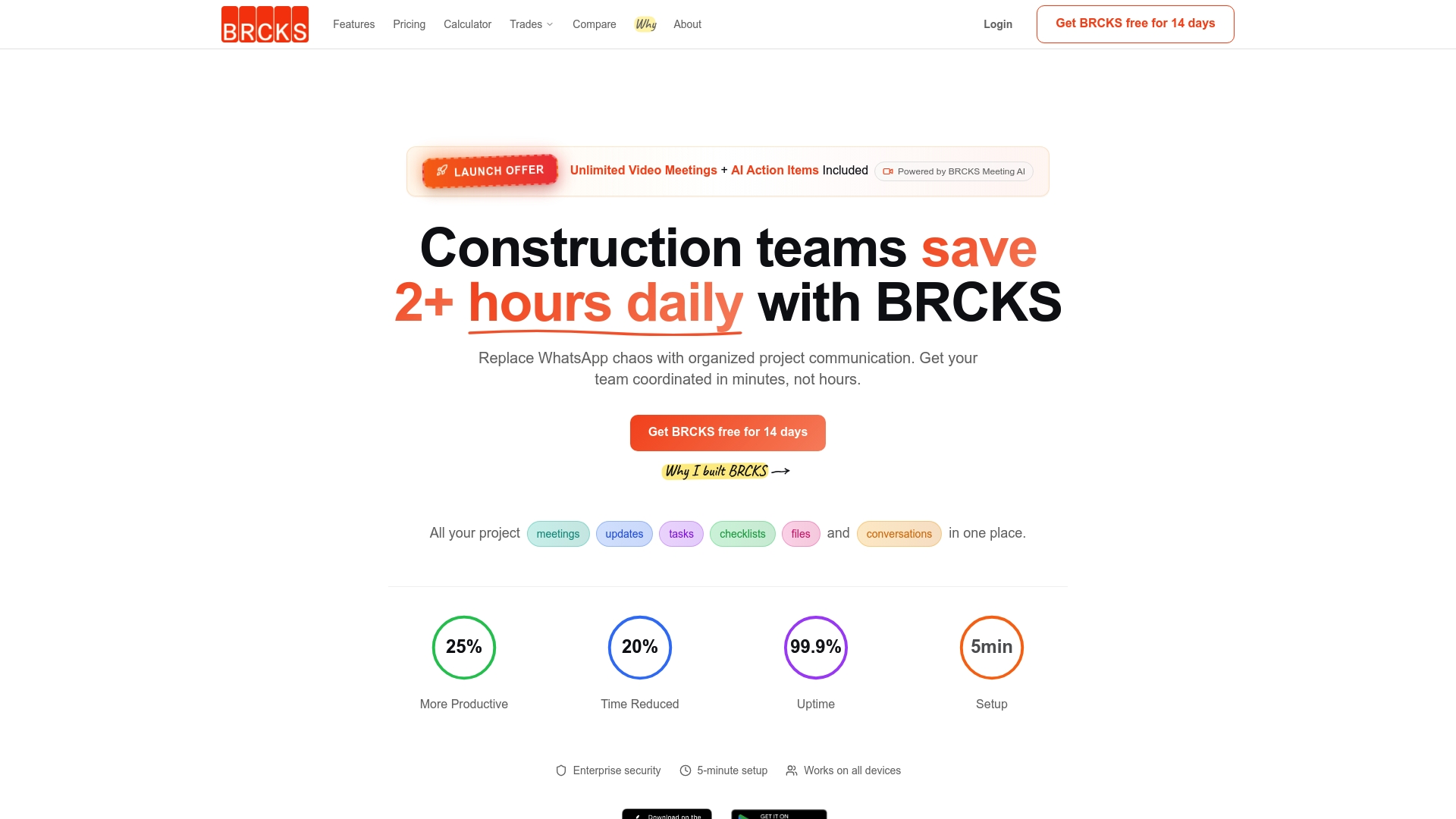
Whether you are a sole trader coordinating with one project manager or a growing subcontracting firm working across multiple sites, BRCKS scales to fit. Explore how construction software for builders can simplify your day-to-day, or see how construction communication software specifically addresses the scheduling and communication challenges covered in this article. Free subcontractor access means there is no barrier to getting started today.
Frequently asked questions
What is the most common reason for scheduling delays in UK construction?
The most common cause is misalignment between contractors and subcontractors due to unclear roles and communication gaps. Early subcontractor integration and using a RACI matrix for communication responsibilities significantly reduces this problem.
How do concurrent delays affect subcontractor claims for extensions of time?
Concurrent delays may entitle subcontractors to a time extension but typically do not justify additional cost recovery under UK standard contract forms such as JCT or NEC.
What tools can help subcontractors improve scheduling accuracy?
Digital scheduling platforms, project communication software, and daily progress update tools are highly effective for improving accuracy. Platforms that combine these functions into a single interface reduce the risk of updates being missed.
Why are RAMS and method statements required before site work begins?
Under HSE/CDM regulations, subcontractors must submit Risk Assessments and Method Statements before commencing work as part of the health and safety planning process required by the principal contractor.
What evidence should be kept for defending against scheduling disputes?
Daily site diaries, updated CPM programmes, timestamped photographs, and written records of communications are all essential. Contemporaneous records kept throughout the project provide the strongest basis for resolving claims efficiently.
Recommended
- Top Construction Schedule Software for UK Builders 2025 | BRCKS
- BRCKS | Construction Project Communication Software
- UK Construction Project Coordination Best Practices 2026 | BRCKS
- Why 68% of UK Residential Construction Projects Go Over Budget (And How to Stop It) | BRCKS
How BRCKS Can Help
Implementing these smart scheduling strategies can significantly reduce downtime and ensure your projects stay on track across the UK’s demanding construction landscape. BRCKS simplifies this process by centralising your site data and providing real-time visibility into every subcontractor’s progress, removing the guesswork from complex timelines. By integrating our intuitive platform into your daily workflow, you can eliminate communication bottlenecks and focus on delivering high-quality results. We invite you to see how BRCKS can transform your operational efficiency by booking a demo or exploring our features today. Learn more at BRCKS and explore our full feature set.