Step by step site meeting process: UK guide 2026
A structured site meeting process is essential for coordinating subcontractors and maintaining programme compliance on UK construction projects.
By James Shorter ·
Step by step site meeting process: UK guide 2026
TL;DR:
- A step-by-step site meeting process ensures clear communication, effective decision-making, and accountability throughout UK construction projects. Proper preparation, disciplined execution, and prompt follow-up are essential for productive meetings and maintaining project progress. Utilising roles, agendas, and technology streamlines communication, saves time, and reduces common challenges like overruns and miscommunication.
A step by step site meeting process is a structured method that guides project managers and site supervisors through organising, conducting, and concluding site meetings to ensure clear communication and timely decision-making. In UK construction, site meetings are formally known as progress meetings or project review meetings, and they serve as the primary mechanism for coordinating subcontractors, resolving issues, and maintaining programme compliance. Bodies such as the RIBA and the Construction Leadership Council recognise structured meeting practice as a core project management discipline. This guide gives you a practical, stepwise walkthrough of every phase, from preparation through to follow-up, grounded in 2026 best practices.
What does a step by step site meeting process involve?
A structured site meeting process covers three distinct phases: preparation, execution, and follow-up. Each phase carries equal weight. Skipping preparation produces unfocused meetings. Skipping follow-up means decisions evaporate before the next site visit.
The process applies to all common meeting types in UK construction, including pre-start meetings, weekly progress meetings, design coordination meetings, and subcontractor reviews. Each type shares the same underlying structure, even if the agenda content differs. Understanding that structure is what separates a productive one-hour meeting from a two-hour session that resolves nothing.
Good site communication workflow starts before anyone enters the room. The meeting itself is where decisions get confirmed, not where problems get discovered for the first time.
How do you prepare for an effective site meeting?
Preparation is where real productivity happens. Pre-meeting work — collecting updates and preparing documentation from subcontractors well before the meeting — saves valuable time and focuses discussion on problem-solving rather than information gathering.
Follow this preparation checklist before every site meeting:
- Define the meeting purpose. Know whether you are reviewing programme progress, resolving a specific issue, or coordinating upcoming works. A vague purpose produces a vague agenda.
- Invite only relevant participants. Every person in the room costs time. Invite attendees based on agenda items, not habit.
- Distribute the agenda 24–48 hours in advance. Best practice agenda distribution gives participants time to prepare, reducing the time spent on updates during the meeting itself.
- Require written updates from subcontractors. Ask subcontractors to submit progress updates 24 hours before the meeting. This frees meeting time for decisions rather than status reports.
- Review previous minutes and open actions. Check which actions from the last meeting are complete, overdue, or blocked. This becomes your first agenda item.
- Prepare visual aids. Updated programmes, drawings, and photographs make discussions faster and more accurate than verbal descriptions alone.
- Confirm the venue or virtual platform. For on-site meetings, check the room is accessible, has adequate seating, and is away from active works. For virtual meetings, test the connection and share the link in advance.
Pro Tip: Use a construction meeting checklist to run through every preparation step before each meeting. A two-minute check prevents a two-hour disaster.
Good site preparation practice applies as much to meetings as it does to groundworks. The principle is the same: set the conditions for success before work begins.
How to conduct the site meeting step by step
Running the meeting well requires discipline, not just a good agenda. The following steps give you a reliable structure for every progress meeting.
- Start on time. Beginning late rewards late arrivals and punishes punctual ones. Set a firm start time and stick to it, even if key attendees are missing.
- Take attendance. Record who is present, who sent apologies, and who is absent without notice. This matters for accountability and for the evidential value of the minutes.
- Appoint a facilitator and a separate note-taker. Separating these roles avoids bias and allows the facilitator to manage discussion and engagement without losing track of the conversation. Combining both roles compromises accuracy and flow.
- Open with a review of previous actions. Confirm which actions are complete, which are in progress, and which are overdue. Do not re-debate completed items.
- Work through the agenda in order. Allocate a time slot to each item and enforce it. A meeting capped at 60 minutes produces better focus and attendance than an open-ended session.
- Record decisions in real time. The note-taker logs each decision as it is made, including the action owner and the deadline. Do not rely on memory after the meeting.
- Park complex or off-topic issues. Allowing one agenda item to consume the entire meeting is the most common mistake in site meetings. Use a visible “parking lot” list to capture issues that need a separate discussion, then move on.
- Assign clear ownership to every action. Every action item needs a named owner and a specific deadline. Vague assignments produce zero accountability.
- Confirm decisions before closing each agenda item. Ask the room to confirm the decision and the action before moving to the next item. This prevents disputes later.
- Close the meeting on time. Summarise the key decisions, confirm the date of the next meeting, and thank attendees for their time.
Pro Tip: Summarise and confirm decisions aloud as you go. A 10-second verbal confirmation at the end of each agenda item prevents a 30-minute argument at the next meeting.
Managing difficult attendees is part of the facilitator’s role. Redirect dominant speakers by name, invite quieter participants directly, and use the parking lot to neutralise tangential debates without dismissing them entirely.
What should site meeting minutes include?
Minutes are the legal and operational record of every site meeting. They carry evidential weight in disputes and form part of the project’s audit trail under UK construction contract law.
Effective minutes focus on decisions and actions, not verbatim debate. Accurate minutes include the decision made, the rationale where relevant, the action owner, and the due date. They do not transcribe every comment made around the table.
Use this structure for every set of minutes:
- Header: Project name, meeting type, date, location, attendees, and apologies.
- Numbered agenda items: Each item gets its own numbered section, matching the agenda.
- Decision record: State the decision clearly in one sentence.
- Action record: Name the owner, state the task, and give the deadline.
- Matters arising: Any new issues raised that were not on the agenda, with a note on how they will be handled.
- Next meeting: Date, time, and location confirmed.
Issue minutes within 24 hours of the meeting. Prompt distribution maintains utility and engagement. Minutes issued a week later are rarely read and carry less weight if challenged.
Technology speeds this process considerably. BRCKS automates site diary entries and captures communications in real time, reducing the time spent drafting minutes manually. A site diary app that integrates with your meeting workflow means less admin and fewer gaps in the record.
Pro Tip: Keep minutes to one page where possible. If attendees know the document is short, they will read it. Long minutes get filed and forgotten.
How do you follow up after a site meeting?
Follow-up is the phase most project managers underinvest in. Without it, the meeting produces decisions that nobody acts on.
Send a concise summary email within two hours of the meeting closing. This reinforces the decisions made and gives attendees a prompt reminder before the formal minutes arrive. The summary does not replace the minutes. It supplements them.
Effective post-meeting follow-up includes:
- Maintaining a live action tracker. Keep a running log of all open actions, visible to relevant stakeholders. Update it as actions are completed or escalated.
- Mid-cycle check-ins. Regular follow-up between meetings, via calls or messages, reduces the risk of unresolved issues impacting the programme. Do not wait until the next meeting to discover an action is overdue.
- Escalation paths for non-compliance. Define what happens when an action is repeatedly missed. Escalation to the project manager, contract administrator, or client should be documented and consistent.
- Scheduling follow-up meetings for parked items. Issues placed in the parking lot during the meeting need a resolution path. Book a separate session within the same week where possible.
Good task tracking practice embeds follow-up into the daily site workflow rather than treating it as a separate administrative task.
What are the most common site meeting challenges?
Poor meeting culture is a project risk, not just an inconvenience. The most frequent problems have straightforward solutions.
- Meetings overrunning. The cause is almost always a poorly controlled agenda. Assign time slots and enforce them. The facilitator’s job is to manage time, not just content.
- Repetitive discussions without progress. This signals missing action ownership. Clear ownership and deadlines on every action item prevent the same issue appearing at three consecutive meetings.
- Low attendance or persistent late arrivals. Set the expectation at project start that attendance is mandatory for named participants. Record absences in the minutes. Patterns of non-attendance become a contract management issue.
- Slow or absent minutes. Assign the note-taking role before the meeting, not during it. Set a KPI of 24-hour distribution and measure it.
- Subcontractors arriving unprepared. Require written progress updates 24 hours before the meeting. Unprepared subcontractors waste everyone’s time and signal a wider communication problem.
Pro Tip: Use the parking lot technique consistently and visibly. Write parked items on a whiteboard or shared screen so attendees can see they have been captured. This prevents the same person raising the same issue repeatedly.
Reducing project miscommunication on site starts with meeting discipline. A well-run meeting is the single most effective communication tool available to a site supervisor.
Key takeaways
A structured site meeting process, covering preparation, execution, and follow-up, is the most reliable method for maintaining project communication and accountability in UK construction.
| Point | Details |
|---|---|
| Prepare before you meet | Distribute the agenda 24–48 hours in advance and require written subcontractor updates beforehand. |
| Separate facilitator and note-taker | Assigning distinct roles improves accuracy and keeps discussion on track throughout the meeting. |
| Cap meetings at 60 minutes | Time-limited meetings produce better focus and higher attendance than open-ended sessions. |
| Issue minutes within 24 hours | Prompt distribution maintains the evidential value of minutes and keeps actions visible. |
| Follow up between meetings | Mid-cycle check-ins and a live action tracker prevent overdue tasks from compounding into programme delays. |
What I have learned from years of site meetings
The meetings that go wrong are almost never the ones with difficult attendees or complex agendas. They are the ones where nobody prepared properly. When I see a meeting overrun by 45 minutes, the root cause is almost always an agenda that was written the morning of the meeting, or not written at all.
Separating the facilitator and note-taker roles changed how I ran meetings entirely. Before I made that split, I was simultaneously trying to manage the room, keep time, and write down decisions. Something always got missed. Once those roles were distinct, the quality of the minutes improved immediately, and the facilitator could actually focus on the people in the room.
The other shift that made a real difference was confirming decisions aloud before moving to the next agenda item. It sounds obvious, but most meetings skip it. People leave with different interpretations of what was agreed. A 10-second verbal confirmation eliminates that ambiguity entirely.
Short meetings are a sign of a well-run project, not a superficial one. If your weekly progress meeting consistently runs to 90 minutes, the problem is not the meeting. The problem is the preparation, the action tracking, or both. Fix those, and the meeting shrinks naturally.
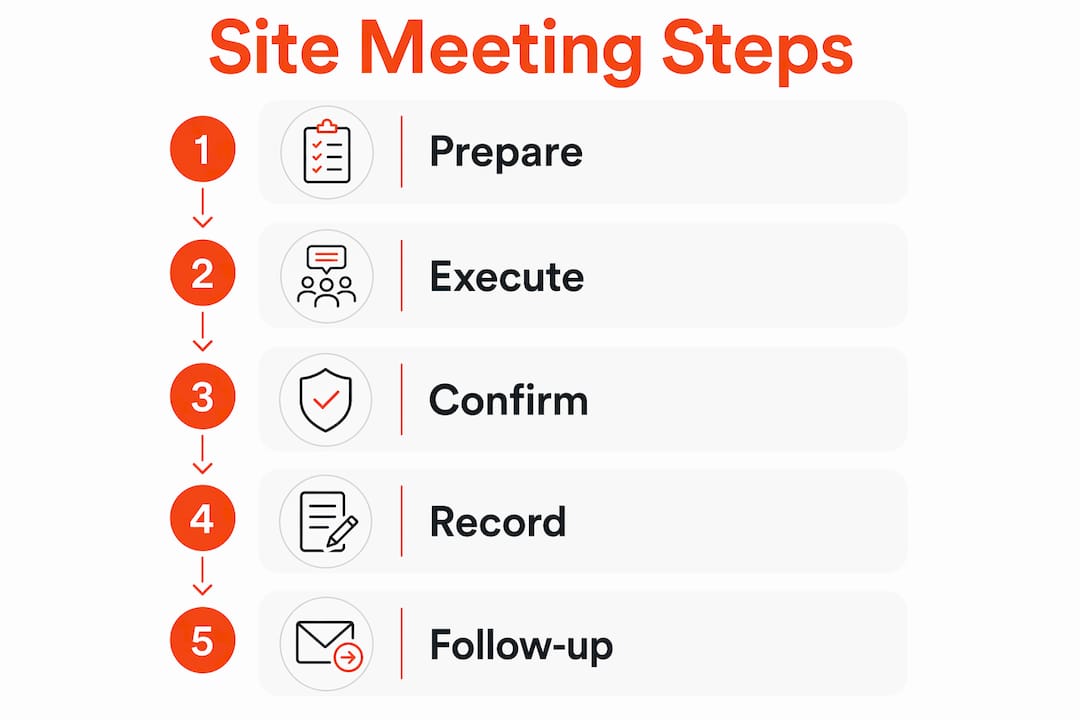
Adapt the process to your project and your team. A two-person refurbishment project does not need the same formality as a multi-trade commercial fit-out. But the core steps, prepare, run, record, follow up, apply to both.
— James
How BRCKS supports your site meeting process
Managing site meetings manually creates real administrative pressure. Agendas get lost in email threads, minutes sit in someone’s drafts folder, and action items disappear into WhatsApp conversations that nobody can search.

BRCKS is built for UK construction teams who need a better way to manage project communication and documentation. Its automated site diary app captures daily records without manual input, while its WhatsApp integration means updates from site reach the right people without creating chaos. For builders managing multiple subcontractors, the BRCKS for builders platform brings agendas, action tracking, and RFI management into one place. Try BRCKS free for 14 days and see how much time your team gets back.
FAQ
What is a site meeting in UK construction?
A site meeting, formally called a progress meeting or project review meeting, is a structured gathering of project stakeholders to review programme status, resolve issues, and assign actions. It is a core project management tool under UK construction practice.
How often should site meetings be held?
Weekly progress meetings are standard on most active UK construction projects. The frequency increases during critical programme phases and decreases during lower-activity periods, but a regular cadence is always preferable to ad hoc sessions.
What should a site meeting agenda include?
A site meeting agenda should include a review of previous actions, programme progress updates, health and safety matters, design or procurement issues, and any other business. Best practice is to distribute the agenda 24–48 hours before the meeting.
How quickly should site meeting minutes be issued?
Minutes should be issued within 24 hours of the meeting. Prompt distribution maintains their utility and evidential value, and keeps action owners accountable before momentum is lost.
Who should attend a site meeting?
Attendance should be limited to participants with a direct stake in the agenda items. Inviting everyone on the project list wastes time and reduces focus. Named representatives from each active trade, the project manager, and the contract administrator are typically sufficient.
Recommended
- Site Meeting Process 2026: UK Construction Guide
- Site Communication Workflow: UK Project Manager’s Guide | BRCKS
- UK Construction Project Coordination Best Practices 2026 | BRCKS
- Construction Team Onboarding Checklist: 2026 UK Guide
How BRCKS Can Help
Mastering the site meeting process is essential for keeping UK construction projects on track and ensuring all stakeholders remain aligned. By integrating BRCKS into your workflow, you can automate minute-taking and track action items in real time, reducing the administrative burden that often follows a site visit. Our platform ensures that every decision is documented and accessible, allowing your team to focus on delivery rather than paperwork. We invite you to explore how BRCKS can streamline your project management and bring greater efficiency to your next site meeting. Learn more at BRCKS and explore our full feature set.