Team coordination methods for construction projects
Discover how structured team coordination methods, from role clarity to asynchronous updates, can prevent project delays and improve site accountability.
By James Shorter ·
Team coordination methods for construction projects
TL;DR:
- Effective construction team coordination involves clear roles, structured communication, and defined interaction protocols. Implementing measurable goals, asynchronous updates, and documented team APIs improves accountability and reduces delays. Strong culture and deliberate design of interfaces prevent miscommunication and enhance project outcomes.
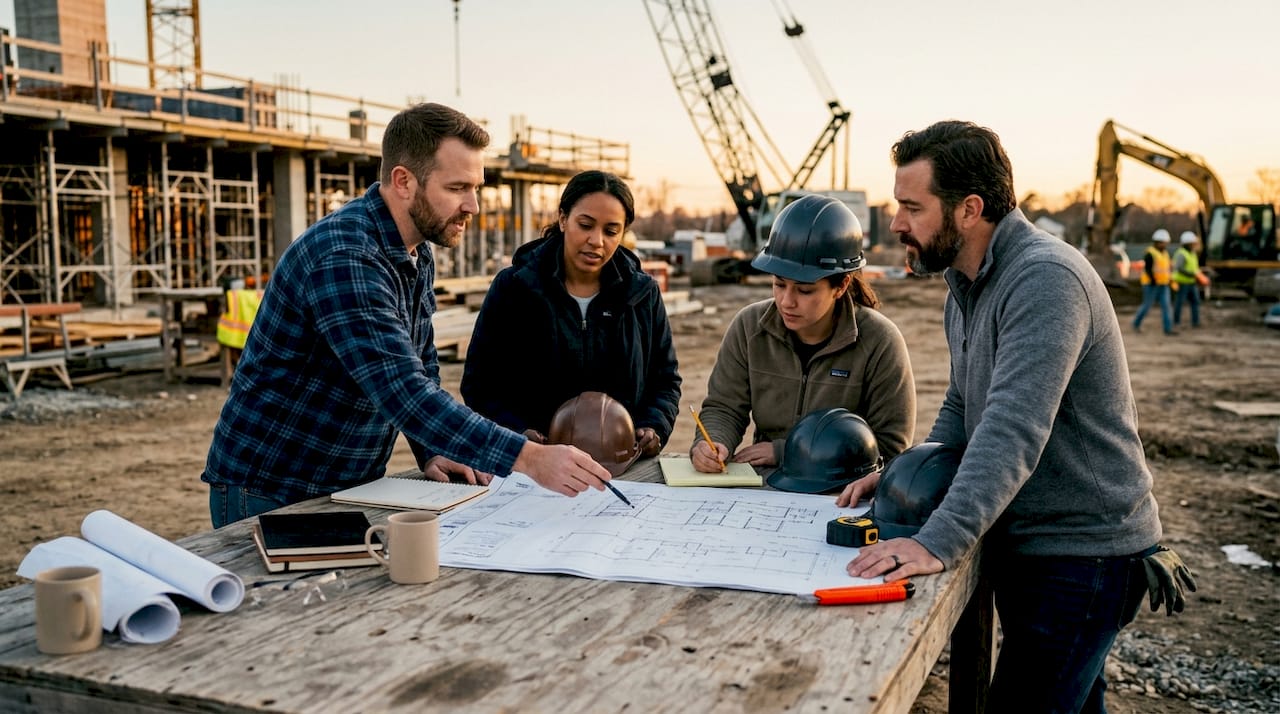
Team coordination methods are deliberate strategies and tools that enable construction project teams to collaborate effectively, align on shared goals, and deliver work on time. Without them, only 23% of teams meet commitments on schedule. That figure reflects a systemic problem in construction: fragmented communication, unclear ownership, and reactive rather than planned collaboration. The industry term for this discipline is team coordination, and it encompasses everything from role definition and communication rhythms to asynchronous updates and structured decision-making. Getting it right is the difference between a project that runs and one that stalls.
What are the essential team coordination methods for construction teams?
The most effective team coordination methods share one characteristic: they make responsibilities and information visible to everyone who needs them. Construction projects fail not because teams lack effort, but because effort is misdirected through unclear roles and poor information flow.
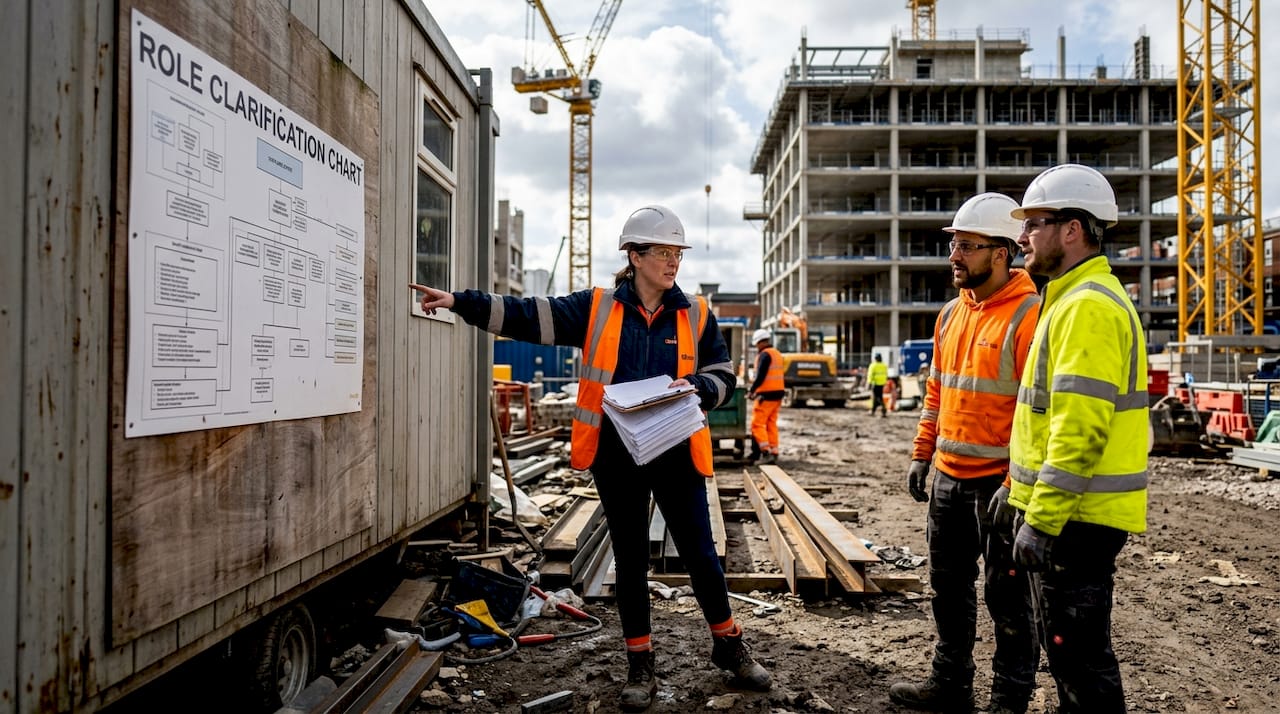
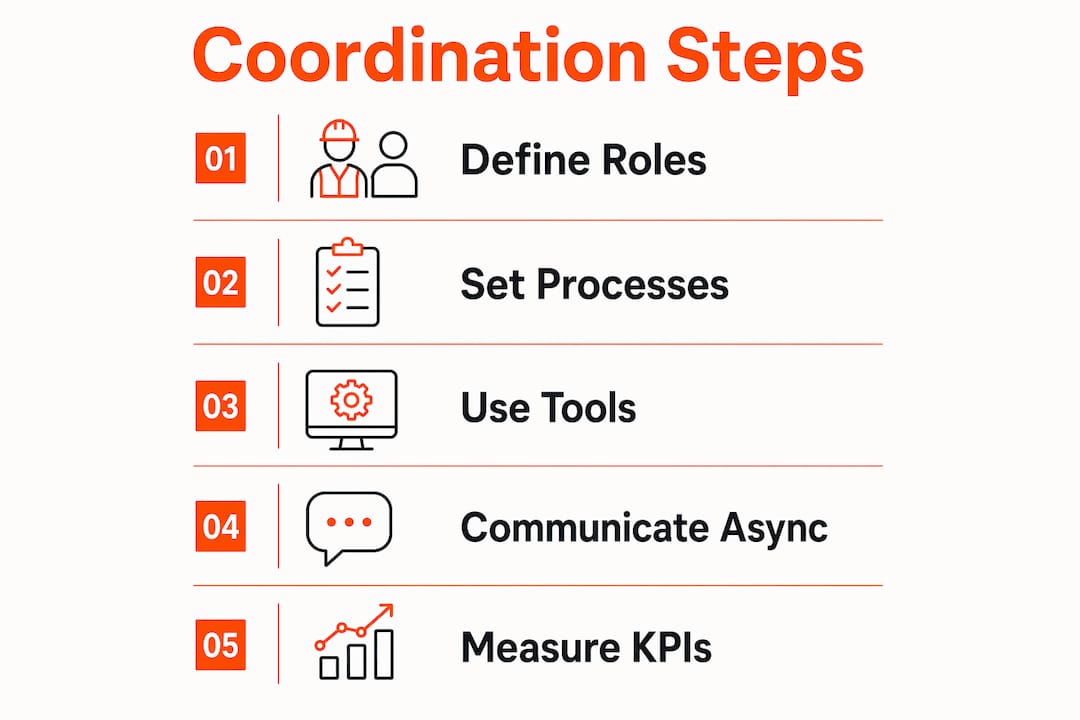
Role clarity is the foundation. Every team member needs a defined function. High-performing construction teams typically assign roles across five behavioural types: Director (drives decisions), Achiever (executes tasks), Stabiliser (maintains consistency), Harmoniser (manages relationships), and Trailblazer (generates new approaches). These are not job titles. They describe how each person contributes to the team’s coordination system. When roles overlap or go undefined, tasks fall through the gaps.
Structured communication processes prevent rework. Clear, documented processes including kickoff meetings, decision logs, and recap notes reduce coordination fatigue and cut rework. A kickoff meeting that produces a written record of scope, ownership, and milestones is worth more than three informal catch-ups. Decision logs are particularly powerful on construction sites, where verbal agreements disappear and disputes follow.
Measurable KPIs align the team around shared outcomes. Linking team goals to specific metrics, such as a 10% output increase in 90 days, gives every team member a concrete target. Vague goals produce vague effort. When a site manager can point to a KPI on a shared dashboard, accountability becomes a daily habit rather than a quarterly review.
Asynchronous updates replace unnecessary meetings. Leading construction organisations are replacing status meetings with continuous async updates. Instead of gathering six people for a 45-minute call to hear what everyone did yesterday, teams post structured updates covering what changed, what is blocked, and what decisions are needed. This model, sometimes called working in public, reduces coordination overhead without sacrificing awareness.
Team APIs define how groups interact. A Team API is a documented agreement between two teams or subcontractors covering responsibilities, request processes, and response times. On a construction project, this might mean a formal protocol between the structural and MEP teams covering how change requests are submitted and when responses are expected. Team APIs eliminate the dependency bottlenecks that cause delays when one trade waits on another without a clear process.
Pro Tip: Create a one-page Team API for each subcontractor relationship at project start. Include who owns what, how requests are made, and the expected response time. Review it at the four-week mark.
What tools and processes support effective coordination on construction projects?
The right tools make coordination methods repeatable. Without supporting processes and software, even well-designed methods degrade under project pressure.
Communication and document control
Construction teams need a single source of truth for project documents, decisions, and updates. Shared dashboards showing live task status replace the need for constant verbal check-ins. Document control systems with version tracking prevent teams from working from outdated drawings. The checklist for effective construction meetings is a practical starting point for teams that want to cut meeting time without losing alignment.
Asynchronous communication platforms
Cloud communication tools built for construction replace the chaos of group chats and email threads. They capture updates in structured formats, tag them to specific tasks or locations, and make them searchable. This matters because managers often mistake communication volume for project state awareness. Communication tools rarely capture real-time project states without governance layers that focus specifically on changes, blockers, and decisions. More messages does not mean better coordination.
Coordination tools by function
| Function | What to look for | Why it matters |
|---|---|---|
| Task ownership | Single named owner per task | Prevents diffusion of responsibility |
| Decision logging | Timestamped, searchable records | Resolves disputes and tracks changes |
| Async updates | Structured format: changed, blocked, decided | Replaces status meetings |
| Document control | Version history and access control | Stops teams working from old drawings |
| Dependency tracking | Visual map of inter-team dependencies | Flags bottlenecks before they cause delays |
Key features to prioritise when evaluating coordination tools:
- Structured update formats that separate status from action items
- Integration with communication channels your team already uses
- Audit trails for decisions and document changes
- Visibility across subcontractor boundaries, not just internal teams
- Mobile access for site-based team members
Pro Tip: Avoid tools that require teams to learn entirely new workflows from day one. Adoption drops sharply when the learning curve is steep. Start with tools that integrate into existing communication habits.
How to implement team coordination methods step by step
Implementation fails when managers treat coordination as a one-off setup task. It requires a structured rollout followed by consistent reinforcement.
-
Set shared, measurable goals. Define project-level KPIs before work begins. Link them to construction KPIs that your team can track weekly, not just at project completion. Every team member should be able to state the top three metrics for their work package.
-
Assign clear ownership. Every task, decision, and deliverable needs a single named owner. Clear ownership with a single accountable decision maker prevents opinion wars and protects project velocity. Committees make plans. Individuals deliver them.
-
Establish communication rhythms. Set a weekly sync for cross-team alignment, a daily async update for individual progress, and a monthly retrospective for process improvement. Write these rhythms into the project plan so they are treated as deliverables, not optional extras.
-
Create Team APIs for each subcontractor relationship. Document who owns what, how requests are submitted, and what the expected response time is. Review these agreements at the four-week mark and update them as the project evolves.
-
Build psychological safety into team culture. Psychological safety is about structured productive disagreement, not avoiding conflict. Teams that can raise problems early fix them cheaply. Teams that suppress concerns fix them expensively, or not at all.
-
Monitor execution and follow up on commitments. Track whether commitments made in meetings are delivered. Use a simple log: commitment, owner, due date, status. Review it at every weekly sync. This single habit closes the gap between planning and delivery.
“Effective collaboration must be deliberate and process-driven rather than simply trying to communicate more.” This distinction separates teams that coordinate well from those that are merely busy.
Pro Tip: Run your first Team API workshop with your two most interdependent subcontractors. The process of writing the agreement surfaces assumptions that would otherwise cause delays mid-project.
What common mistakes arise in coordinating construction teams?
Most coordination failures share a recognisable pattern. Recognising them early is the fastest way to correct course.
-
Confusing communication volume with project awareness. Sending more updates does not mean the team has a clear picture of project state. Effective updates focus on what changed, what is blocked, and what decisions are needed. Everything else is noise.
-
The synchronous dependency trap. When one team cannot proceed without a meeting with another, delays compound. Replacing synchronous dependency meetings with async work breaks this cycle. Teams should be able to make progress between formal touchpoints.
-
Groupthink and dominant voices. In meetings where the most senior person speaks first, quieter team members align with that view rather than contributing their own. The Nominal Group Technique addresses this directly. Team members write down ideas silently before open discussion, which equalises input and surfaces better solutions.
-
Lack of psychological safety. Teams that fear judgement for raising problems hide them until they become crises. Psychological safety fosters productive tension, not conflict avoidance. Managers who respond to bad news with blame destroy the information flow they need to manage the project.
-
Status theatre. Regular meetings that exist to demonstrate activity rather than resolve issues drain time and morale. A 30-minute status meeting with six people costs three hours of productive work. Replace these with async updates and reserve meetings for decisions that genuinely require real-time discussion.
-
No follow-through on commitments. Coordination without accountability is just scheduling. If commitments made in meetings are not tracked and followed up, the coordination system loses credibility and teams stop taking it seriously.
The ways to reduce project miscommunication on site often come down to fixing these six patterns before they become embedded habits.
How do coordination methods improve construction project outcomes?
The benefits of structured coordination are measurable, not theoretical. Teams that implement clear roles, async updates, and accountability systems consistently outperform those that rely on informal communication.
On-time delivery improves when commitments are tracked. The Leadership IQ finding that only 23% of teams deliver on time without rigorous coordination reflects a real gap between intention and execution. Coordination methods close that gap by making commitments visible and follow-through expected.
Rework decreases when decisions are documented. Structured workflows and communication reduce costly errors by ensuring teams work from the same information. Verbal agreements that are not recorded become disputes. Disputes become delays. Delays become cost overruns.
Team engagement rises when roles are clear and contributions are recognised. Teams that understand how their work connects to project KPIs take more ownership. Teams that operate in ambiguity disengage. The project coordination best practices that consistently produce results share this characteristic: they make the connection between individual effort and project outcome explicit.
Decision-making accelerates when ownership is defined. Collaboration that involves everyone in every decision is slow. The most effective model involves the team in generating options and assigns a single owner to make the final call. This balance produces better decisions faster.
Key takeaways
Structured team coordination methods are the single most reliable way to improve on-time delivery, reduce rework, and maintain accountability across construction project teams.
| Point | Details |
|---|---|
| Role clarity drives delivery | Assign defined roles and single task owners before work begins to prevent gaps. |
| Async updates cut meeting waste | Replace status meetings with structured async updates covering changes, blockers, and decisions. |
| Team APIs reduce dependency delays | Document interaction protocols between subcontractors to eliminate bottlenecks. |
| KPIs make goals concrete | Link team targets to measurable metrics so accountability becomes a daily habit. |
| Psychological safety improves information flow | Teams that can raise problems early fix them before they become costly delays. |
What I have learned from coordinating construction teams
Construction coordination is not a technology problem. It is a discipline problem. I have worked with teams that had every tool available and still missed deadlines, because no one had designed how the team would actually communicate and make decisions. The tools were there. The method was not.
The most common mistake I see is treating coordination as something that happens naturally when you put capable people together. It does not. Capable people default to their individual working styles, which creates friction at the boundaries between roles and trades. You have to design the interfaces deliberately.
Psychological safety is the piece most managers underinvest in. They focus on process and tools, which are visible and measurable, and neglect the cultural conditions that determine whether those processes actually work. A team that fears raising problems will not use your async update system honestly. They will post green statuses until the problem is too large to hide.
The Nominal Group Technique is one of the most underused tools in construction meetings. Writing ideas down before discussion takes five minutes and produces noticeably better input from quieter team members. It is not a soft skill exercise. It is a practical method for getting better information into the room.
My honest advice: start with roles and rhythms before you invest in tools. Define who owns what, how updates are shared, and how decisions are made. Then find tools that support those agreements. Doing it the other way around produces expensive shelfware.
— James
How BRCKS supports construction team coordination
Construction teams that have sorted their coordination methods still face one persistent problem: keeping communication captured, structured, and accessible without adding administrative burden.

BRCKS is built specifically for this. It integrates with WhatsApp, the communication channel most UK construction teams already use, and automatically captures updates, decisions, and site records in a structured format. Features including automated site diary entries, RFI tracking, and a variation log mean your coordination records are created as work happens, not reconstructed at the end of the day. BRCKS reports saving teams over two hours of manual effort daily. If your team is ready to put the right structure behind its communication, try BRCKS for builders free for 14 days.
FAQ
What are team coordination methods?
Team coordination methods are structured approaches to aligning roles, communication, and decision-making within a project team. They include tools like Team APIs, async update protocols, KPI tracking, and defined meeting rhythms.
Why do construction teams struggle with coordination?
Construction teams often confuse communication volume with project awareness. Without structured processes for capturing decisions and tracking commitments, information gets lost and accountability breaks down.
How does asynchronous communication improve coordination?
Async updates replace status meetings by requiring team members to post structured updates covering what changed, what is blocked, and what decisions are needed. This reduces meeting time while maintaining team alignment.
What is the Nominal Group Technique?
The Nominal Group Technique is a meeting method where participants write down ideas silently before open discussion. It prevents dominant voices from controlling the conversation and produces more balanced input from all team members.
How do you measure the success of coordination methods?
Track on-time commitment delivery, rework rates, and decision turnaround times. Linking team goals to specific KPIs, such as a 10% output increase over 90 days, gives teams a concrete benchmark for improvement.
Recommended
- UK Construction Project Coordination Best Practices 2026 | BRCKS
- The Ultimate Guide to Construction Time Tracking | BRCKS
- Reduce Project Miscommunication on Site | BRCKS UK
- Checklist for Effective Construction Meetings | BRCKS
How BRCKS Can Help
Effective team coordination is the cornerstone of any successful build, yet managing these complex moving parts requires more than just traditional spreadsheets. BRCKS simplifies this process by centralising communication and providing real-time visibility across every stage of your project. By integrating these collaborative tools into your daily workflow, you can reduce delays and ensure your entire team remains aligned on site and in the office. We invite you to explore how BRCKS can transform your project management and help your business achieve greater operational efficiency. Learn more at BRCKS and explore our full feature set.