Ways to streamline project handovers: 2026 guide
Discover how to eliminate programme overruns and operational issues using structured handoff mapping, staggered knowledge transfer, and formal hypercare periods.
By James Shorter ·
Ways to streamline project handovers: 2026 guide

TL;DR:
- Effective project handovers require structured checklists, staggered knowledge transfer, and formal hypercare periods to minimise delays and operational issues. Starting handover planning early, integrating it into the project schedule, and ensuring clear accountability are essential for successful transitions. Utilising digital tools and conducting operational readiness assessments further enhance documentation accuracy and team preparedness.
A project handover is the formal transfer of responsibility, documentation, and operational knowledge from a delivery team to an operations or client team at the close of a construction phase. Poor handovers are one of the most preventable causes of delay and rework in UK construction, yet most teams still treat them as a single end-of-project event rather than a continuous process. The most effective ways to streamline project handovers combine structured checklist planning, staggered knowledge transfer, and defined hypercare periods. Methods endorsed by Project Management Formula and PRINCE2 confirm that early transition planning prevents last-minute scrambles and protects both budget and programme.

1. Ways to streamline project handovers: start with handoff mapping checklists
The single most effective method for improving project transitions is integrating structured handover planning across the entire project lifecycle, not just the final weeks. Handoff mapping checklists cover four core categories: deliverables, documentation, access rights, and people. This transforms what is typically an administrative burden into a series of strategic milestones with clear ownership. When each category is addressed in sequence, errors reduce significantly and asset transfer becomes traceable rather than assumed.
The checklist approach works because it forces teams to name what is being handed over, to whom, and by when. Without that structure, critical items fall through the gaps, particularly access credentials, outstanding RFIs, and as-built drawings. Construction projects in the UK regularly involve multiple subcontractors, so a single master checklist shared across all parties is far more reliable than informal verbal agreements.
Key items every handoff mapping checklist should cover:
- All project deliverables with completion status confirmed in writing
- Final versions of drawings, specifications, and O&M manuals
- System access credentials and software licences transferred to the client
- Named contacts for each discipline with confirmed availability post-handover
- Outstanding defects, snagging items, and agreed resolution timelines
Pro Tip: Create the handoff checklist at project kick-off, not at practical completion. Populate it progressively so the final handover review is a confirmation exercise, not a discovery exercise.
2. Integrate transition planning into the project schedule from day one
Including transition activities as discrete work packages in the project programme ensures that time and skilled resource are allocated before pressure builds. Most handover failures trace back to the same root cause: the team ran out of programme and compressed the transition into a few days. Treating handover as a gate review rather than an afterthought changes the dynamic entirely.
Embedding exit criteria into project templates, reviewed at regular intervals, is the method recommended by the Project Management Formula lifecycle transition planning guide. Exit criteria might include confirmed risk owners, signed-off test results, and completed training records. When these are reviewed as recurring calendar gates, the project team cannot reach the handover date without having already addressed the majority of transfer requirements.
This approach also protects the client. A client receiving a building or system that has been properly prepared for handover is far less likely to raise disputes or require costly post-completion support from the contractor.
3. Use staggered knowledge transfer sessions to close operational gaps
A single full-day knowledge transfer session is inadequate for any technically complex construction project. Spaced learning sessions spread over two to three weeks produce measurably higher retention than intensive single-day transfers. This matters because the operations team needs to understand not just what a system does, but how to maintain it, troubleshoot it, and adapt it over time.
Structure staggered sessions around specific building systems or project components rather than attempting to cover everything at once. A practical sequence for a commercial fit-out might look like this:
- Week one: mechanical and electrical systems, including plant room walkthrough and BMS demonstration
- Week two: fire safety systems, evacuation procedures, and maintenance schedules
- Week three: building fabric, access control, and outstanding snagging review
- Final session: formal sign-off meeting with all parties, open questions resolved
Recording each session and storing the files in a shared repository gives the operations team a reference they can return to. This is particularly valuable when staff turnover occurs in the months following handover.
Pro Tip: Assign a named knowledge transfer lead on both the delivery side and the operations side. Without a named recipient, sessions drift and accountability dissolves.
4. Embed a formal hypercare period post-handover
A hypercare period is a defined window of structured support provided by the delivery team after formal handover, during which the operations team can raise issues and receive rapid responses. Hypercare periods typically last between 30 and 90 days depending on system complexity, and they are standard practice in well-run construction and infrastructure projects. Without a defined hypercare window, delivery teams face indefinite informal requests that drain resource and blur accountability.
The key elements of an effective hypercare period are:
- A named support lead from the delivery team with confirmed availability
- A defined response time for queries raised during the period
- A log of all issues raised, actions taken, and resolution dates
- A formal end date with written sign-off from both parties
“Formalising hypercare phases with defined support parameters prevents indefinite reliance on delivery teams.” — Transition projects to operations guide
Formalising sign-off from the support lead before the delivery team disengages confirms that knowledge transfer is complete and documented. This protects the contractor from scope creep and gives the client a clear record of what was covered. Projects that skip this step frequently see the delivery team pulled back informally for months, at no additional fee and with no structured outcome.
5. Prioritise structured conversations over documentation alone
Document quality alone does not produce a successful handover. Structured conversations between delivery and operations teams allow assumption testing, clarification of ambiguities, and alignment of expectations in ways that written documents cannot replicate. PRINCE2 identifies this as one of the most frequently overlooked elements of efficient project handover techniques.
A practical way to build structured dialogue into the process is to schedule a series of short readiness meetings in the weeks before handover. Each meeting focuses on a specific risk area or system, with the operations team asking questions and the delivery team confirming answers in writing. This approach surfaces hidden assumptions before they become post-handover disputes.
For construction project managers, improving construction communication at the handover stage means creating a culture where questions are expected and welcomed, not treated as signs of unpreparedness. The operations team will always have gaps in their understanding. The goal is to identify those gaps before the keys are handed over.
6. Use digital tools to centralise documentation and track progress
Centralised documentation repositories and project management software are the practical backbone of any efficient handover process. Tools such as Jira, Trello, and Microsoft Project support task tracking, version control, and automated reminders that keep all parties aligned without relying on email chains. For construction teams, the ability to see which handover tasks are complete, in progress, or overdue in a single view is a significant operational advantage.
A centralised repository also solves the version control problem that plagues construction handovers. When drawings and specifications exist in multiple versions across multiple inboxes, the operations team cannot be confident they are working from the correctdocument. A single source of truth, with access controlled and audit-logged, removes that uncertainty entirely.
The table below compares common digital approaches by their primary benefit:
| Tool type | Primary benefit | Best suited for |
|---|---|---|
| Document management platform | Version control and audit trail | Drawing and specification handover |
| Project management software (Jira, Trello) | Task tracking and deadline visibility | Multi-discipline handover coordination |
| WhatsApp-integrated platforms (BRCKS) | Real-time capture of site communications | Live site updates and RFI tracking |
| Shared cloud storage (SharePoint) | Accessible file repository | O&M manuals and certification storage |
Pro Tip: Set access permissions before handover day, not on it. Discovering that the client cannot open a folder on the day of practical completion is avoidable and damaging to confidence.
7. Conduct operational readiness assessments before signing off
Operational readiness assessments distinguish successful transitions by measuring the receiving team’s actual capacity and confidence, not just the delivery team’s belief that they have communicated everything. An assessment might include a practical walkthrough where the operations team demonstrates they can operate key systems, or a written review of maintenance schedules to confirm understanding.
Readiness assessments also create a defensible record. If a dispute arises six months after handover about whether the client was trained on a particular system, a signed readiness assessment is far more useful than a verbal assurance. For UK construction projects subject to the Building Safety Act 2022, documented evidence of competency transfer is increasingly a regulatory expectation rather than a best practice option.
The assessment should be completed at least two weeks before the planned handover date. This gives time to address any gaps identified without compressing the programme. If the operations team is not ready, the handover date should move. Proceeding with a handover when the receiving team is not prepared is the single most common cause of post-handover operational failure.
8. Clarify roles and accountability before the handover date
Unclear accountability is the silent cause of most handover failures. Every task on the handover checklist must have a named owner, a completion date, and a defined escalation path if it is not delivered on time. This applies to both the delivery team and the client side. Clients who have not assigned a named handover recipient create delays just as damaging as those caused by incomplete contractor documentation.
A responsibility assignment matrix, sometimes called a RACI chart, is a practical tool for making accountability visible. It lists every handover task against four roles: Responsible, Accountable, Consulted, and Informed. For construction handovers, this typically maps across the main contractor, subcontractors, the client’s facilities management team, and any specialist consultants. Reviewing the RACI in the final project meeting before handover confirms that no task is orphaned.
For teams managing construction workflow across multiple concurrent projects, a standardised RACI template saves significant time and reduces the risk of role confusion on each new handover.
Key takeaways
Effective project handovers require structured checklists, staggered knowledge transfer, defined hypercare periods, and clear accountability to prevent delays and operational failures.
| Point | Details |
|---|---|
| Start with a handoff checklist | Cover deliverables, documentation, access, and named contacts from project kick-off. |
| Stagger knowledge transfer | Spread sessions over two to three weeks to improve retention and close operational gaps. |
| Define the hypercare period | Set a 30 to 90 day support window with a named lead and formal sign-off at the end. |
| Prioritise structured dialogue | Schedule readiness meetings to surface assumptions before handover day. |
| Conduct readiness assessments | Confirm the receiving team’s capacity at least two weeks before the handover date. |
What I’ve learned from watching handovers go wrong
The most consistent mistake I see on construction projects is the decision to compress the handover into the final two weeks of programme. By that point, the team is exhausted, the client is impatient, and nobody has the headspace to do the transfer properly. The result is a handover that looks complete on paper but leaves the operations team without the understanding they need to run the building confidently.
The projects I have seen handled well share one characteristic: the project manager treated handover planning as a live workstream from month one, not a checklist to be assembled at the end. Sessions were scheduled, readiness was assessed, and the hypercare period had a named end date that everyone agreed to in advance.
The other pattern worth naming is the reluctance to enforce sign-offs. Teams worry that asking a client to formally confirm receipt of knowledge will create friction. In practice, the opposite is true. Clients who sign off at each stage feel more confident, not less. The sign-off process forces both parties to be honest about what has and has not been transferred, which is exactly the conversation you want to have before the delivery team walks off site.
If you take one thing from this article, make it this: handover is a continuous process, not a final event. Build it into your programme, resource it properly, and close it formally.
— James
How BRCKS helps you manage construction project handovers
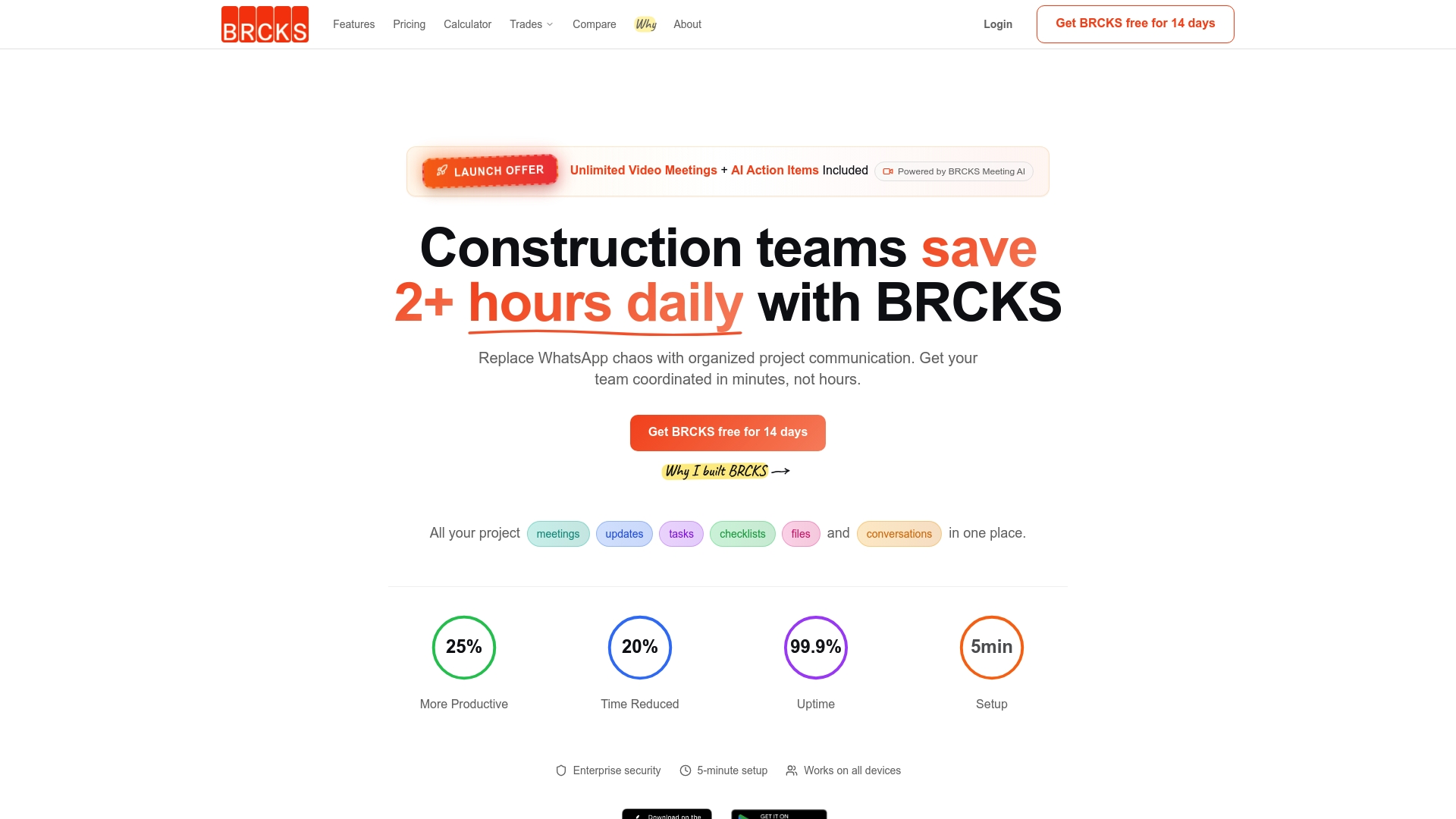
BRCKS is built for construction teams who need to capture project communications and documentation in real time, without adding administrative overhead. Its WhatsApp integration means that site updates, RFI responses, and variation records are logged automatically as work progresses, so the handover documentation package is largely complete before the final weeks of the project. For teams looking to improve project transitions without overhauling their existing workflows, BRCKS fits around the tools your team already uses.
BRCKS also includes a snag list software feature that integrates directly with the handover process, allowing outstanding defects to be tracked, assigned, and closed out within the same platform. Explore BRCKS for builders and start a 14-day free trial to see how it reduces handover preparation time across your projects.
FAQ
What are the best practices for project handovers in construction?
Best practices include using handoff mapping checklists, conducting staggered knowledge transfer sessions over two to three weeks, embedding a formal hypercare period of 30 to 90 days, and completing operational readiness assessments before the handover date.
How long should a hypercare period last?
Hypercare periods typically last between 30 and 90 days depending on system complexity, with a named support lead and formal written sign-off marking the end of the period.
Why is a single-day knowledge transfer session not enough?
Spaced learning sessions spread over multiple weeks produce higher retention than intensive single-day transfers, particularly for complex technical systems where the operations team needs time to ask questions and test their understanding.
What digital tools support efficient project handover techniques?
Tools such as Jira, Trello, Microsoft Project, and WhatsApp-integrated platforms like BRCKS support task tracking, version control, and real-time communication capture, all of which reduce errors during handover.
When should handover planning begin on a construction project?
Handover planning should begin at project kick-off. Including transition activities as discrete work packages in the programme from the outset prevents last-minute compression and under-resourcing at practical completion.
Recommended
- Construction Handover Documentation: The Complete Guide for UK Project Managers | BRCKS
- Streamline UK Construction Communication & Workflows
- BRCKS | Construction Project Communication Software
- UK Construction Project Coordination Best Practices 2026 | BRCKS
How BRCKS Can Help
Streamlining project handovers in 2026 requires a proactive approach to data management and communication from day one. By centralising documentation and automating workflows, BRCKS ensures that every stakeholder has access to the critical information needed for a seamless transition. Our platform is designed to eliminate the last-minute scramble for records, allowing your team to close out projects with total confidence. We invite you to explore how BRCKS can transform your handover process and drive greater efficiency across your entire portfolio. Learn more at BRCKS and explore our full feature set.