What is task centralisation in construction projects?
Discover how centralising task ownership and decision-making can eliminate project delays and improve accountability across your construction site.
By James Shorter ·
What is task centralisation in construction projects?

TL;DR:
- Task centralisation consolidates task ownership and decision-making into a single system for construction projects. It reduces delays and rework by providing clear accountability and visibility of tasks. Effective implementation relies on appropriate software, governance frameworks, and continuous updates to the RACI matrix.
Task centralisation is the process of concentrating task assignments, approvals, and decision-making authority within a single system or group, rather than scattering them across individuals, apps, and WhatsApp threads. For UK construction project managers, this means every action item, from submittals to snagging, lives in one place with a named owner. Tools like SAP Task Centre and frameworks like the RACI matrix exist precisely to make this work in practice. When done correctly, centralised project information reduces rework, speeds up approvals, and cuts the coordination failures that push projects over budget and past deadline.
What is task centralisation and why does it matter on site?
Task centralisation is defined as concentrating decision rights and task visibility within a single authority or system, rather than distributing them across teams or individuals. The key word is “rights.” Centralising where tasks are visible is only half the job. Centralising who can approve, reassign, or escalate them is what actually moves work forward.

Construction projects are particularly vulnerable to fragmented task management. A subcontractor receives instructions via WhatsApp, a site manager logs progress in a spreadsheet, and the project manager chases updates by phone. Each handoff is a potential failure point. The importance of centralising tasks is that it closes those gaps by making ownership explicit and traceable.
The RACI matrix is the most widely used governance framework for this purpose. RACI assigns four roles to every task: Responsible, Accountable, Consulted, and Informed. One person is Accountable per task, which eliminates the “not my job” failures that stall construction projects at inspections, change orders, and handovers. That single rule, one accountable owner per task, is the foundation of effective task management centralisation.
How does task centralisation improve workflow and collaboration?
Centralised task management improves workflow by removing the ambiguity that causes rework. When every team member knows who owns a task and where to find its current status, decisions happen faster and fewer items fall through the cracks.
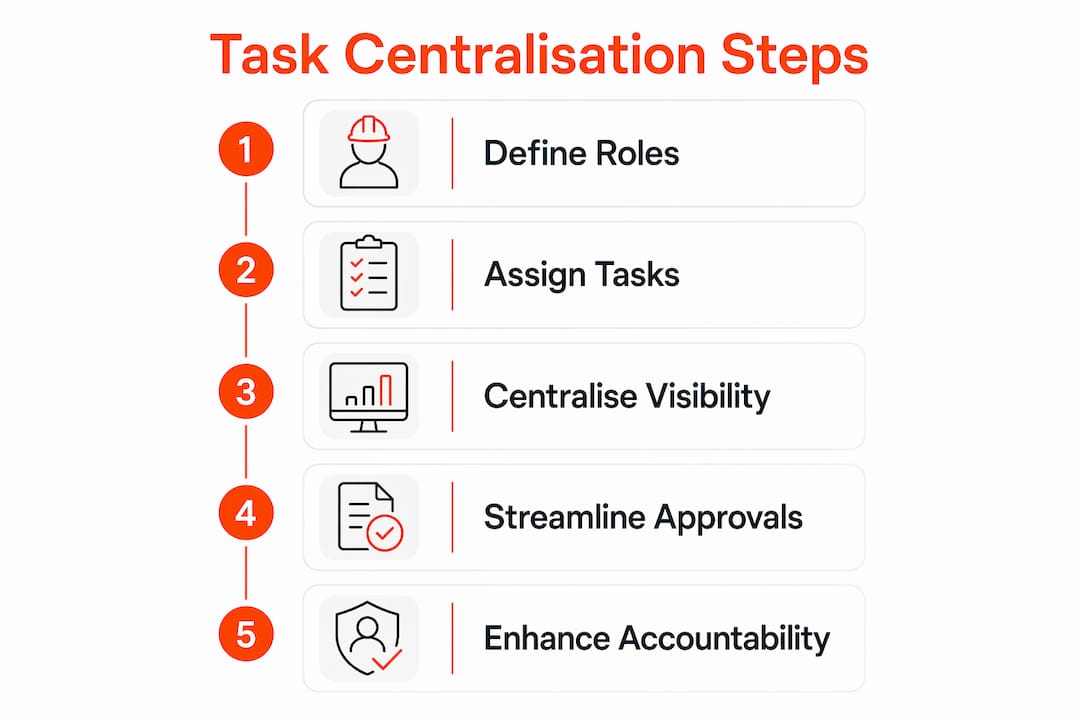
The benefits of task centralisation are both practical and psychological. On the practical side, a unified task hub consolidates approvals, notifications, and action items from multiple systems into a single inbox. SAP Task Centre, for example, federates tasks from separate backend systems so project managers stop switching between apps to find what needs their attention. That reduction in context switching saves time and reduces the cognitive load that leads to missed actions.
The psychological benefit is less obvious but equally real. When teams can see all outstanding tasks in one place, they spend less time chasing updates and more time completing work. Visibility creates accountability without requiring constant management intervention. For construction teams working across multiple sites, this shift in dynamic is significant.
- Clear task ownership via RACI reduces rework caused by unclear responsibility
- A single task inbox cuts time lost switching between email, WhatsApp, and spreadsheets
- Central visibility accelerates approvals at key project milestones such as inspections and change control
- Explicit accountability reduces the frequency of escalations and delays
Pro Tip: Apply RACI at the start of each project phase, not just at the beginning of the project. Precon, inspections, and closeout each have distinct task owners. Updating the matrix per phase prevents stale accountability assignments from causing delays late in the programme.
What systems and tools support task centralisation in construction?
The right tools make the difference between a centralised system that works and one that teams quietly abandon. For UK construction professionals, the choice of tool depends on project size, team structure, and the communication channels already in use.
RACI as a governance framework
The RACI matrix is not software. It is a governance document that defines who does what on every task. Its power lies in linking accountability to real workflow moments: submittals, RFIs, inspections, and variation approvals. When RACI is aligned with project phases rather than applied as a one-off exercise, it reduces handoff failures and keeps decision-making authority clear throughout the build.
Centralised task hubs and construction software
Software tools implement task centralisation by aggregating work items from multiple sources into one interface. SAP Task Centre is an enterprise-level example, consolidating tasks from disparate systems into a single task inbox that improves resilience and reduces approval delays. For UK construction teams, purpose-built platforms offer similar centralisation with features specific to site management.
| Tool type | Primary function | Best suited for |
|---|---|---|
| RACI matrix | Defines task ownership and decision rights | All project sizes and phases |
| Centralised task hub (e.g. SAP Task Centre) | Aggregates tasks from multiple systems | Large, multi-system environments |
| Construction project management app | Combines task tracking, RFIs, and site diaries | Small to mid-size UK contractors |
| WhatsApp workflow integration | Captures site communications into a central record | Field teams and subcontractors |
Purpose-built construction apps go further than generic task managers. They include construction task tracking features such as automated site diaries, variation logs, and RFI tracking, all of which feed into a central project record. Mobile access is non-negotiable for site teams, and the best tools work on the devices and communication channels teams already use.
What are the challenges and limitations of task centralisation?
Task centralisation is not the right approach in every situation. Applied without care, it creates the very bottlenecks it is meant to prevent.
The core risk is over-centralisation. When all decisions must pass through a single authority, that person becomes a constraint on the entire project. Overly top-down task allocation increases coordination load and reduces motivation, particularly in experienced teams who are capable of managing their own work. The result is slower delivery, not faster.
Team maturity is the critical variable. Research into centralised versus self-organising task allocation shows that team performance with centralised allocation depends heavily on the team’s developmental stage. Newer teams benefit from clear top-down direction. Experienced teams perform better with controlled autonomy, where the central system provides visibility and governance without micromanaging every decision.
- Identify team maturity before choosing your model. New teams need centralised direction. Experienced teams need central visibility with delegated decision rights.
- Avoid single-point bottlenecks. If one person must approve every task, build a deputy or escalation path into the RACI from the start.
- Review task load distribution regularly. Centralisation concentrates workload. Monitor who is carrying the most tasks and rebalance before delays occur.
- Combine central governance with local autonomy. Use the central system for visibility and escalation, but allow subcontractors and site managers to self-assign routine tasks within agreed parameters.
Pro Tip: If your project manager is consistently the bottleneck on approvals, the problem is not the team. It is the RACI. Reassign accountability for routine tasks to senior subcontractors or site supervisors, and reserve the project manager’s approval authority for variations, RFIs, and client-facing decisions.
How to implement task centralisation in UK construction projects
Effective implementation follows a clear sequence. Skipping steps, particularly the governance setup, produces a central system that teams work around rather than with.
- Define roles before selecting tools. Build a RACI for each project phase before choosing software. The governance framework must drive the tool choice, not the other way around.
- Choose software that matches your communication habits. Teams that already use WhatsApp will adopt a platform that integrates with it far faster than one that requires a separate login. Construction workflow management tools that capture WhatsApp messages as project records remove the gap between how teams communicate and how tasks are tracked.
- Train on the workflow, not just the software. Teams need to understand why tasks are assigned the way they are, not just how to click through the interface. A short briefing at the start of each project phase is more effective than a one-off onboarding session.
- Monitor task load weekly. Centralisation concentrates visibility, which makes workload imbalances easy to spot. Use that visibility to rebalance assignments before they become delays.
- Integrate with existing site processes. Automated site diaries, RFI tracking, and variation logs should feed into the central task record automatically. Manual data entry defeats the purpose of centralisation.
Pro Tip: For remote or multi-site projects, remote construction management works best when the central task system sends automated updates to clients and stakeholders. This removes the project manager from the loop on routine status queries and frees them for decisions that actually require their input.
Key takeaways
Task centralisation works because it combines clear decision rights with a single source of task visibility, giving construction project managers the control they need without creating bottlenecks.
| Point | Details |
|---|---|
| Define decision rights first | Centralising visibility without centralising authority causes stalls, not speed. |
| Use RACI per project phase | Align task ownership to precon, inspections, and closeout to prevent stale accountability. |
| Match tools to team habits | Software that integrates with WhatsApp achieves faster adoption on UK construction sites. |
| Balance control with autonomy | Experienced teams perform better with central visibility and delegated decision rights. |
| Monitor workload distribution | Central systems make imbalances visible. Rebalance task assignments weekly to avoid bottlenecks. |
The version of task centralisation that actually works on site
My honest view is that most UK construction teams misunderstand what task centralisation means in practice. They buy software, create a shared inbox, and call it done. What they have actually done is centralise visibility without centralising authority. The tasks are all in one place, but nobody is sure who can approve what. That is not centralisation. That is a tidy mess.
The projects I have seen run well share one characteristic: the RACI is treated as a live document, not a kick-off deliverable. It gets updated at each phase gate. When a subcontractor changes, the accountability column changes with them. When a project manager goes on leave, the deputy is already named in the matrix.
The second thing those projects get right is the tool choice. Teams adopt software that fits into how they already work. Forcing a team that runs on WhatsApp into a platform that requires a separate login for every update is a recipe for shadow systems and missed tasks. The construction software for builders that wins on site is the one that meets teams where they are.
Task centralisation is not about control for its own sake. It is about making sure the right person can act on the right task at the right time, without anyone having to chase them for it.
— James
BRCKS brings task centralisation to UK construction teams
Construction project managers who want to centralise tasks without adding admin burden have a practical option in BRCKS.
BRCKS integrates with WhatsApp to capture site communications as structured project records in real time. Automated site diaries, RFI tracking, and variation logs feed directly into a central project view, so nothing is lost in a chat thread. Project managers using BRCKS report saving over two hours of manual effort daily. For builders, electricians, and project managers working across UK sites, BRCKS construction software puts task visibility and accountability in one place without disrupting how teams already communicate. Try BRCKS free for 14 days and see the difference a genuinely centralised workflow makes.
FAQ
What is task centralisation in construction?
Task centralisation is the process of consolidating task assignments, approvals, and decision-making authority into a single system or group. In construction, this means every action item has a named owner and a single location where its status can be tracked.
What are the main benefits of task centralisation?
The primary benefits include faster approvals, reduced rework from unclear ownership, and improved accountability across project phases. RACI reduces handoff failures by making authority explicit, which directly speeds up collaboration on site.
What is a RACI matrix and how does it support task centralisation?
A RACI matrix assigns four roles to every task: Responsible, Accountable, Consulted, and Informed. It supports task centralisation by ensuring one person holds clear accountability per task, eliminating the ambiguity that causes delays at inspections, change orders, and handovers.
Can task centralisation slow a project down?
Yes, if applied without care. Over-centralising task allocation increases coordination load and can reduce motivation in experienced teams. The solution is to centralise governance and visibility while delegating routine decision rights to senior site staff.
How do I centralise tasks on a construction project using software?
Choose a platform that integrates with the communication tools your team already uses, such as WhatsApp, and that includes automated task tracking for RFIs, site diaries, and variations. Pair the software with a phase-specific RACI to ensure the tool reflects clear accountability from the start.
Recommended
- Importance of Centralised Project Information in Construction | BRCKS
- Construction Task Tracking: A UK Project Manager’s Guide
- Streamline UK Construction Communication & Workflows
- UK Construction Project Coordination Best Practices 2026 | BRCKS
How BRCKS Can Help
Adopting task centralisation is a vital step towards eliminating the fragmented communication that often hinders construction timelines. By integrating every workflow into a single source of truth, BRCKS empowers site teams to manage schedules and updates without the risk of data silos. This streamlined approach ensures that everyone remains aligned, reducing errors and improving overall project efficiency. To see how our platform can transform your operational oversight, we invite you to book a demo and explore the BRCKS solution today. Learn more at BRCKS and explore our full feature set.