3 WhatsApp GDPR Rules UK Builders Must Use to Protect Site Records
Discover how UK builders can use WhatsApp safely by following GDPR and PECR rules to protect site records and maintain legal compliance.
By James Shorter ·
3 WhatsApp GDPR Rules UK Builders Must Use to Protect Site Records

Yes, UK builders can use WhatsApp for business communications, but only with proper controls in place. WhatsApp GDPR compliance in construction hinges on three things: document your lawful basis for processing personal data, treat any promotional message under PECR rules with explicit opt-in, and never let WhatsApp become your only project record. Skip any of these and you’re carrying risk you don’t need to.
TL;DR:
- Using WhatsApp for business in construction requires documented lawful bases and strict adherence to GDPR and PECR rules, especially for marketing messages.
- Site culture often risks losing essential safety and project information in chats, making it crucial to record significant messages elsewhere with timestamps and audit trails.
- Critical project decisions and variations should be moved into a proper project management system rather than relying solely on WhatsApp messages.
- Controls like device management, retention schedules, and offboarding processes reduce GDPR risks while preserving WhatsApp’s communication speed.
- Combining WhatsApp with tools like BRCKS ensures message traceability and legal compliance, especially when handling disputes or subject access requests.
Table of Contents
- How UK GDPR and PECR apply to WhatsApp for business
- Why WhatsApp creates particular risks on construction sites
- Lawful bases for WhatsApp uses: service, transactional and marketing
- Practical controls that reduce WhatsApp GDPR risk
- Handling subject access requests and using WhatsApp as evidence
- A safer pattern: WhatsApp for chat, the project record elsewhere
- Why builders reach for WhatsApp, and what it costs them
- Keep WhatsApp, build the record with BRCKS
- Official guidance and useful reading
- Sources
- FAQ
How UK GDPR and PECR apply to WhatsApp for business
UK GDPR applies the moment your firm processes personal data through WhatsApp, whether that’s a subbie’s phone number, a client’s address, or a photo with someone’s face in it. The app doesn’t shield you from the rules. Your business stays the controller, meaning the ICO’s UK GDPR guidance expects you to know what data you’re handling and why.
PECR is the separate regime that catches most builders out. It governs electronic marketing, and a WhatsApp message pushing a seasonal offer or asking for a referral counts as marketing. Most of these need explicit opt-in consent, not just an assumption that because someone messaged you once, they’re fair game for updates.
Practical compliance boils down to a short list:
- Run a data protection impact assessment (DPIA) if you’re processing sensitive data at scale, such as CCTV stills or health information from accident reports.
- Keep a written record of your lawful basis for each type of WhatsApp use, whether that’s consent, contract, or legitimate interest.
- Check whether you need a data processing arrangement covering Meta’s role as a processor, particularly if you’re using WhatsApp Business features.
None of this requires a legal department. It requires a decision, written down, and followed.
Why WhatsApp creates particular risks on construction sites
Site culture makes WhatsApp risk worse than in most other industries. Photos of snags get forwarded between three group chats before anyone logs them properly. A foreman leaves his phone in a van overnight and the only record of a variation instruction sits unlocked on the passenger seat. Construction Management’s sector analysis flags exactly this: consumer messaging apps threaten the golden thread of information the Building Safety Act now demands for higher-risk buildings.
Three failure patterns show up repeatedly:
- A safety-critical instruction gets buried in a group chat with 200 unrelated messages and nobody actions it.
- A subcontractor leaves the project, and with them goes the only copy of a decision made three months earlier.
- A dispute over a variation comes down to a screenshot nobody can verify wasn’t edited or taken out of context.
Pro Tip: If a message would matter in a dispute six months from now, it shouldn’t live only in WhatsApp. Confirm it somewhere with a timestamp and an audit trail.
Lawful bases for WhatsApp uses: service, transactional and marketing
Not every WhatsApp message needs the same legal justification. A message confirming tomorrow’s start time is different from one chasing a Google review.
For service and transactional messages, legitimate interest or contract usually covers you. Telling a client their bathroom fit-out is delayed by a day, or confirming a delivery slot with a supplier, falls within what a reasonable person would expect from doing business with you.
Marketing is where PECR bites harder. Sending an unsolicited offer, a referral request, or a “get 10% off your next job” message needs explicit opt-in, not implied consent.
Acceptable ways to capture that consent include:
- A tick box on your enquiry form specifically for WhatsApp marketing updates.
- A keyword reply system where the client texts “YES” to opt in.
- A recorded verbal consent logged in your project system when a client agrees on-site.
Useline’s practical guide to WhatsApp Business GDPR points out that most small business breaches come from something simple: reusing a number given for a booking enquiry to send marketing later, with no record anyone ever agreed to that. Fix the process once and the risk mostly disappears.
Practical controls that reduce WhatsApp GDPR risk
Controls matter more than the platform itself. A written WhatsApp use policy should set out what’s acceptable to discuss on the app (delivery times, quick queries, photo updates) and what must be confirmed elsewhere (variations, RFIs, RAMS sign-off, anything safety-critical).
Device management matters too. Where possible, issue a work number or managed device for site staff rather than relying on personal phones for business chat. It’s not always practical on smaller jobs, but it’s worth building into onboarding.
A short checklist for most firms:
- Set a retention schedule, typically matching your claims window, and stick to it consistently rather than deleting or keeping messages on a case-by-case basis.
- Run a scheduled archive of anything WhatsApp-based that touches a live project, rather than leaving it to memory.
- Include a data processing clause in contracts with subcontractors covering how they handle client data on their own devices.
Pro Tip: Offboarding is where most firms slip. When a subbie leaves the project, their phone often holds the only copy of key decisions. Build a step into your leaver process that captures anything relevant before access is lost.
Handling subject access requests and using WhatsApp as evidence
A subject access request (SAR) can require you to produce any personal data you hold on someone, including WhatsApp messages that mention them by name or reference their work. Construction Management’s legal Q&A on site messaging notes that these messages are disclosable in employment tribunals and civil disputes, and courts don’t care that the chat felt informal at the time.
When a SAR or legal request lands, act fast:
- Instruct staff not to delete anything relevant, even messages that look unimportant.
- Capture message metadata (timestamps, sender, group name) alongside the content itself, since screenshots alone can be challenged.
- Notify whoever handles legal or compliance queries internally before responding to the requester.
Your retention policy should drive whether you keep or delete data, not convenience in the moment. Follow it consistently or it won’t hold up under scrutiny.
A safer pattern: WhatsApp for chat, the project record elsewhere
The fix most UK builders land on isn’t banning WhatsApp. It’s splitting what goes where. Casual, low-risk chat (a quick photo, “running 20 minutes late”, a query about parking) stays in WhatsApp. Formal decisions, variations, RFIs and sign-offs move to a project record.
ed-off documents move into a controlled project system with a proper audit trail.Simple triggers make this workable without extra admin:
- If a message changes scope, price, or programme, it gets logged as a variation, not left in a thread.
- If a photo shows a defect or a completed stage, it gets tagged against the relevant task, not scrolled past.
- If a client or subbie asks a question that needs a documented answer, the answer goes into the project record, with a link back if useful.
BRCKS’s own site diary and variation tools are built specifically to capture this kind of thing automatically from WhatsApp workflows your team already uses.
Why builders reach for WhatsApp, and what it costs them
James: Builders adopt WhatsApp because it’s fast and everyone already has it, not because it’s the right tool for records. That speed is exactly why decisions vanish when a subbie changes phones. BRCKS’s site diaries, photo checklists and audit trails exist to catch what WhatsApp drops, without asking anyone to change how they message.
— James
Keep WhatsApp, build the record with BRCKS
BRCKS is the practical fix for firms who want to keep messaging the way they already do without carrying the GDPR risk WhatsApp alone creates. Your team stays in WhatsApp, but BRCKS turns those messages into a searchable project record, with variations logged, photos filed against the right job, and an audit trail that survives a subbie leaving mid-project.
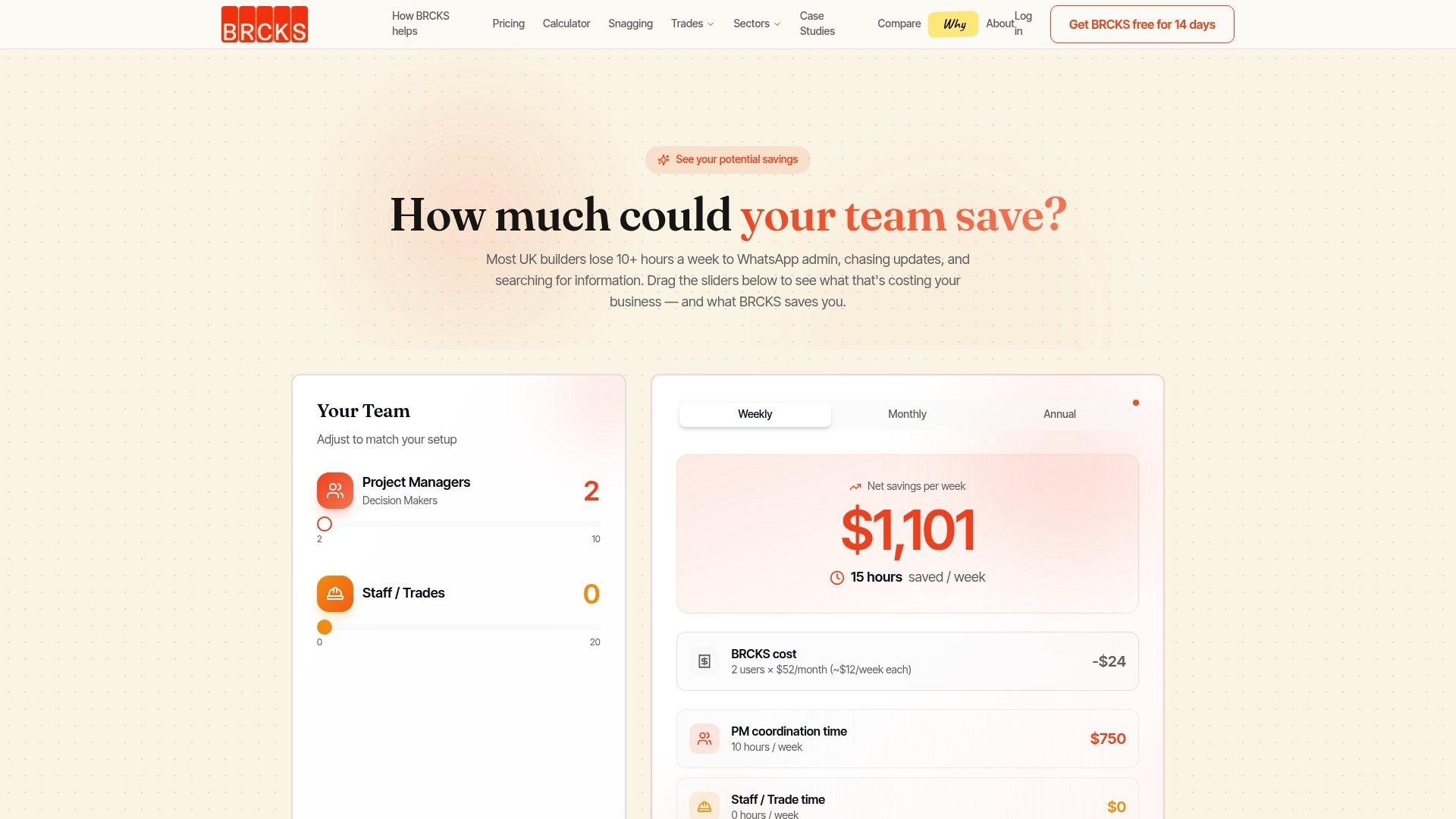
That means less exposure if a SAR or dispute lands on your desk, and less unpaid admin chasing down who said what in which group chat. Retention and offboarding stop being manual jobs someone forgets to do. BRCKS charges a monthly fee per seat, billed annually, with subcontractors and clients invited free, so the people generating the data aren’t the ones paying to store it properly. See how the WhatsApp integration works and start a 14-day free trial to check it against your own project.
Official guidance and useful reading
- ICO — UK GDPR guidance and resources for controller obligations and DPIAs.
- Construction Management on WhatsApp for site communications for legal and disclosure risks.
- Stephens Scown on WhatsApp and work for employer liability.
- Sprintlaw’s privacy guidance for construction PMs for retention and processor contracts.
Sources
- ICO — UK GDPR guidance and resources
- Should we use WhatsApp for site communications? — Construction Management
- WhatsApp and work: a legal minefield employers can’t ignore — Stephens Scown
- Privacy rules for UK construction project managers — Sprintlaw
FAQ
Is WhatsApp GDPR compliant in the UK?
WhatsApp itself isn’t automatically compliant or non-compliant. Compliance depends on how your business uses it, meaning you need a documented lawful basis, PECR opt-ins for marketing, and a retention policy, as set out by ICO guidance.
Is a WhatsApp message legal proof in the UK?
Yes, WhatsApp messages can be used as evidence in employment tribunals and civil disputes, but Construction Management’s legal analysis notes that informal chat can create contractual uncertainty compared with a formal written instruction.
Can the UK government see WhatsApp messages?
WhatsApp’s end-to-end encryption means the government cannot routinely access message content, though authorities can compel disclosure through legal processes such as a court order, and legal commentary notes the app still lacks the audit controls needed for robust business governance.
Can your employer force you to be in a WhatsApp group?
An employer can ask staff to join a work WhatsApp group for operational reasons, but forcing personal device use raises data protection and boundary concerns that a written WhatsApp use policy should address clearly.
Does using the WhatsApp Business app change GDPR obligations?
No. The WhatsApp Business app and the WhatsApp Business Platform (API) both leave your firm as the data controller, so lawful basis, retention and PECR rules for marketing still apply regardless of which version you use.
Recommended
- Tired of WhatsApp? Best Construction Messaging Apps for UK Builders
- Construction WhatsApp Bot: 2026 Guide for UK Builders
- WhatsApp Construction Software for UK Builders: 2026 Guide
- Why WhatsApp Fails UK Construction Client Communication
How BRCKS Can Help
While WhatsApp offers convenience, relying on it for site records leaves your business vulnerable to significant GDPR risks and fragmented data. BRCKS solves this by providing a secure, centralised platform designed specifically for the UK construction industry, ensuring all project communication remains compliant and professional. By moving your site documentation into a dedicated environment, you protect your firm from legal pitfalls while keeping your team aligned. Discover how BRCKS can streamline your project management and safeguard your data by exploring our features today. Learn more at BRCKS and explore our full feature set.