Why fragmented communication costs UK construction 60% of delays
Fragmented communication is the hidden driver behind 60% of UK construction delays. Discover the true cost of information silos and how to fix them.
By James Shorter ·
Why fragmented communication costs UK construction 60% of delays
TL;DR:
- Fragmented communication causes over 60% of UK construction project delays and leads to significant cost overruns. Implementing centralised, structured communication platforms and clear protocols can reduce errors, rework, and delays. Cultural and structural barriers often hinder progress, but proper processes and technology adoption improve project outcomes.
Communication failures contribute to over 60% of UK construction project delays, yet most project managers still attribute problems to budgets, weather, or supply chain issues. The real culprit is hiding in plain sight: scattered messages, missed updates, and siloed information that compound daily across your teams and subcontractors. This guide breaks down what fragmented communication actually means, why it costs far more than most firms realise, and the practical steps you can take right now to fix it. If you manage a construction project in the UK, this is essential reading.
Table of Contents
- What is fragmented communication in construction?
- The true cost: Delays, waste and risk in UK construction
- Mechanics: How fragmentation actually damages your project
- Solving the problem: Practical strategies for seamless communication
- Why most UK construction teams underestimate communication risks
- Take the next step to better project outcomes
- Frequently asked questions
Key Takeaways
| Point | Details |
|---|---|
| Fragmentation wastes resources | Lost messages and silos drive costly delays, rework, and safety risks on construction projects. |
| Centralisation saves money | Switching to a central communication platform can reduce miscommunication and cut rework by up to 52 per cent. |
| Change requires process, not just tools | True improvement comes from agreed rules, not just adopting apps or tech solutions. |
| Address legal and cultural gaps | Updated protocols and compliance with UK laws like the Building Safety Act are now essential for UK teams. |
What is fragmented communication in construction?
Fragmented communication happens when your team members send project information across multiple disconnected channels without any central system to tie it all together. Think WhatsApp groups for daily updates, email chains for change orders, phone calls for urgent decisions, and paper notes for site instructions. Each channel operates independently. Nothing connects.
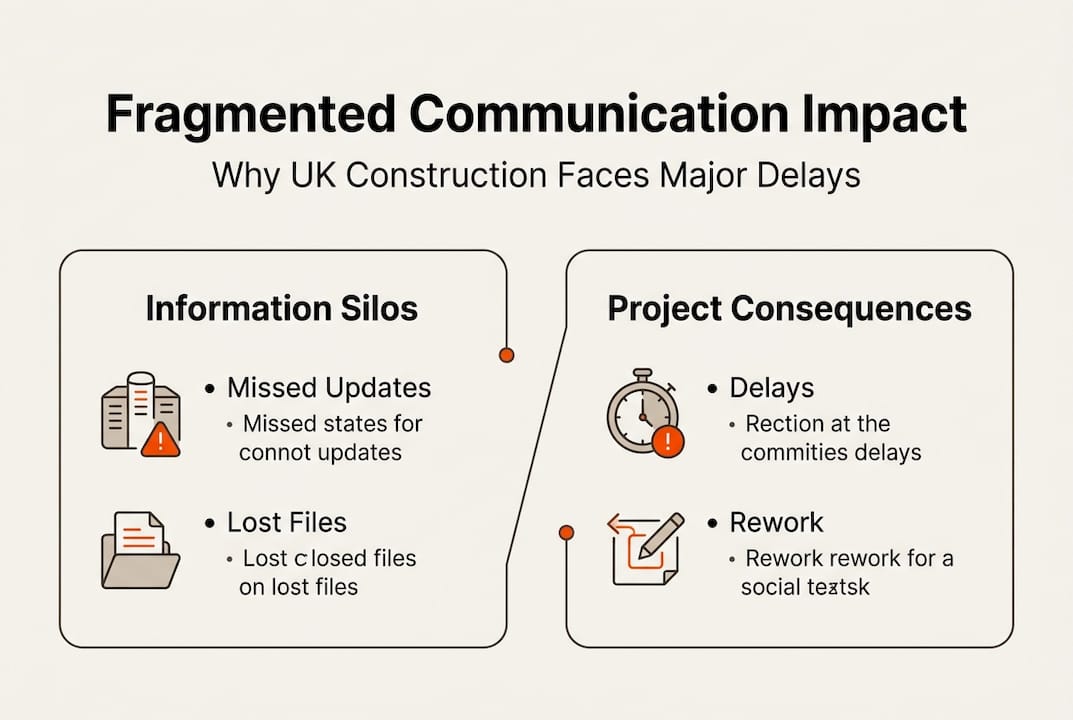
The result is what industry professionals call information silos. Critical data gets trapped inside individual inboxes, chat threads, or even someone’s memory. When a subcontractor needs to verify a specification change, they may receive a different answer depending on who they contact and which message thread they find first. Fragmented communication creates info silos, lost context, duplicate work, and misaligned data across every layer of your project.
The root causes are structural. UK construction relies heavily on a subcontracting model where multiple independent firms work side by side, each with their own preferred communication tools and workflows. Formal change protocols are often informal or entirely absent on smaller projects. And without a central platform to anchor information, every new subcontractor or trade that joins a project adds another fragmented layer.
Common construction communication problems that signal fragmentation include:
- Contradictory instructions reaching different trades on the same day
- Version confusion over drawings or specifications
- No clear record of who approved a change or when
- Repeated questions that were already answered in a different thread
- Key decisions made verbally with no written trail
“The biggest project risk is not a technical one. It is the gap between what was said, what was heard, and what was actually done.”
This gap widens every time a message goes to the wrong channel. Using project communication platforms specifically designed for construction is one of the most direct ways to close it.
The true cost: Delays, waste and risk in UK construction
Poor communication is not just an operational inconvenience. It carries a measurable financial and human cost that most firms are not fully accounting for.
The UK construction industry loses £20 to £25 billion annually to inefficiencies, with poor communication identified as a leading cause. Average projects overrun by 20 to 30%, and 5 to 10% of total costs are wasted on rework that stems directly from miscommunication.
The scale of the problem at a glance:
| Impact area | Consequence of fragmented comms |
|---|---|
| Schedule | 20 to 30% average project overrun |
| Rework cost | 5 to 10% of total project cost |
| Non-productive time | 35% of working hours wasted |
| Delays caused | 49% of delays from poor communication |
| Rework incidents | 48% of rework linked to miscommunication |
| Industry-wide annual loss | £20 to £25 billion |
These numbers reflect real projects and real firms. And they compound quickly once you factor in the indirect costs of poor communication such as strained client relationships, delayed payment cycles, and the management time spent untangling information problems instead of driving delivery.
Safety is another dimension that often gets overlooked. When site instructions are unclear or unverified, operatives may proceed with incomplete information. Errors in safety-critical decisions, such as lifting plans or temporary works, can have serious consequences beyond cost and time.
Legal exposure is also real. Disputes over scope, variations, and responsibilities frequently trace back to a lack of documented communication. Firms without proper audit trails struggle to defend their position when a contract dispute escalates. Improving reducing disputes through better documentation is one of the most underutilised risk management tools available to UK project managers.
The subcontracting model, manual data handling, and informal information handovers all intensify these risks. The more parties involved in a project, the more opportunities there are for a message to go astray.
Mechanics: How fragmentation actually damages your project
These numbers become far more real when we see how fragmentation actually unfolds on site. A single missed message can trigger a chain of events that costs thousands of pounds.
Typical error chain from one missed update:
- A design change is emailed to the main contractor but not forwarded to the affected subcontractor
- The subcontractor proceeds with the original specification
- Incorrect work is completed and signed off before the discrepancy is spotted
- Rework is ordered, delaying follow-on trades and extending the programme
- A dispute over responsibility arises, consuming management time and potentially legal fees
This sequence is entirely preventable. Yet it plays out repeatedly on UK sites because fragmented comms scatter information across WhatsApp, email, and phone calls with no audit trail. Central platforms reduce miscommunications by 40%, which is a measurable return on a straightforward operational change.
Fragmented vs. centralised workflows:
| Workflow element | Fragmented approach | Centralised approach |
|---|---|---|
| Audit trail | Scattered or absent | Timestamped and searchable |
| Version control | Multiple conflicting copies | Single live document |
| Information retrieval | Manual, slow, unreliable | Instant, role-based access |
| Change management | Informal, verbal | Logged and approved formally |
| Subcontractor access | Excluded or separate | Integrated, real-time |
In a multi-subcontractor environment, silos form naturally. Each trade communicates internally using its own tools and only interfaces with others when problems arise. Duplicate data, lost context, and missed handovers fill the gaps between those interactions.
Pro Tip: Start with one simple fix. Create a shared log for every change instruction issued on site, even if it is just a shared document to begin with. This single audit trail immediately reduces he-said-she-said disputes and gives your team something to reference in real time.
If you are serious about improving communication across trades, pairing this audit trail habit with a structured platform is the next logical step. Firms that have adopted this approach report significant gains in accountability and fewer on-site surprises. Research into cutting rework with workflows confirms that structured processes alone can reduce rework by over half.
Solving the problem: Practical strategies for seamless communication
The good news is that fragmented communication can be fixed with the right strategies backed by industry experience. You do not need to overhaul your entire operation overnight.
Start with the fundamentals. Structured platforms for real-time updates and trade-specific threading give every team member a single place to receive, respond to, and verify information. Formal change protocols prevent variation disputes before they escalate to legal territory.
Quick wins you can act on this week:
- Agree a single approved channel for each type of update, for example, one platform for instructions, one for RFIs, one for safety alerts
- Implement real-time progress boards accessible to all active trades
- Require written confirmation for any verbal instruction within 24 hours
- Use field-friendly apps that work on mobile so operatives can access information without leaving the site
- Schedule a weekly information alignment meeting with subcontractor leads to catch gaps before they become problems
Edge cases require additional thought. A UCL study on UK construction found that heavy reliance on the subcontracting model versus a more integrated approach reduces productivity measurably. Where subcontractor independence is unavoidable, clarity of process becomes even more important. Language barriers are another real factor on UK sites; using visual checklists and diagram-based updates reduces the risk of misunderstanding regardless of language.
Handover points are among the highest-risk moments for information loss. When one trade completes and another begins, ensure a formal handover document is signed off by both parties.
Pro Tip: Set up trade-specific threads within your communication platform so electricians, groundworkers, and finishing trades are not wading through each other’s updates. Add a standing 15-minute alignment call at the start of each week. For SMEs, this simple rhythm alone dramatically reduces the number of reactive fires to fight.
Improving information sharing across trades can cut construction errors by up to 70%. Following proven best practices for coordination and investing in managing subcontractors more systematically will pay dividends on every future project.
Why most UK construction teams underestimate communication risks
Stepping back, it is worth asking why fragmented communication remains widespread when the risks and solutions are so well understood. The answer is rarely technical. It is cultural and structural.
Most project teams reach for a new app when communication breaks down, without changing the underlying process or behaviour. Technology without process change delivers minimal results. Teams also view centralised platforms as an administrative burden rather than a delivery tool, especially on fast-moving sites where getting work done feels more urgent than logging it properly.
The subcontracting model naturally resists centralisation. Each firm has its own systems, preferences, and loyalties. Asking everyone to adopt a shared platform feels like imposing control, even when it benefits all parties.
Legislation is starting to force a rethink. The Building Safety Act now mandates structured information management, particularly on higher-risk buildings. But regulatory compliance tends to lag behind genuine behavioural change.
The hidden costs that most teams miss are staff burnout from constant message-chasing, the quiet cover-up of mistakes made due to missing information, and silent data losses that only surface when a dispute arises. These costs do not appear in project budgets but they damage firms over time. Understanding why comms problems persist across the industry is the first step toward deciding to do something different.
Take the next step to better project outcomes
Ready to reduce costly mistakes and reclaim your team’s time? Here is how to take action.
Fragmented communication is not just a workflow inconvenience. It is a business risk that compounds across every project you deliver. The steps outlined above give you a clear starting point, but the most significant gains come from consolidating your tools into one place.
 BRCKS.io">
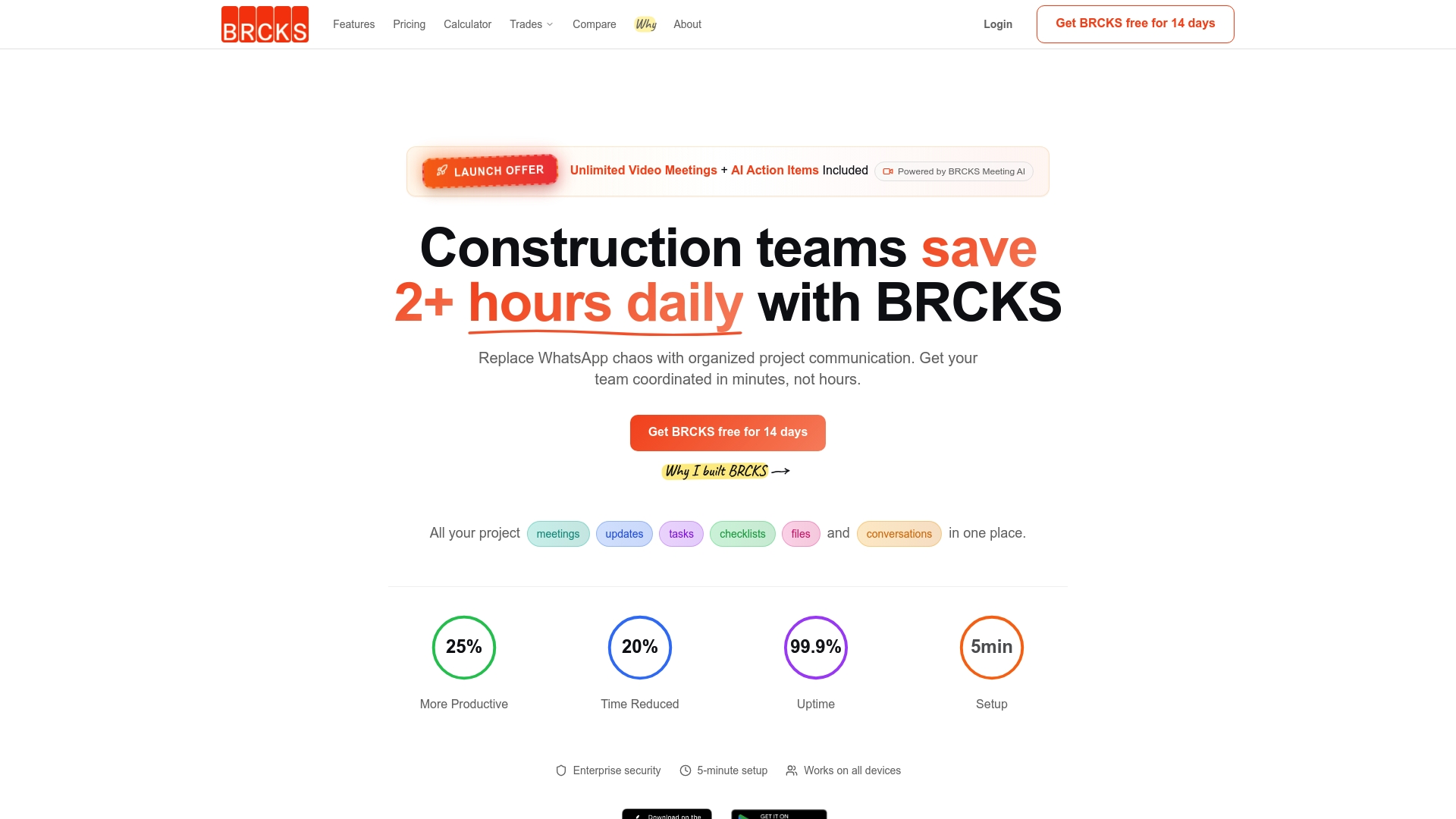
BRCKS is built specifically for construction teams managing this exact challenge. From trade-specific messaging and real-time updates to client portals, file sharing, and automated task management, everything connects in a single platform. Explore software for builders designed around how construction actually works. See how our construction communication platform maps directly to the risks covered in this guide. Or find out how BRCKS compares to your current tools with our WhatsApp vs BRCKS breakdown. Get started free for 14 days.
Frequently asked questions
How does fragmented communication actually cost construction firms money?
It increases rework, causes delays, and duplicates effort across teams, and the UK industry loses £20 to £25 billion annually to these inefficiencies with communication identified as a primary driver.
Can using WhatsApp and email for project updates create problems?
Yes. These tools scatter information with no audit trail, making it easy to miss critical updates and nearly impossible to maintain version control across multiple trades.
What are fast ways to start fixing fragmented communication?
Introduce a single structured platform for updates, set agreed channels for each type of information, and require written records for every change instruction issued on site.
Are there any legal consequences to poor communication on site?
Yes, communication failures regularly lead to variation disputes, contract liability, and under the Building Safety Act, potential non-compliance penalties for firms that cannot demonstrate proper information management.
How do language barriers and technology gaps contribute to fragmentation?
67% of communication failures involve language barriers, and with 53% of teams still relying on manual data transfer, the risk of errors and lost messages on UK sites remains high.
Recommended
- BRCKS | Construction Project Communication Software
- BRCKS | Construction Project Communication Software
- Construction Document Management: Solving the £21bn Problem | BRCKS
- BRCKS | Construction Project Communication Software
How BRCKS Can Help
Eliminating the friction caused by fragmented communication is the most effective way to protect your margins and keep projects on track. By centralising every conversation, document, and site update into one unified platform, BRCKS ensures that your team stays aligned from the office to the site. Our software is designed to bridge these costly gaps, turning potential delays into streamlined progress. We invite you to see how BRCKS can transform your project delivery by booking a demo or exploring our features today. Learn more at BRCKS and explore our full feature set.