Why choose all-in-one platforms for construction teams
Explore how unified software systems eliminate fragmented data and the integration tax, ensuring your construction project records remain searchable and secure.
By James Shorter ·
Why choose all-in-one platforms for construction teams

TL;DR:
- All-in-one platforms unify project management, communication, and documentation for construction teams. They reduce errors, save time, and improve contractual compliance by preserving context and enabling real-time updates. Using a hybrid approach with core systems and specialist tools offers the best balance for complex construction projects.
An all-in-one platform is defined as a unified software system that consolidates project management, communication, and documentation into a single environment. For construction teams, this matters because fragmented tools create fragmented projects. When your site supervisor logs a delay in one app, your project manager tracks RFIs in another, and your client chases updates on WhatsApp, the result is miscommunication, lost records, and costly rework. Platforms like BRCKS and Zoho One address this directly by replacing disconnected tool stacks with a single source of truth. The question of why choose all-in-one platforms is not abstract for construction professionals. It is a daily operational decision with real consequences for programme delivery and budget control.
Why choose all-in-one platforms to cut integration complexity
Construction teams typically run five or more separate tools: a messaging app, a document store, a task tracker, an RFI log, and a site diary. Each connection between those tools requires maintenance, and every gap between them costs time. This overhead is called the integration tax, and unified platforms eliminate it by handling data normalisation internally rather than pushing that burden onto your team.
The second problem is context sprawl. When a decision is made on a WhatsApp thread, the reasoning behind it rarely makes it into the project record. Work sprawl across disconnected tools means that when a team member leaves or a dispute arises, the context is gone. A unified workspace with shared documents, chat, and task management keeps that context intact and searchable.
For distributed construction teams who cannot rely on in-person communication to fill the gaps between tools, this is not a minor convenience. It is the difference between a project record that holds up under scrutiny and one that falls apart at the first sign of a claim.
- Single login across all project functions reduces onboarding time for new site staff
- Shared document libraries prevent version conflicts between trades
- Integrated task and chat views reduce the number of meetings needed to align teams
- Automatic audit trails capture who said what and when, without manual effort
Pro Tip: When evaluating a unified platform, test the onboarding flow with a new user who has no prior training. If they can log a site event within ten minutes, the platform will work on site. If they cannot, your team will revert to WhatsApp within a week.
All-in-one vs best-of-breed: what are the real tradeoffs?
The best-of-breed approach means selecting the strongest specialist tool for each function: one app for RFIs, another for scheduling, a third for document control. The appeal is depth. Each tool is built for one job and does it well. The problem is that integration maintenance and permission governance fall entirely on your team, not the vendor.
All-in-one platforms shift that burden back to the vendor. Your team stops managing API connections and starts managing projects. The tradeoff is that no single platform matches the depth of a dedicated specialist tool in every category. A construction scheduling specialist will always outperform the scheduling module inside a general platform.
The practical answer for most construction teams is a hybrid software strategy: use an all-in-one platform for the core workflow, and add one or two specialist tools where depth genuinely matters. This balances operational simplicity with the niche functionality that complex projects require.
| Feature | All-in-one platform | Best-of-breed stack |
|---|---|---|
| Setup and onboarding | Fast, single login | Slow, multiple accounts |
| Integration maintenance | Handled by vendor | Handled by your team |
| Depth per function | Moderate | High |
| Cost predictability | Fixed, per user | Variable, per tool |
| Vendor lock-in risk | Higher | Lower |
| Context preservation | Strong | Weak across tools |
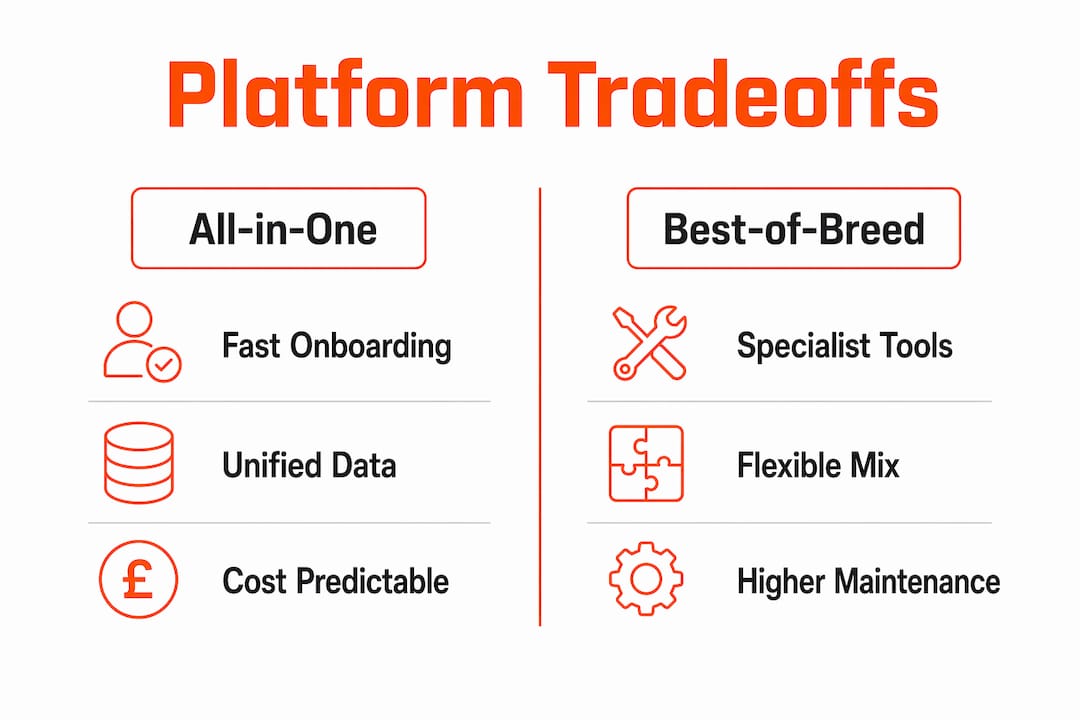
The cost difference is also worth noting. Platforms like Zoho One offer broad functionality at a predictable monthly rate, which makes budgeting straightforward for smaller construction firms. A comparable best-of-breed stack often costs more once you account for integration tools and the staff time spent maintaining them.
How do all-in-one platforms improve construction compliance?
Construction disputes almost always come down to documentation. Who raised the issue, when did they raise it, and did they follow the correct contractual process? Informal cooperation on WhatsApp does not satisfy those requirements. Formal notice and documentation captured in an integrated platform protect contractual entitlement by preserving timelines, notifications, and decision trails in a format that holds up under scrutiny.
The notification trap is a real risk on UK construction projects. A contractor may be fully aware of a delay-causing event but fail to issue a formal notice within the required contractual window. Without a platform that prompts and records those notices alongside the related task updates, the entitlement is lost. Centralised data without decision context creates a memory gap. The files exist, but the reasoning behind decisions does not. That gap is exactly what opposing parties exploit in disputes.
Integrated platforms close that gap by linking RFIs, site diary entries, formal notices, and chat records into a single timeline. For construction compliance management, this contemporaneous record is the strongest evidence available.
- Formal notice triggers are logged with timestamps alongside related task updates
- RFI responses are stored next to the original query, not in a separate inbox
- Site diary entries capture weather, labour, and progress data automatically
- Variation logs record client approvals with a clear audit trail
Pro Tip: The most valuable delay evidence is captured during the delay period itself, not reconstructed afterwards. Time Impact Analysis is far stronger when the platform has been recording events in real time throughout the project.
What practical benefits do construction teams see day to day?
The operational improvements from a unified platform show up quickly. New site staff need one login and one orientation session rather than separate training on five tools. That reduction in onboarding time is significant on projects with high subcontractor turnover, where getting trades productive fast directly affects programme.
File sharing is another area where integrated platforms improve coordination across multiple trades. When drawings, specifications, and RFI responses live in the same system as the task list, there is no version confusion. The electrician and the plumber are working from the same document, and any update is visible to both immediately.

Real-time project updates also drive earlier issue detection. When a site supervisor logs a problem in the same platform where the project manager tracks programme, the issue surfaces before it becomes a delay rather than after. That early visibility is one of the clearest advantages of integrated platforms over disconnected tool stacks.
The daily advantages for construction teams using a unified platform include:
- One login for all project functions, reducing time lost switching between apps
- Searchable records that surface relevant documents, decisions, and conversations instantly
- Automatic site diary generation from daily activity logs, saving manual write-up time
- Client portals that keep clients informed without requiring team members to write separate update emails
- Variation and RFI logs that update in real time, giving the whole team current status without chasing
Poor communication between trades is one of the leading causes of rework costs on UK construction projects. A unified platform does not eliminate miscommunication entirely, but it reduces the number of gaps through which critical information can fall.
Key takeaways
All-in-one platforms deliver the greatest value in construction when they consolidate communication, documentation, and task management into a single system that preserves context and supports contractual compliance.
| Point | Details |
|---|---|
| Integration tax is real | Disconnected tool stacks impose ongoing maintenance costs that unified platforms shift back to the vendor. |
| Context preservation matters | Centralising files without capturing decision reasoning creates a memory gap that weakens dispute evidence. |
| Hybrid approach works best | Use an all-in-one platform for core workflows and add specialist tools only where depth genuinely matters. |
| Compliance depends on documentation | Formal notices and RFI records captured in real time protect contractual entitlement far better than informal chat logs. |
| Onboarding speed is a practical gain | Single-login platforms get new site staff productive faster, which matters most on projects with high subcontractor turnover. |
What I have learned from watching construction teams adopt unified platforms
The teams that get the most from an all-in-one platform are not the ones with the most sophisticated IT setup. They are the ones who were previously drowning in WhatsApp threads and spreadsheets. For them, any coherent system is an improvement. The platform does not need to be perfect. It needs to be used consistently.
Where I have seen adoption fail is when project managers treat the platform as a reporting tool rather than a working tool. If the site team logs events in the platform but the PM still makes decisions from a separate spreadsheet, you have not reduced complexity. You have added a layer to it.
The vendor lock-in concern is legitimate, but it is often overstated. The practical risk of switching platforms mid-project is far higher than the theoretical risk of being locked in long-term. Choose a platform with an open API so you can export your data cleanly if you ever need to move. That single requirement eliminates most of the lock-in risk.
My honest view is that the all-in-one versus best-of-breed debate is mostly irrelevant for the majority of UK construction firms. Most teams do not need the deepest possible scheduling tool. They need a system where the site diary, the RFI log, and the client update all live in the same place and do not require a dedicated administrator to maintain. That is a low bar, and a good all-in-one platform clears it comfortably.
— James
BRCKS brings all of this together for UK construction teams
Construction teams evaluating unified platforms should look at what BRCKS does differently. BRCKS captures project communications through WhatsApp integration, turning informal site messages into structured records automatically. Site diaries, RFI tracking, and variation logs update in real time without requiring staff to log into a separate system.
For builders managing multiple trades, the BRCKS platform for builders removes the administrative overhead that typically falls on the project manager at the end of each day. The site diary app generates compliant records from daily activity without manual write-up. BRCKS reports saving users over two hours of manual effort daily. That time goes back into running the project. Try BRCKS free for 14 days and see how a unified construction platform performs on your next project.
FAQ
What is an all-in-one platform in construction?
An all-in-one platform consolidates project management, communication, documentation, and compliance tools into a single system. Construction teams use them to replace disconnected tool stacks and reduce the administrative overhead of managing multiple apps.
How do unified platforms reduce project delays?
Unified platforms surface issues earlier by linking site diary entries, RFIs, and task updates into a single real-time view. Early visibility means problems are flagged before they affect programme rather than after.
What is the main risk of choosing an all-in-one platform?
Vendor lock-in is the primary risk. Choosing a platform with an open API and clean data export options reduces this risk significantly and protects your project records if you ever need to switch.
Are all-in-one platforms better than best-of-breed tools for construction?
For most UK construction teams, a unified platform outperforms a best-of-breed stack because it reduces integration maintenance and preserves project context. A hybrid approach, using an all-in-one platform for core workflows and specialist tools for niche functions, delivers the best balance.
How does BRCKS differ from standard project management software?
BRCKS integrates directly with WhatsApp to capture site communications as structured project records automatically. This removes the manual logging step that causes most documentation gaps on construction projects.
Recommended
- Construction Software for Builders | BRCKS
- Cloud Communication for UK Construction Teams | BRCKS
- Ditch WhatsApp for Construction Project Comms | BRCKS | BRCKS
- What is a Project Management Platform? UK Construction Guide
How BRCKS Can Help
Consolidating your project data into a single source of truth is the most effective way to eliminate communication gaps and keep your site teams aligned. BRCKS provides a comprehensive all-in-one solution designed to streamline these complex workflows, ensuring that every stakeholder has access to real-time updates without the hassle of switching between disjointed tools. By centralising your management processes, you can focus less on administrative friction and more on delivering quality builds on time. We invite you to explore how BRCKS can transform your operational efficiency and help your business scale with confidence. Learn more at BRCKS and explore our full feature set.