Collaborative planning methods in construction: 2026 guide
Discover how collaborative planning methods like Early Contractor Involvement and the Last Planner System are revolutionising UK construction project delivery in 2026.
By James Shorter ·
Collaborative planning methods in construction: 2026 guide

TL;DR:
- Collaborative planning methods involve all project stakeholders early to improve quality and reduce delays. Applying digital tools, structured schedules, and aligned commercial incentives enhances project efficiency and control. Without proper commercial structures, collaboration becomes superficial and ineffective.
Collaborative planning methods in construction are structured approaches that engage all project stakeholders, from contractors to clients, early and continuously to achieve better quality, fewer delays, and shared accountability. Organisations using collaborative project approaches report 83% improvement in quality, 82% higher innovation, and 81% greater efficiency compared to traditional contracting. These are not marginal gains. They reflect a fundamental shift in how projects are planned, communicated, and delivered. Frameworks such as NEC collaborative contracts, the Last Planner System, and Early Contractor Involvement are now central to effective planning techniques in construction across the UK.
1. Collaborative planning methods in construction: what they are and why they matter
Collaborative planning is the recognised industry term for what procurement frameworks increasingly mandate: structured, multi-party involvement in project decisions from the earliest design stages onwards. The core principle is that no single party holds all the answers. Contractors understand buildability. Clients understand operational requirements. Designers understand spatial logic. Bringing these perspectives together before work starts prevents the costly corrections that dominate traditional delivery models.

NEC collaborative contracts embed this principle legally, requiring mutual trust and cooperation with early warning mechanisms to surface risks before they become disputes. This matters because disputes are expensive. Early warning systems shift the culture from blame to problem-solving, which is where genuine efficiency gains are made.
The methods covered here span contractual frameworks, scheduling systems, and digital tools. Each one addresses a different failure point in traditional project delivery.
2. Early Contractor Involvement (ECI): the method that saves billions
Early Contractor Involvement, known as ECI, is the practice of bringing the main contractor into the project at RIBA Stage 2 or earlier, well before detailed design is complete. The contractor contributes buildability input, supply chain knowledge, and risk assessment at the point when changes are still cheap to make.
The financial case is clear. Applying ECI across UK public sector infrastructure can save up to £13 billion by enabling accurate risk allocation and better buildability input from early design stages. That figure reflects the cumulative cost of late-stage design changes, rework, and disputes that ECI prevents.
ECI changes the contractor’s role fundamentally. Rather than arriving on site to execute a fixed design, the contractor becomes a long-term accountable partner who shapes the project from the outset. This shift produces three concrete benefits:
- Accurate risk allocation: Contractors identify risks they are best placed to manage, rather than accepting blanket risk transfer through adversarial contracts.
- Buildability improvements: Design teams receive practical feedback on sequencing, materials, and access before drawings are issued for construction.
- Innovation opportunity: Contractors can propose alternative methods or materials that reduce cost or programme duration without compromising quality.
Pro Tip: When implementing ECI, agree the contractor’s fee for the pre-construction phase separately from the construction contract. This protects both parties if the project does not proceed to build.
The cultural shift ECI requires is significant. Clients must share more information earlier. Contractors must invest resource before a construction contract is signed. Both parties need commercial structures that reward this openness rather than penalise it.
3. The Last Planner System: lean scheduling that actually works on site
The Last Planner System (LPS) is a lean construction scheduling method developed to close the gap between what planners intend and what site teams actually deliver. Traditional master programmes are produced by planners and handed down to site. LPS inverts this. The people doing the work, the “last planners,” commit to what they can reliably complete each week.
The system operates across three planning horizons:
- Master programme: The overall project timeline, logic-linked and baseline-controlled.
- Lookahead planning: A 2–6 week rolling window that identifies constraints before they affect work. Effective LPS use demands this lookahead horizon to remove constraints ahead of weekly commitments.
- Weekly work plans: Short-interval commitments made by trade contractors based on confirmed readiness.
Integrating LPS with digital tools like Primavera P6 improves planning reliability, schedule performance, and coordination between site teams and trade contractors. Digital integration means constraint removal is tracked in real time, not discovered at the weekly meeting.
The most common failure in LPS implementation is confusing lookahead planning with master scheduling. Teams that treat the lookahead as a compressed version of the master programme miss the point entirely. The lookahead exists to ask one question: what needs to happen before this task can start? Answering that question proactively is what makes LPS work.
Pro Tip: Measure Percentage Plan Complete (PPC) weekly. If PPC falls below 70%, the problem is almost always constraint removal, not team performance. Fix the process, not the people.
LPS works best when combined with construction workflow management practices that give every trade a clear view of their upcoming commitments and dependencies.
4. Programme-first methodology: the discipline that holds everything together
The programme-first approach is the planning discipline that prevents projects from losing control under pressure. The principle is straightforward: every planning document, risk register, interface schedule, change log, and logistics plan must reference the logic-linked master programme directly. Nothing floats free.
Successful collaborative planning depends on this programme-first rule. When risk registers reference programme dates, a delay in one area immediately flags its impact on downstream activities. When change logs are tied to programme logic, the cost and time implications of any variation are visible to all parties at the moment the change is proposed.
The key components of a programme-first approach include:
- Logic-linked master programme: Every activity connected to its predecessors and successors, with float calculated and visible.
- Risk register tied to programme dates: Risks are assessed against specific programme milestones, not in isolation.
- Interface schedule: Identifies every point where one trade or package hands over to another, with agreed dates and responsibilities.
- Change log linked to programme: Every variation is assessed for programme impact before it is approved.
- Commissioning sequence: The end of the project is planned backwards from the handover date, with commissioning activities logic-linked to construction completion.
| Planning document | Programme link | Purpose |
|---|---|---|
| Risk register | Milestone dates | Flags time impact of each risk |
| Interface schedule | Handover dates | Prevents gaps between packages |
| Change log | Activity IDs | Shows programme impact of variations |
| Logistics plan | Sequence dates | Aligns deliveries with work fronts |
Without this discipline, teams resort to shadow planning. Individual packages produce their own programmes, disconnected from the master. When pressure builds, the master programme becomes irrelevant and control is lost entirely. Recovering control at that point costs far more than maintaining it from the start.
5. Digital collaboration tools: where communication becomes a planning asset
Miscommunication is one of the most persistent causes of construction errors, rework, and delay. Digital communication platforms in UK construction reduce project errors by up to 70%, enabling transparency and fast resolution of issues. That reduction comes from replacing fragmented, informal communication with structured, searchable, and auditable records.
The features that drive this improvement are specific. Shared document libraries mean every party works from the current revision. Live dashboards surface programme status without waiting for weekly reports. Instant messaging integrated with project records means a query raised on site is answered and logged in the same action.
These tools also support collaborative contract requirements directly. NEC contracts require early warnings to be issued promptly. A platform that captures and timestamps communications makes compliance straightforward rather than burdensome.
BRCKS addresses this directly. By integrating with WhatsApp, the messaging channel most site teams already use, BRCKS captures communications and converts them into structured project records automatically. Site diaries, RFI tracking, and variation logs are populated from conversations that would otherwise disappear into a chat thread. Teams report saving over two hours of manual effort daily. For reducing project miscommunication on site, this kind of integration is more practical than asking teams to adopt an entirely new communication habit.
Pro Tip: Before selecting any collaboration platform, audit how your site teams currently communicate. If WhatsApp is already the default, choose a tool that works with that behaviour rather than against it.
The most effective digital collaboration tools share three characteristics: they work on mobile devices without reliable Wi-Fi, they require minimal training for site-based users, and they produce audit trails that satisfy contract and regulatory requirements without additional effort from the team.
Key takeaways
Collaborative planning methods in construction deliver measurable gains in quality, efficiency, and cost control when teams combine early involvement, structured scheduling, programme discipline, and real-time digital communication.
| Point | Details |
|---|---|
| ECI saves significant cost | Involving contractors at RIBA Stage 2 prevents late-stage design changes and improves risk allocation. |
| LPS closes the planning gap | Weekly work plans based on confirmed readiness outperform top-down master scheduling alone. |
| Programme-first prevents chaos | Every planning document must reference the logic-linked programme to maintain control under pressure. |
| Digital tools reduce errors | Structured communication platforms cut construction errors by up to 70% in UK projects. |
| Commercial alignment is non-negotiable | Pain/gain mechanisms and NEC-style contracts make collaboration a contractual requirement, not a preference. |
Why most teams get collaborative planning wrong
The uncomfortable truth about collaborative planning is that most teams treat it as a process problem when it is actually a commercial problem. You can implement LPS, adopt NEC contracts, and deploy the best digital tools available. If the commercial structure still rewards individual parties for protecting their own position, collaboration will not happen. Teams will go through the motions.
Without aligned commercial structures like pain/gain mechanisms, teams default to siloed thinking, undermining collaboration despite partnering agreements. I have seen this play out repeatedly on projects where the contract language was collaborative but the incentives were not. The weekly collaborative planning meetings became performance theatre. The real decisions happened in separate conversations.
The fix is not complicated, but it requires courage from clients. Shared risk and reward, transparent cost reporting, and early warning cultures must be written into the commercial structure before the first spade goes in. Cultural change follows commercial change, not the other way around.
The second mistake is treating digital tools as the solution rather than the enabler. A platform that captures every communication is only useful if the team has agreed what decisions require a formal record and who is responsible for acting on each one. Spend as much time on governance as you do on software selection.
— James
How BRCKS supports collaborative planning on live projects
Collaborative planning depends on communication that is captured, structured, and accessible to the whole team. Most site teams already communicate through WhatsApp. The problem is that those conversations carry critical project information that never makes it into the formal record.
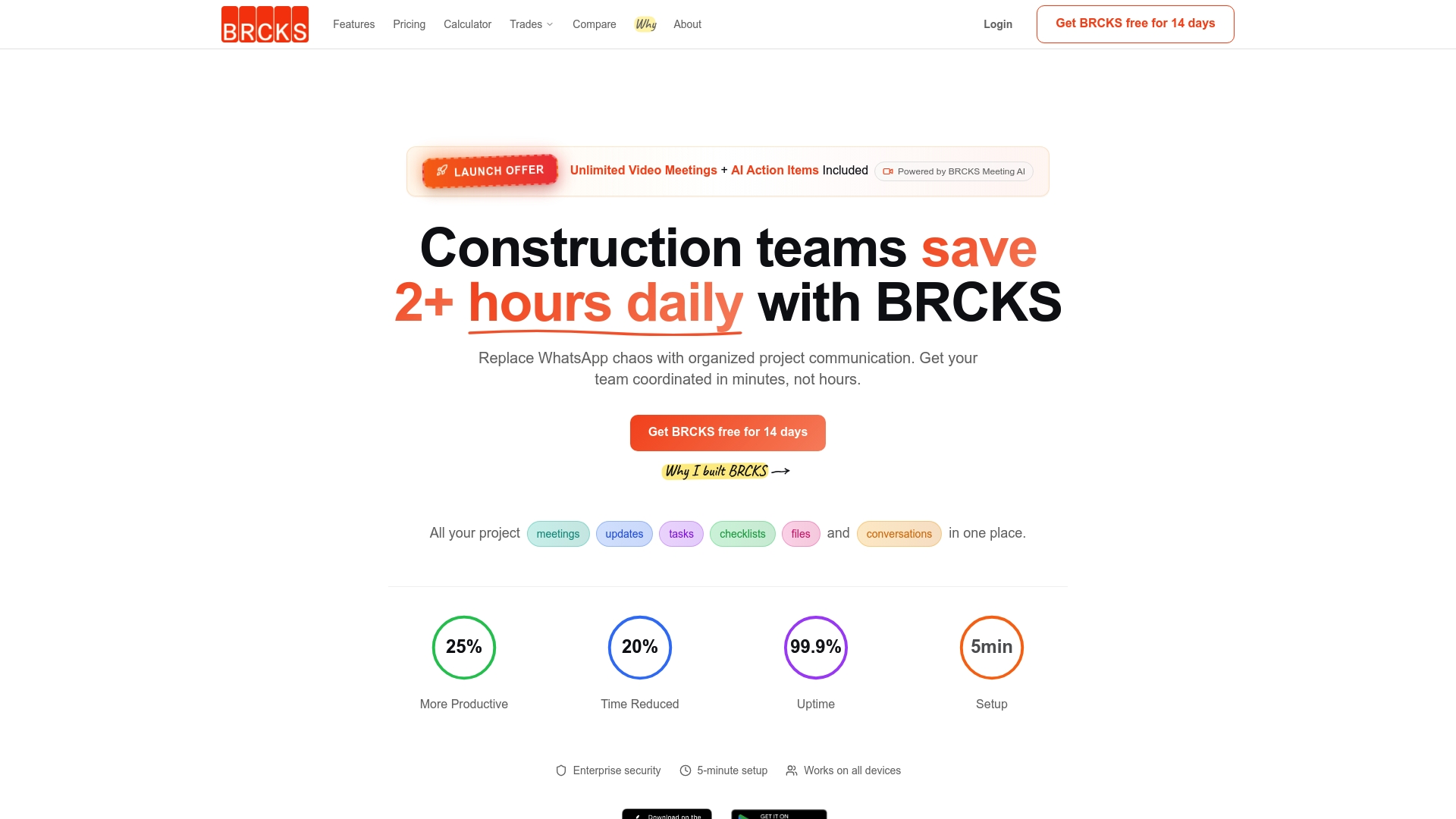
BRCKS integrates directly with WhatsApp to convert site communications into automated site diaries, RFI logs, and variation records in real time. Project managers save over two hours of manual effort daily. Client portals keep stakeholders informed without interrupting the site team’s workflow. For builders and project managers who want construction software built for site teams, BRCKS offers a 14-day free trial with no setup complexity. The WhatsApp project management workflow means your team adopts it immediately because it works the way they already work.
FAQ
What are collaborative planning methods in construction?
Collaborative planning methods are structured approaches that involve all project stakeholders, including contractors, designers, and clients, in shared decision-making from early design stages through to handover. The goal is to improve quality, reduce delays, and align risk across the project team.
What is Early Contractor Involvement and when should it start?
Early Contractor Involvement (ECI) brings the main contractor into the project at RIBA Stage 2 or earlier to contribute buildability input and risk assessment before design is finalised. Applying ECI across UK public sector infrastructure can save up to £13 billion by preventing late-stage design changes.
How does the Last Planner System improve construction scheduling?
The Last Planner System replaces top-down scheduling with short-interval commitments made by the people doing the work, supported by a 2–6 week lookahead that removes constraints before they affect delivery. Integrating LPS with digital tools like Primavera P6 significantly improves schedule adherence and team coordination.
Why is the programme-first approach important for collaborative projects?
The programme-first approach ties every planning document, including risk registers, change logs, and interface schedules, directly to the logic-linked master programme. This prevents shadow planning and maintains control when project pressure increases.
How do digital tools support collaborative planning requirements?
Digital platforms that capture and structure site communications reduce construction errors by up to 70% in UK projects. They also support NEC contract requirements for early warnings and transparent data sharing, making compliance a natural outcome of normal team communication.
Recommended
- UK Construction Project Coordination Best Practices 2026 | BRCKS
- Site Meeting Process 2026: UK Construction Guide
- BRCKS | Construction Project Communication Software
- Meaning of Project Collaboration for Site Teams | Brcks
How BRCKS Can Help
Adopting collaborative planning methods is no longer just an operational advantage but a necessity for staying competitive as we head towards 2026. BRCKS streamlines this transition by providing a centralised platform where real-time data and seamless communication bridge the gap between the office and the site. By integrating these modern workflows into your daily routine, BRCKS ensures your team remains synchronised and projects stay on schedule. We invite you to explore how our software can transform your project delivery and help you build a more integrated future. Learn more at BRCKS and explore our full feature set.