Construction business best practices: your 2026 guide
Discover essential best practices for running a profitable construction firm in 2026, from navigating UK compliance to mastering milestone-based payments.
By James Shorter ·
Construction business best practices: your 2026 guide

TL;DR:
- Running a construction business requires managing licensing, insurance, regulations, and project complexity to ensure compliance.
- Firms improve financial stability by structuring contracts with milestones, building cash flow forecasts, and choosing the right business structure.
A construction business is an organisation that plans, manages, and delivers building or infrastructure projects while coordinating workforce, compliance, client relations, and finances. Profit margins in the sector typically sit at just 2–5%, which means every operational decision carries real financial weight. Licensing, insurance, cash flow timing, and marketing are not background concerns. They are the difference between a firm that grows and one that stalls. This guide covers the practices that separate profitable contractors from those constantly fighting fires.
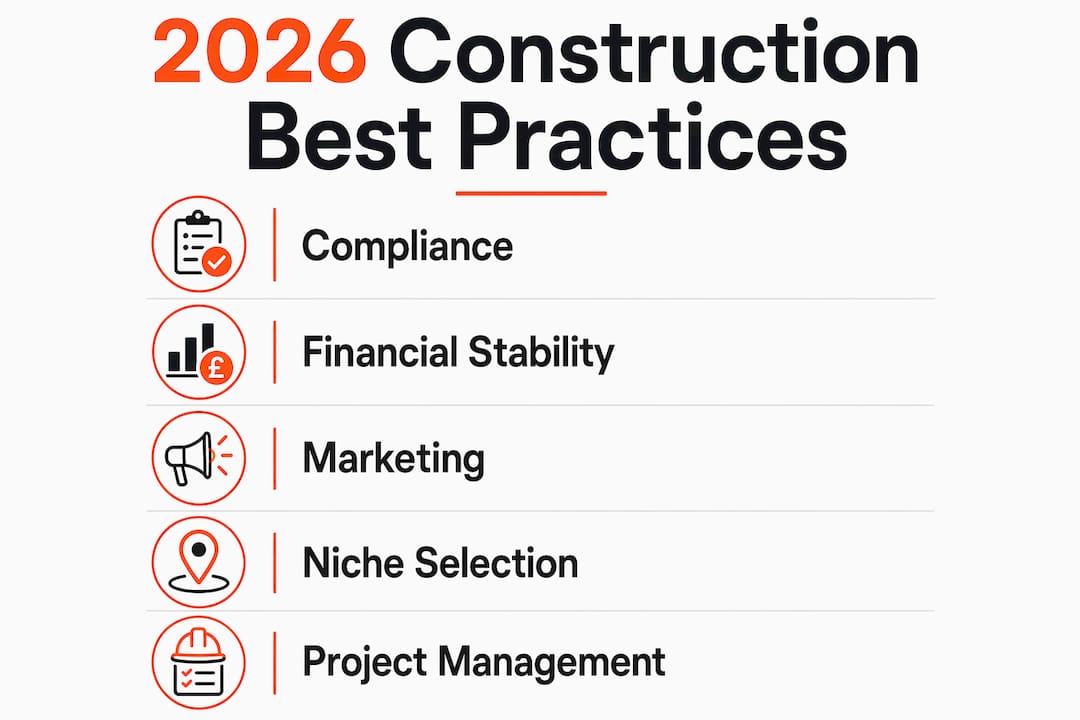
What does running a construction business actually require?
Running a construction firm means managing obligations that most industries never encounter. Licence and bonding requirements vary by jurisdiction, trade, and project type. A general contractor in England must register with Companies House, hold relevant trade qualifications, and carry appropriate insurance before taking on a single contract.
The core compliance requirements every firm must address:
- General liability insurance: Covers third-party property damage and bodily injury on site.
- Employers’ liability insurance: Legally required in the UK the moment you hire staff.
- Professional indemnity insurance: Protects against claims of negligence in design or advice.
- Licences and permits: Vary by trade. Electrical work requires Gas Safe or NICEIC registration; certain groundworks need Environment Agency permits.
- Building regulations compliance: Every project must meet current UK Building Regulations, with sign-off from a building control body.
Compliance with building code requirements is not a one-time task. Regulations update regularly, and firms that fail to track changes face enforcement action, project delays, and reputational damage.
Project management complexity adds another layer. Permits must be secured before groundbreaking. Retainage clauses in contracts can lock up 5–10% of your payment until practical completion. Subcontractor coordination, site safety compliance under the Construction (Design and Management) Regulations 2015, and client reporting all demand structured systems. A solid construction workflow management process is not optional. It is the foundation that keeps projects on programme and disputes out of court.

Pro Tip: Keep a compliance calendar that tracks licence renewal dates, insurance expiry, and regulatory update schedules. Missing a renewal can invalidate your ability to tender.
How can construction businesses improve financial stability?
General contractors operate on margins of 2–5%, which leaves almost no room for cost overruns or payment delays. That margin reality shapes every financial decision a firm makes.
The most effective financial practices for contractors:
- Structure contracts with progress payment milestones. milestone-based payments reduce the cash flow drag caused by retainage and long payment cycles. Tie invoices to measurable project stages, not calendar months.
- Build a cash flow forecast before mobilising. Map your outgoings for the first 90 days of any project before a single worker sets foot on site. Labour, plant hire, and materials all precede client payment.
- Choose your business structure deliberately. Business structure affects taxes, liability, bonding capacity, and capital raising. A sole trader cannot bond large public contracts. A limited company offers liability protection but carries reporting obligations.
- Separate project accounts from operating accounts. Mixing funds is the fastest route to misreading your cash position. Each project should have its own cost centre.
- Review your overhead monthly, not annually. Plant depreciation, vehicle costs, and office expenses creep upward. Monthly reviews catch problems before they compound.
Pro Tip: When negotiating retainage terms, push for a reducing retainage clause. This releases half the held funds at practical completion and the remainder after the defects period, rather than holding everything until the end.
| Financial area | Key action | Why it matters |
|---|---|---|
| Cash flow | Milestone payment schedules | Prevents liquidity gaps during long projects |
| Business structure | Choose Ltd vs sole trader carefully | Affects bonding, tax, and liability exposure |
| Budgeting | Monthly overhead reviews | Catches cost creep before it erodes margin |
| Retainage | Negotiate reducing clauses | Releases funds earlier, improving working capital |
A money-saving guide for builders covers additional cost control techniques specific to UK contractors, including plant hire optimisation and subcontractor payment terms.
Which marketing strategies generate leads for construction firms?
Inbound marketing generates 54% more leads than traditional outbound methods in construction. That figure matters because most contractors still rely almost entirely on word of mouth and repeat clients, leaving a significant volume of qualified enquiries on the table.
Marketing is infrastructure, not an optional extra. Firms that connect their marketing activity directly to pipeline and revenue win better-fit projects at better margins. Those that treat it as a cost to cut in lean periods find themselves competing on price alone.
The channels that work in construction:
- Search engine optimisation (SEO): Ranking for local search terms like “loft conversion contractor London” or “commercial fit-out Bristol” puts your firm in front of buyers at the moment of intent.
- Google Business Profile: A fully completed profile with photos and reviews drives local enquiries at zero media cost.
- LinkedIn: The primary B2B channel for reaching developers, architects, and facilities managers. Case study posts and project photography perform well.
- Email marketing: A monthly update to past clients and warm prospects keeps your firm front of mind when their next project starts.
- Content marketing: Project case studies, planning guides, and technical articles build authority and support SEO rankings simultaneously.
Testimonials, case studies, and reviews are the single most effective trust-building tools in construction. Lack of client trust is the primary barrier to winning bids. A portfolio of documented project outcomes, with client quotes and measurable results, addresses that barrier directly.
Construction companies typically invest 1–3% of revenue in marketing. Growth-stage firms should sit at the upper end of that range. Established firms with strong referral networks can sustain the lower end, provided they track where enquiries originate.
SEO and AI-generated search visibility are now both relevant for construction marketing. As AI-powered search tools surface answers directly, firms with well-structured, authoritative content appear in those results alongside traditional search rankings.
What niche markets offer the best opportunities in 2026?
Specialising in high-margin niches gives construction firms better pricing power and stronger market positioning than general contracting. Firms that shift from doing everything to doing one thing exceptionally well achieve greater resilience when market conditions tighten.
The most commercially attractive specialisms in 2026:
| Niche | Key demand driver | Margin advantage |
|---|---|---|
| Energy retrofitting | UK net zero targets and EPC regulations | High: government-backed demand, limited supply of qualified firms |
| Smart home integration | Consumer demand and new-build specification requirements | High: technology premium and repeat client relationships |
| Modular and offsite construction | Labour shortages and programme certainty demands | Medium-high: factory efficiency reduces waste |
| Accessible design and adaptation | Ageing population and Equality Act compliance | Medium: steady demand, less price competition |
| Commercial fit-out | Post-pandemic office reconfiguration | Medium: volume work with repeat developer clients |
| Heritage and conservation | Listed building stock and planning requirements | High: specialist skills command premium fees |
The energy retrofitting market is particularly strong. UK legislation requiring rental properties to meet minimum EPC ratings has created sustained demand for insulation, heat pump installation, and window replacement specialists. Firms with the relevant MCS certification or TrustMark accreditation can access government-backed funding schemes that their clients use to pay for the work.
Pro Tip: Before committing to a niche, map the accreditations required and the time needed to obtain them. Some certifications, like Passivhaus tradesperson status, take 12–18 months to achieve. Factor that into your business planning.
Skilled labour shortages affect generalist firms most severely. A specialist firm can train and retain a focused team, build a reputation in a defined market, and charge accordingly. A generalist firm competes for the same labour pool as every other contractor in the area.
Key takeaways
A construction business succeeds through disciplined financial management, targeted marketing, and deliberate niche selection rather than through volume of work alone.
| Point | Details |
|---|---|
| Compliance is non-negotiable | Licensing, insurance, and building regulations must be current before tendering for any project. |
| Cash flow beats profit margin | Milestone payment schedules and retainage management protect liquidity on thin-margin contracts. |
| Inbound marketing outperforms outbound | Inbound methods generate 54% more leads; invest 1–3% of revenue in a structured marketing programme. |
| Niche specialisation improves margins | Firms focused on energy retrofitting, smart homes, or heritage work command premium fees and face less price competition. |
| Business structure has strategic consequences | The choice between sole trader and limited company affects bonding capacity, tax position, and liability exposure. |
Why I think most construction firms are leaving money on the table
The contractors I see struggling most are not the ones with poor tradespeople. They are the ones running a generalist operation in a market that has quietly moved on. General contracting is a volume game with thin margins and constant price pressure. The firms growing their revenue and their profit simultaneously are almost always the ones that made a deliberate choice to specialise.
The second pattern I notice is the treatment of marketing as a luxury. A firm with a £2 million turnover investing £10,000 a year in marketing is sitting at 0.5% of revenue. That is not a marketing budget. It is a gesture. The firms winning the projects they actually want to win are the ones with a documented marketing plan, a consistent online presence, and a library of case studies that do the selling before the first meeting.
Cash flow is the third area where I see avoidable pain. Contractors sign contracts with retainage clauses they have not read carefully, then wonder why they are chasing payment six months after practical completion. Milestone-based contracts, reducing retainage clauses, and a unified project hub that keeps client communications documented and timestamped are not complicated solutions. They are standard practice in well-run firms.
The uncomfortable truth is that most of these problems are not technical. They are organisational. The firms that fix them grow. The ones that do not keep competing on price.
— James
How BRCKS supports construction firms day to day
Construction project management generates an enormous volume of communication, documentation, and admin. Most of it happens across WhatsApp threads, email chains, and paper site diaries that nobody can find when a dispute arises.
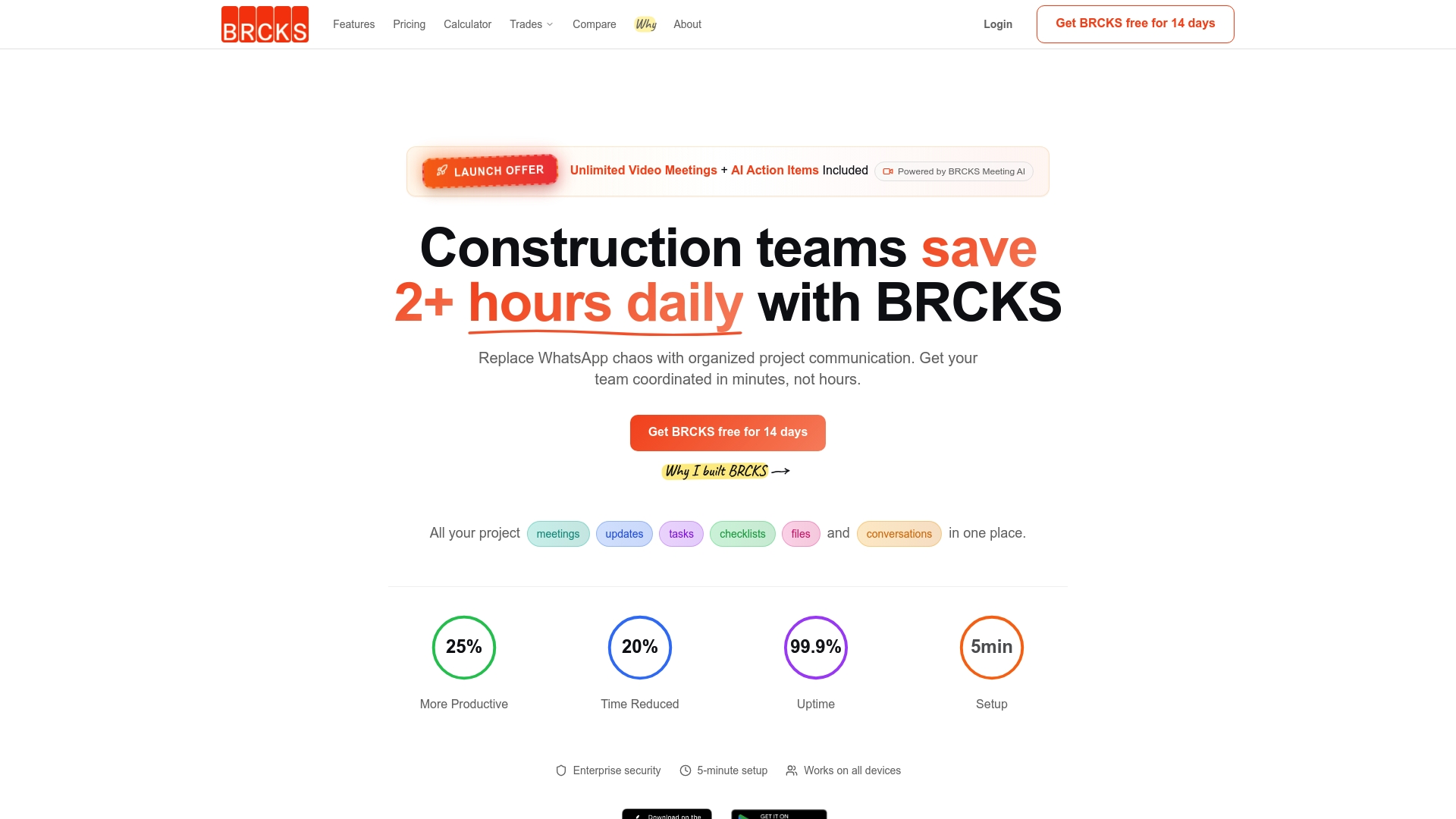
BRCKS captures that communication automatically, turning WhatsApp messages and site updates into structured records, automated site diaries, and RFI logs without adding work to your team’s day. BRCKS reports saving users over two hours of manual admin daily. For builders managing multiple projects, that time compounds quickly. Explore construction software for builders to see how BRCKS fits into your workflow, or take a look at the dedicated solution for electricians managing projects. A 14-day free trial is available with no commitment required.
FAQ
What licences does a construction business need in the UK?
Licence requirements depend on the trade. Electrical contractors need NICEIC or NAPIT registration, gas engineers need Gas Safe registration, and all firms must comply with CDM 2015 regulations on notifiable projects.
What profit margin should a construction business expect?
General contractors typically operate on margins of 2–5%. Specialist firms in high-demand niches such as energy retrofitting or heritage conservation can achieve higher margins due to reduced competition and premium pricing.
How much should a construction firm spend on marketing?
Construction companies typically invest 1–3% of annual revenue in marketing. Growth-stage firms should target the upper end of that range and track enquiry sources to measure return.
What is the best business structure for a construction firm?
A limited company suits most established contractors because it provides liability protection and supports bonding for larger public contracts. Sole trader status works for early-stage or low-turnover operations but limits bonding capacity.
How do construction firms manage cash flow on long projects?
The most effective method is structuring contracts with progress payment milestones tied to measurable project stages. This reduces the cash flow impact of retainage and avoids long gaps between invoice and payment.
Recommended
- BRCKS | Construction Project Communication Software
- UK Construction Project Coordination Best Practices 2026 | BRCKS
- Remote Construction Management: Best Practices for Success
- BRCKS | Construction Project Communication Software
How BRCKS Can Help
Adopting these best practices will ensure your firm remains competitive and resilient as the industry evolves toward 2026. BRCKS simplifies this transition by unifying project data and streamlining communication, allowing you to focus on quality delivery rather than administrative hurdles. By integrating these modern strategies into your daily operations, you can future-proof your business and achieve sustainable growth. We invite you to explore how BRCKS can transform your project management and help you stay ahead of the curve. Learn more at BRCKS and explore our full feature set.