Effective team coordination steps for construction managers
Discover how structured coordination, from BIM clash detection to daily site diaries, ensures construction projects stay on schedule and within budget.
By James Shorter ·
Effective team coordination steps for construction managers

TL;DR:
- Effective team coordination in construction requires early planning, clear roles, and live documentation to prevent costly conflicts. Regular weekly meetings, a live Construction Phase Plan, and daily site diaries help teams stay aligned and address issues promptly. Strong leadership and consistent enforcement of processes ensure projects deliver on time and within budget.
Effective team coordination is the deliberate process of aligning construction teams through clear roles, communication protocols, and scheduling to deliver projects on time and within budget. Applied correctly, these effective team coordination steps reduce rework, cut conflict resolution costs, and keep every trade moving in sequence. Field-discovered conflicts cost 5–10 times more to resolve than those caught before construction begins. That single fact makes early, structured coordination the highest-return activity a project manager can prioritise.
What prerequisites support effective team coordination?
Coordination does not begin on the first day of site work. The optimal coordination timeline starts 3–6 months before construction, with 4–8 weeks dedicated to Building Information Modelling (BIM) coordination and 2–4 weeks for integrated schedule development. Starting this early gives teams the time to identify clashes, agree on sequencing, and resolve conflicts before they become costly field problems.
The table below shows the core tools every project manager needs in place before work starts on site.
| Tool | Primary purpose |
|---|---|
| BIM (Building Information Modelling) | Clash detection and spatial coordination across trades |
| Look-ahead schedule | Short-term sequencing and trade conflict prevention |
| Communication platform | Structured channel for updates, RFIs, and decisions |
| Construction Phase Plan (CPP) | Live governance document for site coordination |
Leadership sets the tone for all of this. Before a single subcontractor arrives, the project manager must define which tools the team will use, who owns each one, and how updates flow between them. Without that clarity, even the best software sits unused.
Pro Tip: Run a pre-construction coordination workshop with all lead trades present. Use BIM clash reports as the agenda. Teams that see conflicts on screen before they hit site are far more motivated to coordinate proactively.
For a broader view of foundational coordination practices, the BRCKS resource library covers the UK-specific context in detail.
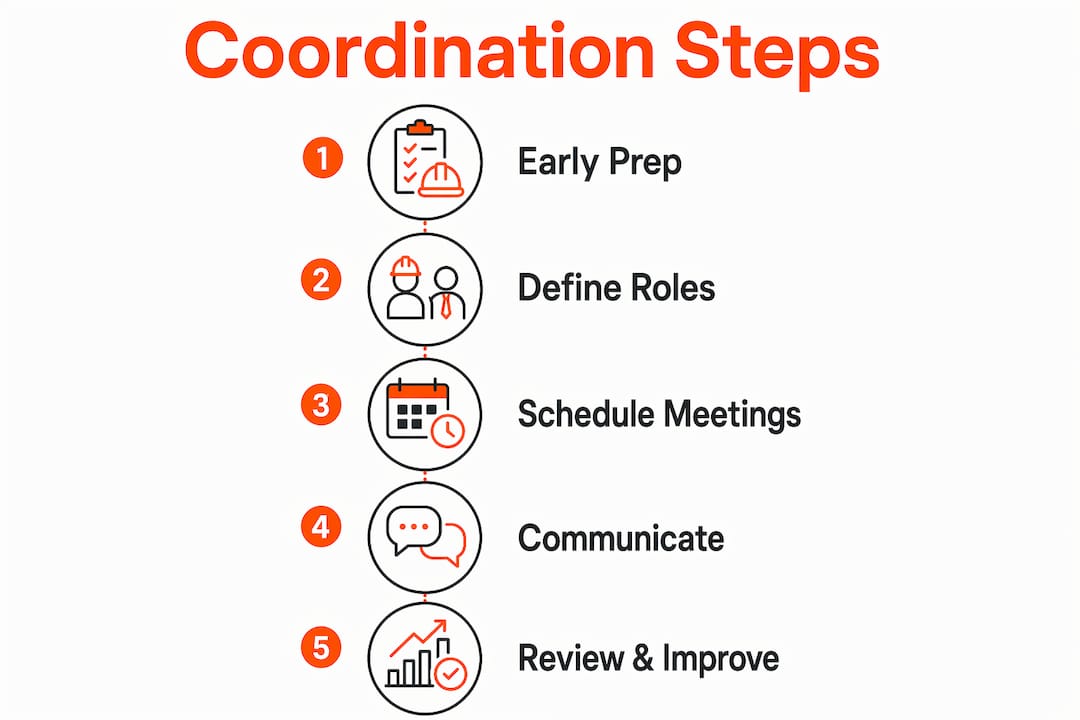
How do you establish clear roles and communication protocols?
Unclear communication channel expectations are the leading cause of coordination breakdown on construction sites. The fix is straightforward: define which channel handles which type of message before the project starts, and write it down.

A working protocol separates urgent updates from detailed discussions. Urgent safety alerts and same-day decisions belong in a fast-response channel. Formal instructions, RFIs, and variation requests belong in a documented system where records are kept automatically. Mixing these two types of communication in one place is where information gets lost.
Defined roles and responsibilities reduce duplicated effort and make communication purposeful. Every team member should know:
- Who makes decisions on programme changes
- Who raises and tracks RFIs
- Who approves variations before work proceeds
- Who is responsible for updating the look-ahead schedule each week
Early alignment meetings, held before the construction phase begins, give teams the chance to agree on these boundaries. The meetings should be short and focused. Their purpose is not to discuss the project in detail but to confirm who owns what and how the team will communicate.
Pro Tip: Create a one-page communication protocol document and share it with every subcontractor at mobilisation. Teams that have a written reference point escalate fewer issues and resolve more problems at the right level.
Reducing information loss on site starts with clear site communication workflows. Getting this right early pays dividends throughout the project lifecycle.
What are the step-by-step processes for coordinating teams during construction?
Execution is where coordination either holds or falls apart. The following steps reflect how high-performing construction teams maintain alignment from mobilisation through to practical completion.
- Publish a 3–6 week look-ahead schedule. The look-ahead schedule is the primary coordination tool in weekly meetings. It shows which trades are working where and when, making conflicts visible before they become delays.
- Run a structured weekly coordination meeting. Review the look-ahead, check BIM clash reports, assign actions, and confirm who resolves each issue before the next meeting. Keep minutes brief and circulate them the same day.
- Keep the Construction Phase Plan live. The CPP gains value as a live document reviewed at defined triggers, not as a static file produced at the start and forgotten. Trigger a review whenever scope changes, a new trade mobilises, or a programme shift occurs.
- Encourage subcontractors to raise constraints early. Early constraint raising by subcontractors shifts coordination from conflict resolution to proactive problem-solving. Create a standing agenda item in weekly meetings for constraints and blockers.
- Track all actions with named owners and due dates. An action log without ownership is a list of good intentions. Every item needs a name, a date, and a follow-up at the next meeting.
The table below summarises a weekly coordination meeting structure that works in practice.
| Meeting stage | Duration | Owner | Output |
|---|---|---|---|
| Look-ahead review | 15 minutes | Project manager | Updated 3-week programme |
| BIM clash review | 10 minutes | BIM coordinator | Clash resolution actions |
| Constraint log | 10 minutes | All trades | Constraint register update |
| Action review | 10 minutes | Project manager | Closed and open actions |
Pro Tip: Circulate the look-ahead schedule 48 hours before the weekly meeting. Trades that arrive prepared raise better constraints and the meeting runs in half the time.
For practical guidance on structuring these sessions, the construction meeting checklist from BRCKS covers agenda formats and facilitation tips.
How do you troubleshoot common coordination challenges and avoid delays?
The most common coordination failure is reactive firefighting. Teams spend their time resolving conflicts that were visible weeks earlier but never formally raised. Early coordination reduces project costs by 30–50% and shortens schedules by 25–40%. Those figures represent the difference between a project that delivers on time and one that bleeds money through rework and delay claims.
Poor communication is the second major cause of project disruption. When instructions travel through informal channels, they get misread, forgotten, or never received. The result is duplicated work, missed deadlines, and disputes over what was actually agreed.
Three tactics prevent the most common coordination failures:
- Avoid static documents. A programme printed at the start of a project is out of date within weeks. Keep all coordination documents live and version-controlled.
- Do not rely on memory. Every verbal instruction that matters must be followed up in writing, the same day, through the agreed channel.
- Address conflicts at the lowest level possible. Trade supervisors who can resolve sequencing issues between themselves should be encouraged to do so. Escalation to the project manager should be the exception, not the routine.
A daily site diary recorded in real time carries significantly greater evidentiary weight than one reconstructed from memory. Records completed by 4pm each day are the standard for commercial claims and dispute resolution. A site diary app that captures updates automatically removes the risk of gaps in the record.
Pro Tip: Set a daily 4pm cut-off for site diary entries. Teams that build this habit have a complete, timestamped record of every site event, which is invaluable when a variation or delay claim arises.
What ongoing practices keep teams aligned throughout a project?
Coordination is not a one-off setup task. It requires continuous reinforcement as the project evolves, trades change, and the programme shifts.
Periodic reviews of coordination and communication practices identify improvements and simplify workflows, building team ownership and adaptability. A monthly review of how the team is actually communicating, not just what the protocol says, surfaces problems before they become habits.
Practices that sustain coordination over the full project lifecycle include:
- Reviewing role clarity at each project phase. The team that mobilises groundworks is not the same team finishing fit-out. Role boundaries need reconfirming as trades change.
- Checking schedule adherence weekly. A look-ahead that is consistently wrong is a signal that constraints are not being raised early enough.
- Asking the team what is slowing them down. Direct feedback from site supervisors identifies friction points that managers rarely see from the office.
- Using digital tools to automate compliance monitoring. Automated RFI tracking, variation logs, and site diary capture reduce the administrative load on project managers and create a reliable audit trail without manual effort.
The goal is a coordination system that improves itself. Teams that review their own processes regularly deliver better outcomes on subsequent phases and future projects.
Key takeaways
Effective team coordination in construction requires early preparation, defined roles, live documentation, and consistent weekly discipline to prevent costly conflicts and delays.
| Point | Details |
|---|---|
| Start coordination early | Begin BIM and schedule integration 3–6 months before construction to catch conflicts cheaply. |
| Define communication channels | Specify which channel handles urgent updates versus formal instructions before work starts. |
| Use the look-ahead schedule weekly | Review a 3–6 week programme in every coordination meeting to resolve trade conflicts in advance. |
| Keep the CPP live | Trigger a Construction Phase Plan review whenever scope, trades, or programme change. |
| Record site events daily | Complete site diary entries by 4pm each day to maintain a reliable record for commercial claims. |
Why most coordination problems are leadership problems
The coordination frameworks in this article work. BIM clash detection, look-ahead scheduling, and live Construction Phase Plans are proven tools. The reason projects still run into the same coordination failures, year after year, is not a lack of tools. It is a lack of consistent leadership behaviour.
I have seen projects with excellent BIM models and weekly meetings that still descended into reactive firefighting by week six. The common thread was always the same: the project manager stopped enforcing the process when the programme got tight. Subcontractors stopped raising constraints because they had learned that nothing happened when they did. The weekly meeting became a status update rather than a coordination session.
The shift from reactive to proactive coordination is a leadership decision, not a software decision. Technology helps. Automated site diaries, RFI tracking, and real-time communication capture reduce the administrative burden significantly. But no tool replaces a project manager who holds the team to the process, week after week, regardless of programme pressure.
My honest advice: treat your coordination meeting as the most important 45 minutes of your week. Protect it. Prepare for it. And follow up every single action before the next one.
— James
How BRCKS supports coordination across your project team
Construction teams that apply these coordination steps still face one persistent problem: the administrative burden of capturing everything. Instructions sent over WhatsApp, verbal decisions on site, and variation requests raised informally all create gaps in the record.

BRCKS is built for construction builders and project managers who need those gaps closed automatically. It captures WhatsApp communications in real time, generates automated site diaries, tracks RFIs, and maintains a structured variation log, saving project teams over two hours of manual effort every day. The client portal keeps stakeholders informed without pulling the project manager away from site. Try BRCKS free for 14 days and see how much administrative time your team gets back.
FAQ
What are the first steps to coordinate a construction team?
Define roles, assign communication channels, and publish a look-ahead schedule before construction begins. Starting BIM coordination 3–6 months before site work identifies conflicts at a fraction of the cost of resolving them on site.
How often should construction coordination meetings take place?
Weekly coordination meetings are the standard for active construction projects. Each session should review the look-ahead schedule, address BIM clashes, and assign named owners to every open action.
What is a look-ahead schedule in construction?
A look-ahead schedule is a short-term programme, typically covering 3–6 weeks, that shows which trades are working where and when. It is the primary tool for identifying and resolving sequencing conflicts before they cause delays on site.
Why is the Construction Phase Plan important for team coordination?
The CPP sets out how the project will be managed and coordinated on site. Treated as a live document and reviewed at defined triggers, it keeps coordination aligned with actual site conditions rather than the assumptions made at the start of the project.
How does a daily site diary help with team coordination?
A site diary recorded in real time provides a timestamped record of decisions, instructions, and events. That record is the foundation for resolving disputes, supporting variation claims, and maintaining accountability across the project team.
Recommended
- UK Construction Project Coordination Best Practices 2026 | BRCKS
- Checklist for Effective Construction Meetings | BRCKS
- BRCKS | Construction Project Communication Software
- BRCKS | Construction Project Communication Software
How BRCKS Can Help
Mastering team coordination is the foundation of any successful build, but manual processes often hinder even the most experienced managers. BRCKS simplifies this challenge by centralising communication and providing real-time visibility across every stage of your project. By integrating these collaborative habits with our intuitive platform, you can eliminate bottlenecks and ensure your site runs like clockwork. We invite you to discover how BRCKS can transform your workflow by exploring our features today. Learn more at BRCKS and explore our full feature set.