Improving team productivity steps for construction managers
Learn the structured governance and digital workflows required to boost site output and reduce project overruns in the UK construction sector.
By James Shorter ·
Improving team productivity steps for construction managers
TL;DR:
- Proactive construction management involves early coordination, disciplined communication, and workforce development to boost productivity. Digital tools like BIM, real-time data, and standardised workflows improve project tracking and reduce delays. Effective governance and clear accountability are essential for realising this potential and preventing project overruns.
Improving team productivity steps are deliberate, structured actions that construction managers take to reduce rework, align project goals, and cut schedule overruns. The UK construction sector has long grappled with productivity gaps, and the gap between high-performing and average sites is not accidental. It comes down to governance, communication, digital adoption, and workforce development. This guide covers each of those areas with specific techniques drawn from 2026 industry practice, giving you a clear framework to raise output on your next project without adding headcount.
How does multidisciplinary collaboration reduce rework and delays?
Early coordination between engineers, contractors, and specialists is the single most effective way to cut rework. Integrating multidisciplinary teams early in a project reduces rework by up to 30% and schedule overruns by 15%. That figure reflects what happens when clashes are caught in a model rather than on site.
BIM coordination is the standard mechanism for achieving this. Teams using disciplined BIM coordination report 50–70% fewer on-site clashes and can save 5–12% off whole-life project costs. Fewer clashes mean fewer variation orders, fewer delays, and less pressure on your programme.
Governance structures make the difference between a team that collaborates and one that merely communicates. For projects around £25m, fortnightly steering group meetings with mandatory clash detection reviews are an established industry standard. A neutral chair, a clear RACI matrix, and defined approval windows prevent scope creep from accumulating unnoticed.
The core team composition matters too. Teams of 6–12 specialists mapped via a formal RACI chart reduce duplicated effort and clarify accountability. A typical setup includes a project manager, lead estimator, design lead, site foreman, M&E coordinator, and procurement lead. Each person knows their lane, and the RACI makes escalation paths explicit.
- Appoint a neutral steering group chair with authority to resolve disputes quickly.
- Run clash detection reviews at every fortnightly meeting, not just at design milestones.
- Map every team member to the RACI chart before mobilisation, not after problems arise.
- Use integrated contracts where possible to align commercial incentives with collaborative behaviour.
Pro Tip: Set a standing agenda item at every steering group for “emerging clashes.” Teams that name clashes early resolve them in hours. Teams that wait resolve them in weeks.
What digital tools actually improve team performance monitoring?
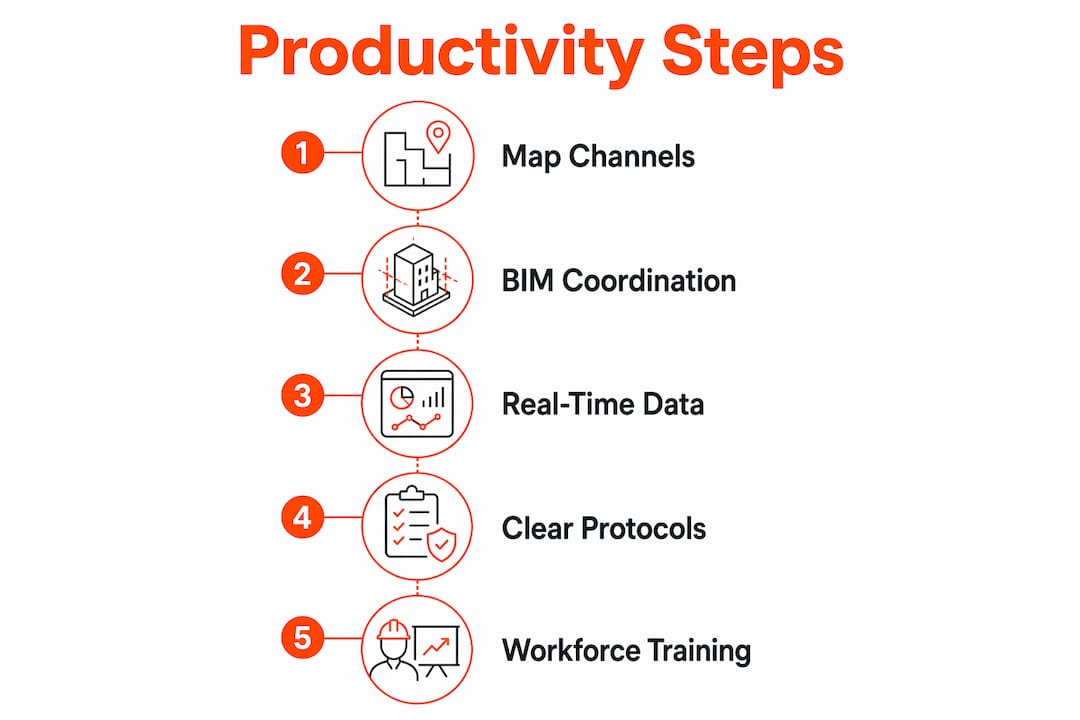
Real-time data is the foundation of accurate progress tracking. The Mace Group’s Timber Square project demonstrated that triangulating crane telemetry, video capture, and turnstile data with daily site diaries produces far more reliable metrics than manual reporting alone. Each data source validates the others, removing the guesswork that distorts weekly progress reports.

AI in project management has moved beyond scheduling assistance. AI now acts as critical infrastructure for structured data, predictive risk control, and compliance under the Building Safety Act. It augments engineering judgement rather than replacing it, flagging risk patterns that a site manager reviewing spreadsheets would miss.
A connected digital ecosystem with standardised productivity metrics enables consistent performance interpretation across projects. That consistency is what makes benchmarking meaningful. Without it, each project team defines progress differently, and you cannot compare sites or identify systemic problems.
| Monitoring method | What it measures | Key benefit |
|---|---|---|
| Crane telemetry | Lift frequency and load cycles | Validates labour productivity claims |
| Video capture | Workforce density and movement | Identifies idle time and bottlenecks |
| Turnstile data | Actual site attendance | Cross-checks against reported headcount |
| Site diaries | Daily activities and weather | Provides narrative context for data anomalies |
| AI predictive tools | Schedule risk and compliance flags | Enables early intervention before delays compound |
Pro Tip: Never rely on a single data source for progress reporting. If your crane telemetry shows high activity but turnstile data shows low attendance, you have a reporting problem worth investigating immediately.
Connecting your digital workflows in construction to a single platform removes the version control issues that plague multi-tool environments. When every team member reads from the same data set, decisions are faster and disputes are shorter.
How do you establish communication protocols that prevent delays?
Communication failures in construction almost always trace back to the same root cause: multiple uncoordinated platforms running simultaneously without clear ownership. Mandating a single source of truth per information type and running weekly cross-discipline stand-ups with tight scope change reviews are the two practices that prevent drift most reliably.
The steps below give you a practical framework for setting communication standards on any project:
- Designate one platform per information type. Drawings live in one place. RFIs live in one place. Variations live in one place. Teams that use WhatsApp for drawings, email for RFIs, and spreadsheets for variations create three separate audit trails and guarantee something gets missed.
- Set weekly cross-discipline stand-ups. Keep them to 30 minutes with a fixed agenda. Each discipline reports progress, flags blockers, and confirms next-week commitments. The meeting is not a forum for problem-solving; it is a forum for surfacing problems so they can be solved offline.
- Enforce a 48-hour scope change review window. Weekly stand-ups and 48-hour scope reviews prevent decision drift and improve decision velocity. When a variation lands, the team has two working days to assess impact on programme and cost before it is formally accepted or rejected.
- Assign a communication lead for each discipline. One person per trade owns the information flow for their team. This eliminates the “I thought someone else sent that” problem that delays approvals.
- Audit your communication channels quarterly. Remove any platform that duplicates a function already covered. Every redundant channel is a liability, not a backup.
Good digital communication strategies do not require expensive enterprise platforms. They require discipline and clear expectations set at project kick-off. The technology is secondary to the protocol.
For teams managing complex project management workflows, the principle is the same: fewer channels, clearer ownership, faster decisions.
How does workforce development sustain long-term team efficiency?
Workforce capacity is a productivity constraint that no amount of digital tooling can fix on its own. The UK government’s £625m training package aims to train 60,000 construction workers by 2029, including 10 new building colleges and over 40,000 funded industry placements annually. That investment signals the scale of the skills gap construction managers are working against.
Workforce morale and inclusivity are directly linked to productivity. Structured pathways and mentoring improve retention and team capacity. Partnerships with local training providers open under-represented talent pools to meet demand at scale. This is not a diversity initiative separate from productivity. It is a productivity strategy.
Practical steps for building workforce capacity on your projects:
- Partner with local colleges to create a pipeline of trainees who know your systems before they arrive on site.
- Pair new recruits with experienced site staff for the first 90 days. Mentoring reduces early attrition and accelerates competence.
- Create visible progression routes. Workers who can see a path from labourer to foreman to site manager stay longer and perform better.
- Run short, focused toolbox talks on process changes rather than relying on written notices. Verbal briefings land faster on busy sites.
- Track attendance at training sessions the same way you track site attendance. If uptake is low, the training is not relevant or accessible enough.
Inclusive recruitment expands your available talent pool at a time when skilled labour is genuinely scarce. Teams that recruit from a wider range of backgrounds consistently report better problem-solving and lower turnover. The residential construction sector has seen measurable gains from combining digital tools with structured workforce development, with some projects reporting 5–8% cost savings from the combination.
Key takeaways
Improving team productivity in construction requires combining early multidisciplinary coordination, real-time data monitoring, disciplined communication protocols, and sustained workforce development into a single, consistent approach.
| Point | Details |
|---|---|
| Integrate teams early | Early BIM coordination cuts on-site clashes by 50–70% and reduces whole-life costs by 5–12%. |
| Use triangulated data | Combine crane telemetry, video, and turnstile data to validate progress and catch reporting errors. |
| Mandate one platform per information type | Single-source communication prevents audit trail fragmentation and speeds up decisions. |
| Enforce 48-hour scope change reviews | Fast variation assessment stops scope creep from compounding into programme overruns. |
| Invest in workforce pathways | Mentoring, local college partnerships, and visible progression routes improve retention and long-term output. |
Why technology alone will not fix your team’s productivity
I have worked alongside construction managers who invested heavily in monitoring platforms, AI scheduling tools, and digital dashboards, then watched their projects run late anyway. The technology was not the problem. The governance was.
The teams that consistently deliver on programme share one trait: they treat communication protocols and accountability structures with the same rigour they apply to their programme. A RACI chart that nobody enforces is decoration. A weekly stand-up that drifts to 90 minutes with no fixed agenda becomes a morale drain rather than a coordination tool.
What I find most managers underestimate is the compounding effect of small communication failures. A variation that sits unreviewed for a week does not just delay that one decision. It delays every downstream activity waiting on it. The 48-hour review rule exists precisely because construction programmes have no slack to absorb slow decisions.
The other thing worth saying plainly: AI and real-time monitoring tools are genuinely useful, but they amplify good processes and amplify bad ones equally. If your site diaries are inconsistent, your AI-generated risk reports will be inconsistent. Garbage in, garbage out applies as much to a £200,000 monitoring platform as it does to a spreadsheet.
Build the human systems first. Then layer the technology on top.
— James
How BRCKS supports construction teams day to day
Construction teams that replace fragmented WhatsApp threads and email chains with a structured platform recover significant time every week. BRCKS is built specifically for this problem.
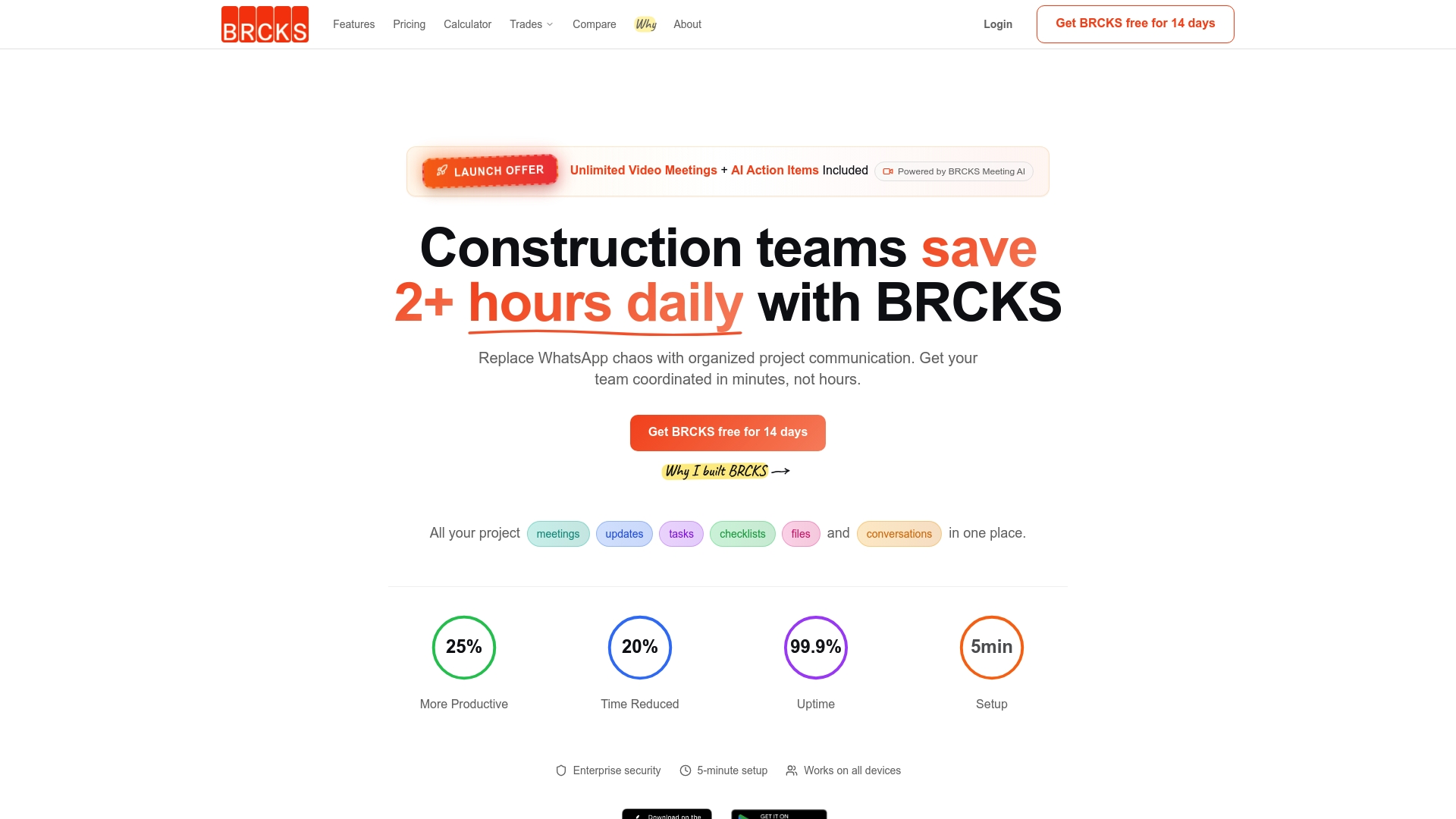
BRCKS captures site communications in real-time, automates site diary entries, and maintains a structured variation log and RFI tracker, all within a single platform. Teams using BRCKS report saving over two hours of manual admin daily. The site diary app removes the end-of-day scramble to reconstruct what happened on site, and the client portal keeps stakeholders informed without pulling your team into unnecessary update calls. For builders looking to bring their whole workflow into one place, BRCKS for builders is a practical starting point. Try it free for 14 days.
FAQ
What are the first steps to improve construction team productivity?
Start by mapping your current communication channels and identifying where information gets lost or duplicated. Then introduce a single platform per information type and run weekly cross-discipline stand-ups with a fixed agenda.
How does BIM coordination improve team performance?
BIM coordination reduces on-site clashes by 50–70% by catching design conflicts in the model before work begins. Fewer clashes mean fewer variations, less rework, and a more predictable programme.
What is a RACI matrix and why does it matter for construction teams?
A RACI matrix assigns Responsible, Accountable, Consulted, and Informed roles to every key task or decision. It removes ambiguity about who owns what, which speeds up approvals and reduces duplicated effort on site.
How can construction managers address the UK skills shortage?
Partnering with local colleges, offering funded industry placements, and creating structured mentoring programmes are the most direct routes. The UK government’s £625m training package provides a framework that managers can align their own workforce strategies with.
What is the 48-hour scope change rule?
The 48-hour scope change rule requires teams to assess the programme and cost impact of any variation within two working days of it being raised. This prevents unreviewed variations from accumulating and causing compounding delays.
Recommended
- BRCKS | Construction Project Communication Software
- Construction Project Management Insights | BRCKS Blog
- Checklist for Effective Construction Meetings | BRCKS
- BRCKS | Construction Project Communication Software
How BRCKS Can Help
Boosting productivity on-site requires a delicate balance of clear communication and streamlined workflows. By centralising your project data and automating routine administrative tasks, BRCKS empowers construction managers to focus on high-impact decision-making rather than manual paperwork. Our platform is designed to bridge the gap between the office and the field, ensuring your team remains synchronised and efficient throughout every phase of the build. We invite you to discover how BRCKS can transform your operational performance by exploring our features today. Learn more at BRCKS and explore our full feature set.