Master construction action items for project success
Discover how to transform on-site execution by mastering construction action items. Learn the SMART framework to ensure accountability and prevent project delays.
By James Shorter ·
Master construction action items for project success
 A purpose-built construction snagging software keeps these items tracked through to sign-off.
TL;DR:
- Effective construction project management relies on documenting and tracking clear action items to ensure accountability and prevent costly delays. Structured routines and digital tools improve visibility, reinforce timely completion, and build trust among teams and clients. Embedding these practices into project workflows enhances coordination, reduces rework, and ensures smoother delivery of construction projects.
Even the best-planned construction projects can fall apart at the execution stage. A meeting ends, decisions are made, but nobody writes down who is doing what or by when. Tasks drift, deadlines pass, and suddenly you are dealing with costly rework, frustrated subcontractors, and a client who has lost confidence in your team. Construction action items are specific, documented tasks arising from meetings, discussions, or project reviews, assigned to individuals with deadlines, owners, and status tracking to ensure accountability and progress. This article gives you a clear, practical framework for using them effectively on UK sites.
Table of Contents
- What are construction action items and why do they matter?
- The SMART anatomy of effective action items
- How action item tracking boosts project delivery
- Best practices: Making action items work on your construction site
- The uncomfortable truth: Why many construction teams fail at action items
- Next steps: Streamline action items with modern construction software
- Frequently asked questions
Key Takeaways
| Point | Details |
|---|---|
| Defined tasks mean progress | Action items clarify responsibilities and deadlines, driving projects forward. |
| SMART action items work best | Specific, measurable action items prevent confusion and boost task completion. |
| Tracking prevents delays | Maintaining an action item log reduces risk of missed tasks and costly hold-ups. |
| Best practices ensure results | Routines, review sessions, and digital tools keep teams accountable on any sized project. |
What are construction action items and why do they matter?
Now that you have recognised this core issue, let us lay out exactly what construction action items are and why they transform on-site execution.
A construction action item is more than a note on a pad. It is a formal, structured task that has been captured, assigned, and tracked. The difference between an action item and a verbal instruction is accountability. When something is documented, ownership is clear. When it is only spoken, it is easily forgotten or disputed.
“Construction action items are specific, documented tasks arising from meetings, discussions, or project reviews, assigned to individuals with deadlines, owners, and status tracking to ensure accountability and progress.”
Action items typically originate from:
- Site meetings and progress reviews where tasks are identified and delegated
- Client briefings where scope changes or queries require follow-up
- Safety inspections where hazards or non-compliances must be rectified
- Design coordination sessions where clashes or queries need resolution
- Subcontractor handovers where responsibility passes between trades
Each of these situations generates tasks. Without a structured system, those tasks live only in someone’s memory or in a WhatsApp message that gets buried under thirty other notifications.
The consequences of skipping action item documentation are well documented. Teams that rely on structured tracking consistently report improved execution rates and fewer delays compared to those using informal methods. On UK construction projects, where margins are already tight and client expectations are high, the cost of a missed task is rarely just the task itself. It is the knock-on effect across the programme.
Linking your action items to strong document control in construction practices means every task is traceable and auditable. This is particularly important during disputes or at practical completion, where your handover documentation guide will rely on a full record of decisions made and actions completed.
The SMART anatomy of effective action items
Having laid out the big picture, it is time to get specific: what makes an action item truly effective?
The SMART framework is widely used in project management and applies directly to construction. An action item that follows SMART principles is Specific, Measurable, Achievable, Relevant, and Time-bound. Each of these attributes removes ambiguity and increases the likelihood that the task will be completed correctly.
Here is a practical breakdown of what each element looks like in a construction context:
| SMART attribute | What it means | Construction example |
|---|---|---|
| Specific | Clear description of what needs doing | “Submit revised drainage layout to structural engineer” |
| Measurable | Success can be confirmed | “All 12 window fixings torqued to specification” |
| Achievable | Realistic for the assigned person | Assigned to a competent trades supervisor |
| Relevant | Linked to project progress | Tied to the upcoming inspection milestone |
| Time-bound | Hard deadline, not “when possible” | Completed by Thursday 17:00 |
When you structure your action items this way, there is no room for interpretation. The person responsible knows exactly what is expected and when.
To write an effective action item every time, follow these steps:
- State the task clearly. Avoid generic instructions like “sort out the drainage issue.” Instead write: “Confirm the gradient of the surface water drain from manhole 3 to the soakaway meets the engineer’s specification.”
- Assign a single owner. Tasks assigned to a group are tasks assigned to nobody. One person holds responsibility, even if others support them.
- Set a firm deadline. A date and time. Not “end of week” but “Friday 12:00.”
- Define the priority level. Is this blocking another trade, or is it a low-risk admin task? Priority helps teams triage when workloads spike.
- Specify the output. What does “done” look like? A signed-off drawing, a confirmation email, a photograph uploaded to the site record?
Good document control methods ensure that completed action items are filed correctly and traceable.
Pro Tip: At the end of every site meeting, read back the action items before anyone leaves. This takes less than two minutes and immediately flags any misunderstandings about ownership or deadlines. Teams that do this consistently report far fewer disputes about what was agreed.
Common mistakes to avoid include writing vague tasks (“chase the supplier”), assigning tasks to job titles rather than named individuals, and failing to update status after completion. These gaps are where accountability breaks down.
How action item tracking boosts project delivery
Once you know how to write a strong action item, the next step is ensuring those items are not lost or forgotten. This is where tracking comes in.

Tracking is the practice of recording each action item in a central register and updating its status regularly. This sounds simple, but it is where most teams fall down. They write the action item in the meeting minutes, and then nobody looks at those minutes again until the next meeting, by which point the deadline has already passed.
Teams that use structured tracking for action items consistently outperform those relying on informal methods. The reason is straightforward: visibility creates accountability. When everyone can see the list and their name against an overdue task, the social and professional pressure to act is real.
Here is a comparison of how projects perform with and without structured tracking:
| Factor | Without structured tracking | With structured tracking |
|---|---|---|
| Task visibility | Low, relies on memory or notes | High, central register accessible to all |
| Accountability | Disputed or unclear | Named owner, clear deadline |
| Follow-up | Ad hoc, often at next meeting | Regular status reviews |
| Delay risk | High, tasks missed routinely | Reduced, early warning via status |
| Rework frequency | Higher due to miscommunication | Lower, tasks completed to specification |
| Audit trail | Minimal or non-existent | Complete, traceable record |
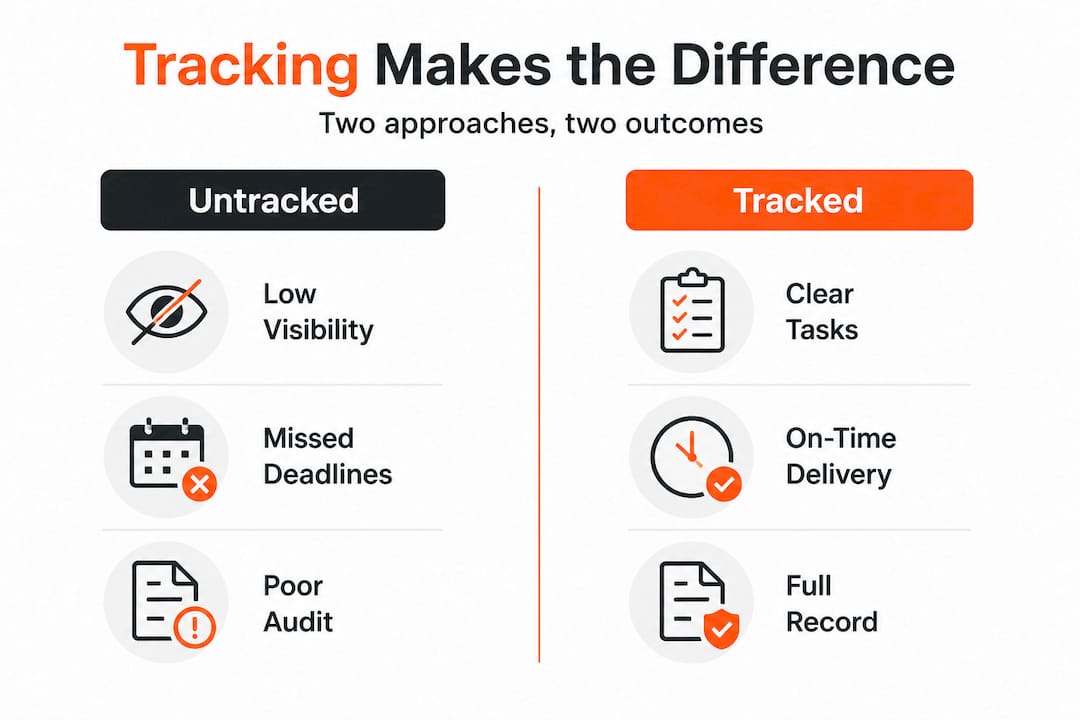
The impact on communication workflow is significant. When your team knows that action items are tracked and reviewed, the culture of follow-through strengthens. People stop assuming someone else will pick it up.
Poor communication on construction projects carries a substantial financial cost. Analysis of rework costs from communication breakdown in UK construction shows that unclear instructions and missed tasks are among the top drivers of expensive rework. Structured action item tracking directly addresses this by removing the ambiguity that leads to errors.
Quick-win communication practices for team leaders include:
- Opening every site meeting by reviewing the previous action item register, not by launching into new business
- Sending a written summary of action items within one hour of every meeting
- Using software with status flags so overdue items trigger automatic notifications
- Holding a five-minute daily stand-up on critical-path action items during busy phases
- Sharing the action item list with clients where appropriate, to demonstrate progress and build confidence
The role of real-time updates in construction cannot be overstated. When your team can update task status from the site on a mobile device, the register stays current and accurate, rather than being a snapshot that is already outdated by the time it reaches the office.
Pro Tip: Colour-code your action item register using three statuses: green for complete, amber for in progress, red for overdue. A quick visual scan at the start of any meeting tells you everything you need to know about project health in under thirty seconds.
Best practices: Making action items work on your construction site
With the why and how of tracking clear, let us put it into practice with actionable steps for your next site meeting.
The most effective action item systems are built into the rhythm of the project, not bolted on as an afterthought. This means creating review routines at different intervals.
Follow these steps to embed action items into your site management:
- Daily review. At the start of each working day, the site manager checks all action items due that day or tomorrow. Any at risk of slipping are escalated immediately, not at the next weekly meeting.
- Weekly team review. Every week, the full action item register is reviewed with the relevant team leads. Completed items are closed. New items from the week are added. Priorities for the coming week are confirmed.
- Post-meeting capture. Within sixty minutes of any meeting, a written summary of action items is distributed to all attendees. This is non-negotiable. Verbal handovers degrade quickly.
- Monthly programme alignment. Once a month, action items are cross-referenced against the project programme using schedule management tools to confirm nothing critical has been missed or deprioritised.
- Formal close-out. At key milestones, review and formally close all completed action items. Archive them as part of your project record.
Teams working on complex or multi-phase projects also benefit from decision tracking alongside action item registers. This ensures that when a decision drives an action, both the decision and the resulting task are documented together.
Best practice tracking reinforces the value of consistent review routines. Without them, even the best action item register becomes a list nobody looks at.
Common pitfalls to avoid:
- Scope creep within action items. An action item should be a single, discrete task. If it grows in complexity, break it into multiple items.
- Unclear owners. Never write “site team” or “management” as the owner. One name, one responsibility.
- Missing context. The action item should explain why it exists, not just what needs to be done. Context helps the owner complete it correctly without needing to ask questions.
- Forgetting to close items. Completed tasks that remain open on the register create noise and erode trust in the system.
For small teams, a shared spreadsheet can work initially. For larger operations, purpose-built construction software eliminates the manual effort and ensures nothing falls through the gaps.
Pro Tip: On smaller sites, make the action item list visible physically, printed and pinned in the site office. Visibility drives behaviour. When people see the list every day, they act on it. Digital-only lists can be too easily ignored.
The uncomfortable truth: Why many construction teams fail at action items
You have mastered the playbook. Here is why even strong plans sometimes fail in the real world, and how to address it.
The uncomfortable reality is that most teams know what good action item management looks like. They have read the guidance, attended the training, and introduced the register. Yet within a few weeks, the system quietly collapses. The register is not updated. The weekly review gets skipped. The WhatsApp group fills up again with verbal instructions that disappear into the noise.
Why does this happen? The answer is culture, not process. Writing down tasks feels like bureaucracy to a team under pressure to get concrete poured by Friday. Following up on colleagues feels confrontational in a culture where trust is built on personal relationships and word of mouth.
The difference between teams that make action items work and those that do not is not the quality of their spreadsheet. It is whether every person on the team, from the project manager to the site operative, believes that the system exists to help them, not to catch them out.
Transparency is the hardest part. Sharing an action item register with a client or a senior stakeholder means your delays and missed tasks are visible. That feels uncomfortable. But it is also what builds the long-term trust that wins repeat business. Teams that commit to ending scattered communications and replacing them with structured, transparent systems consistently report stronger client relationships and fewer disputes.
The solution is not more enforcement. It is embedding action item reviews so deeply into the project rhythm that skipping them feels abnormal. When the weekly action item review is as routine as the Monday morning safety briefing, the system sustains itself.
Next steps: Streamline action items with modern construction software
If you are ready to move from spreadsheets and sticky notes to streamlined digital action items, here are tailored solutions for UK builders and project managers.
Managing action items manually across emails, WhatsApp, and spreadsheets creates exactly the kind of fragmentation this article is designed to help you avoid. BRCKS is built specifically for construction teams who need one place to track tasks, share updates, and keep clients informed.

With BRCKS, your action item tools for builders include task assignment, status tracking, file sharing, and automated reminders, all accessible on any device from site. The platform’s construction communication software replaces the noise of scattered messages with structured, searchable project communication. Teams save over two hours a day by consolidating their tools. Subcontractor access is free, and setup takes minutes. Try BRCKS free for 14 days and see how much clearer your action item process can be.
Frequently asked questions
What is an example of a construction action item?
A construction action item might read: “Order 10 pallets of engineering bricks by Friday 12:00, assigned to the site manager, status tracked in the project action item register.” This follows the SMART format with a clear owner, deadline, and measurable output.
How does action item tracking reduce delays?
Structured tracking ensures every team member knows their responsibilities and deadlines, so fewer tasks are forgotten or deprioritised, which directly reduces the knock-on delays that push projects over programme.
Are action items only for big projects?
No. Even a two-person refurbishment team benefits from clear, well-tracked action items because the principles of ownership, deadlines, and accountability apply regardless of project size or team headcount.
What is the difference between a snag list and an action item list?
A snag list captures defects or incomplete works that need rectification before practical completion, whereas an action item list covers all tasks requiring follow-up at any stage of the project, from design through to handover.
Recommended
- BRCKS | Construction Project Communication Software
- BRCKS | Construction Project Communication Software
- BRCKS | Construction Project Communication Software
- Document Control in Construction: Streamline UK Projects | BRCKS
How BRCKS Can Help
Mastering action items is essential for keeping your projects on track and ensuring nothing falls through the cracks during a busy build. By centralising these tasks within BRCKS, you can easily assign responsibilities, track progress in real time, and maintain a clear audit trail for every decision made on-site. This streamlined approach reduces administrative friction and allows your team to focus on delivering high-quality results without the stress of manual tracking. We invite you to explore how BRCKS can transform your project management and help you achieve greater operational efficiency today. Learn more at BRCKS and explore our full feature set.