Project management terminology guide for UK construction teams
Clear construction terminology prevents costly miscommunications and project delays. Build a shared language to ensure consistent understanding across your UK site teams.
By James Shorter ·
Project management terminology guide for UK construction teams

TL;DR:
- Clear construction terminology prevents costly miscommunications and project delays across UK teams.
- Developing, documenting, and reinforcing a shared glossary ensures consistent understanding among all stakeholders.
When two people use the same word and mean entirely different things, projects suffer. In UK construction, this happens more often than most project managers care to admit. A subcontractor hears “handover” and thinks practical completion; the client means full sign-off including the snagging list. That single miscommunication can trigger disputes, rework, and delays that push budgets past breaking point. This guide covers the most critical project management terms, explains their practical meaning in a UK construction context, and shows you how to build a shared language across your entire team, from site to boardroom.
Table of Contents
- Why clear terminology matters in construction project management
- Key project management terms every UK construction team should know
- How terminology shapes construction team workflows
- Best practices for embedding project terminology in your team
- Expert perspective: Why most construction teams struggle with terminology and how to break the cycle
- Make terminology work for your construction team with BRCKS
- Frequently asked questions
Key Takeaways
| Point | Details |
|---|---|
| Standard language boosts efficiency | Sharing common project terms like WBS and PID reduces rework and costly miscommunication. |
| Glossaries help teams align | Clear, accessible glossaries make sure everyone on the job understands key milestones and instructions. |
| Terminology impacts daily workflow | Using agreed language for reporting, procurement and snagging streamlines on-site and office collaboration. |
| Update terminology regularly | Revisit your team’s glossary each project for accuracy as standards or roles change. |
Why clear terminology matters in construction project management
Words carry weight on a construction site. When a project manager tells the site foreman to begin “procurement,” does the foreman understand whether that means issuing purchase orders, selecting suppliers, or simply requesting quotes? The ambiguity is real, and the consequences are measurable.
Miscommunication and rework are not minor inconveniences. Rework alone consumes 25% of total project time, largely because teams operate with inconsistent definitions for core terms. Standardising terminology, whether drawing from PRINCE2’s Project Initiation Documentation (PID) framework or PMBOK’s Work Breakdown Structure (WBS), creates a shared reference point that removes guesswork from daily decision-making. You can also explore coordination best practices for further guidance on aligning your site and office teams.
Some of the most frequently misunderstood terms in UK construction include:
- Snag: A defect or incomplete item identified before or during handover. Not the same as a defect that occurs post-completion.
- Scope: The defined boundaries of what the project will deliver. “Scope creep” is the gradual, often undocumented, expansion beyond those boundaries.
- Handover: The formal transfer of a completed building or phase to the client. Different parties often assume this includes different documents and sign-off stages.
- Procurement: The full process of identifying, selecting, contracting, and paying for goods and services. Often used loosely to mean just “ordering materials.”
- WBS (Work Breakdown Structure): A hierarchical breakdown of all project deliverables into manageable components. Frequently confused with a simple task list.
The UK Government Project Delivery Glossary provides standardised definitions for public sector project terminology that can serve as a useful reference point for any UK construction team, regardless of whether the project is public or private sector.
“Shared language is not a soft skill. It is a structural component of project delivery. Without it, even competent teams build the wrong thing at the wrong time.”
Pro Tip: Create a one-page project glossary at the start of every job and pin it to the site cabin notice board. Include both the formal term and a plain-English explanation. Update it when the project scope changes significantly.
Key project management terms every UK construction team should know
With the context established, it is time to look at the terms your team will encounter on a daily basis. These definitions are grounded in both PRINCE2 and PMBOK frameworks, which are the two dominant methodologies in UK construction management. The APM Project Management Terms Glossary offers a comprehensive reference for UK professionals, providing terms relevant to UK professionals including those in the construction sector.
| Term | Acronym | Definition | Practical example |
|---|---|---|---|
| Project Initiation Document | PID | A formal document defining scope, objectives, costs, and stakeholders at project start | Completed before groundworks begin on a new housing development |
| Work Breakdown Structure | WBS | Hierarchical decomposition of all deliverables into work packages | Breaking a commercial fit-out into MEP, structural, and finishing packages |
| Acceptance criteria | AC | Conditions that must be met before a deliverable is approved | A roof is accepted once it passes a water-tightness test and inspection |
| Request for Information | RFI | A formal query raised to clarify design or specification gaps | Subcontractor raises an RFI when structural drawings conflict with MEP plans |
| Practical completion | PC | The point at which a building is considered substantially complete | Triggered when the building is ready for occupation, even if snagging remains |
| Snagging list | N/A | A formal record of outstanding defects and incomplete works | Compiled during the pre-handover walkthrough with the client |
| Programme | N/A | The project schedule showing tasks, durations, and dependencies | A Gantt chart showing sequenced trades across a 24-week build |
Understanding how these terms differ between frameworks avoids a common trap. PRINCE2, widely used in UK public sector construction, emphasises governance and documentation. PMBOK, more common in larger private sector builds, focuses on process groups and knowledge areas. Neither is universally superior; what matters is knowing which framework your client or employer expects, and applying its terminology consistently. You can improve your workflow management by aligning your internal processes with the framework your project requires.
Terms that are frequently confused or misused on UK sites include:
- Programme vs. plan: A programme is the formal schedule; a plan can be informal and does not carry the same contractual weight.
- Variation vs. change request: A variation typically refers to a contractual instruction to change the works; a change request is a broader PM term for any proposed amendment.
- Practical completion vs. handover: Practical completion is a contractual milestone; handover is the operational process of transferring the building to the client.
- Risk vs. issue: A risk is a potential future event; an issue is a problem that has already occurred. Conflating them leads to poor risk registers and missed early warnings.
- Defect vs. snag: A snag is pre-handover; a defect arises during the defects liability period after handover. The distinction affects who pays and who is responsible.
You can also review how construction snagging software helps teams manage post-inspection lists more efficiently. Equally, understanding acronym usage in construction reduces the risk of trades and project managers talking past each other.
How terminology shapes construction team workflows
Knowing the definitions is only half the work. The real challenge is applying them consistently across every touchpoint in your project: RFIs, task assignments, progress reports, and client updates. When terminology is inconsistent, the effects compound quickly.

| Inconsistency | Direct consequence | Downstream impact |
|---|---|---|
| “Snag” used interchangeably with “defect” | Subcontractor disputes liability | Delayed sign-off and retention withheld |
| “Handover” date not clearly defined | Client and PM have different expectations | Conflict at completion, potential legal action |
| “Scope” not documented formally | Verbal agreements override contract | Variations uncosted, budget overrun |
| “Acceptance criteria” absent from brief | No agreed standard for sign-off | Rework cycles, programme delays |
| RFI process undefined | Queries handled verbally | No audit trail, disputes over design intent |
To reinforce consistent terminology across your team, follow this sequential approach:
- Define before you start. At the project kick-off meeting, walk through your glossary with all key stakeholders. Include subcontractors and client representatives. Do not assume familiarity.
- Embed terms in written communication. Use the correct term in every email, report, and checklist. Avoid informal substitutes, especially in contractual correspondence.
- Use templates that carry the language. Standardised RFI forms, snagging checklists, and handover documentation naturally reinforce the correct terms every time they are used.
- Correct informally but consistently. When a team member uses the wrong term verbally, a quick, non-confrontational correction builds good habits without creating resentment.
- Review at project milestones. At each stage gate, check whether any new terms or ambiguities have emerged and update your glossary accordingly.
The PMBOK 8th Edition glossary defines core terms including acceptance criteria and actual cost with precision that removes interpretation from the equation. Using these definitions as your baseline reduces the risk of disputes arising from different professional backgrounds on your site.
Managing documentation carefully is also essential. The £21 billion document problem in UK construction is in part a terminology problem. When documents use inconsistent language, version control breaks down and teams act on contradictory information. Similarly, when managing subcontractors, clear terminology in scope documents and task assignments directly reduces the number of queries, revisits, and disputes.
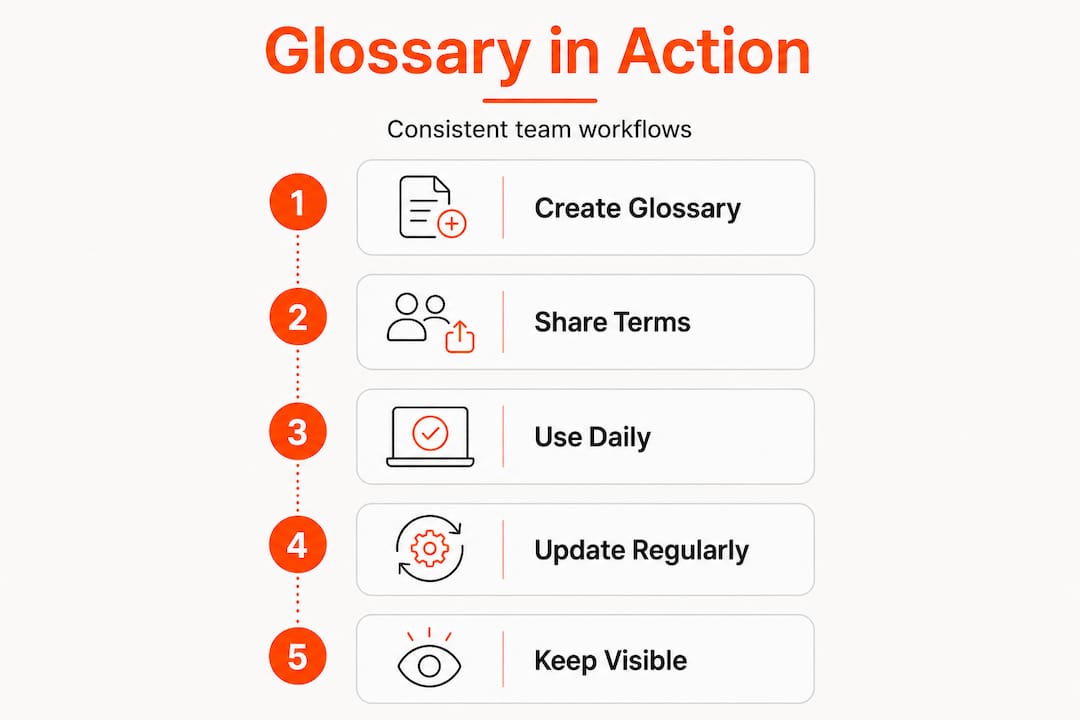
Pro Tip: Integrate your project glossary directly into the tools your team already uses. Pin it as a fixed message in your team chat, include it in onboarding packs for new subcontractors, and reference it in your standard checklist templates. Accessibility drives adoption.
Best practices for embedding project terminology in your team
Standardising language is a process, not a one-off task. Teams that treat it as a document to be filed and forgotten see little benefit. Teams that actively reinforce it see faster decisions, fewer queries, and cleaner handovers. Here is how to build that consistency into your everyday practice.
- Create a project-specific glossary. Start with a core set of terms drawn from the UK Government Project Delivery Glossary, which standardises public sector project terms that are increasingly used across private sector construction as well. Add any project-specific or client-specific terms on top.
- Tailor it to your audience. A glossary for site operatives needs plain-English explanations alongside the formal term. A glossary for senior project managers can use more technical language. Both versions should coexist.
- Make it a living document. As the project evolves, as scope changes, as new stakeholders join, update the glossary. A glossary that reflects an outdated scope is worse than no glossary at all.
- Integrate it into your quality and document control processes. Your document control practices should explicitly reference the glossary. When issuing revised drawings or specifications, check that the language used is consistent with the agreed terms.
- Make terminology part of induction. Every new trade, subcontractor, or client-side representative should receive the glossary as part of their site induction. This sets expectations immediately and removes the assumption that everyone shares the same understanding.
- Audit verbal communication. Attend site meetings with the glossary in mind. Note when informal or ambiguous terms are used and follow up in writing with the correct terminology. Over time, the formal language becomes the default.
Understanding concepts in context also helps. Resources such as key construction concepts can bridge the gap for team members who are newer to formal project management language.
Pro Tip: Review and update your glossary at the end of every project phase. What worked at groundworks stage may need revision at fit-out. A version-controlled glossary gives you an audit trail and shows clients that your team manages language with the same rigour you apply to the programme.
Expert perspective: Why most construction teams struggle with terminology and how to break the cycle
Here is an uncomfortable observation. The teams that most need a shared language are often the ones least likely to create one. Under pressure, even experienced project managers fall back on informal language because it feels faster. “Sort the snag” is quicker to say than “complete the items on the pre-handover defect schedule.” But that shortcut costs far more time when the subcontractor does something entirely different from what was intended.
The real problem is assumed knowledge. On multi-trade sites, you have electricians, structural engineers, quantity surveyors, and site managers all operating under different professional vocabularies. The electrician’s “commissioning” is not the same as the project manager’s “commissioning.” When these assumed meanings collide at critical project milestones, the results are expensive.
Top-performing teams do something different. They revisit their shared language deliberately. At the start of a new phase, before bringing on a new subcontractor, and after any significant scope change, they check that everyone is still working from the same definitions. This is not bureaucracy. It is risk management.
Consider a real scenario. A main contractor’s project manager issues a handover notice. The client interprets this as the point at which they can take full occupation and begin trading. The contractor means it as the trigger for the snagging and defects liability period to begin. Neither party is wrong based on their own understanding. But the lack of agreed terminology around team communication standards around the term “handover” creates a dispute that takes three weeks and significant legal cost to resolve.
That three weeks is avoidable. A single paragraph in the project glossary, defining exactly what “handover” means on this specific project, would have prevented it. The teams that save money on project management errors are the ones who invest in clarity before problems arise, not after.
Make terminology work for your construction team with BRCKS
Clear language is only as effective as the systems that carry it. If your glossary lives in a folder that nobody opens, it will not change how your team communicates.
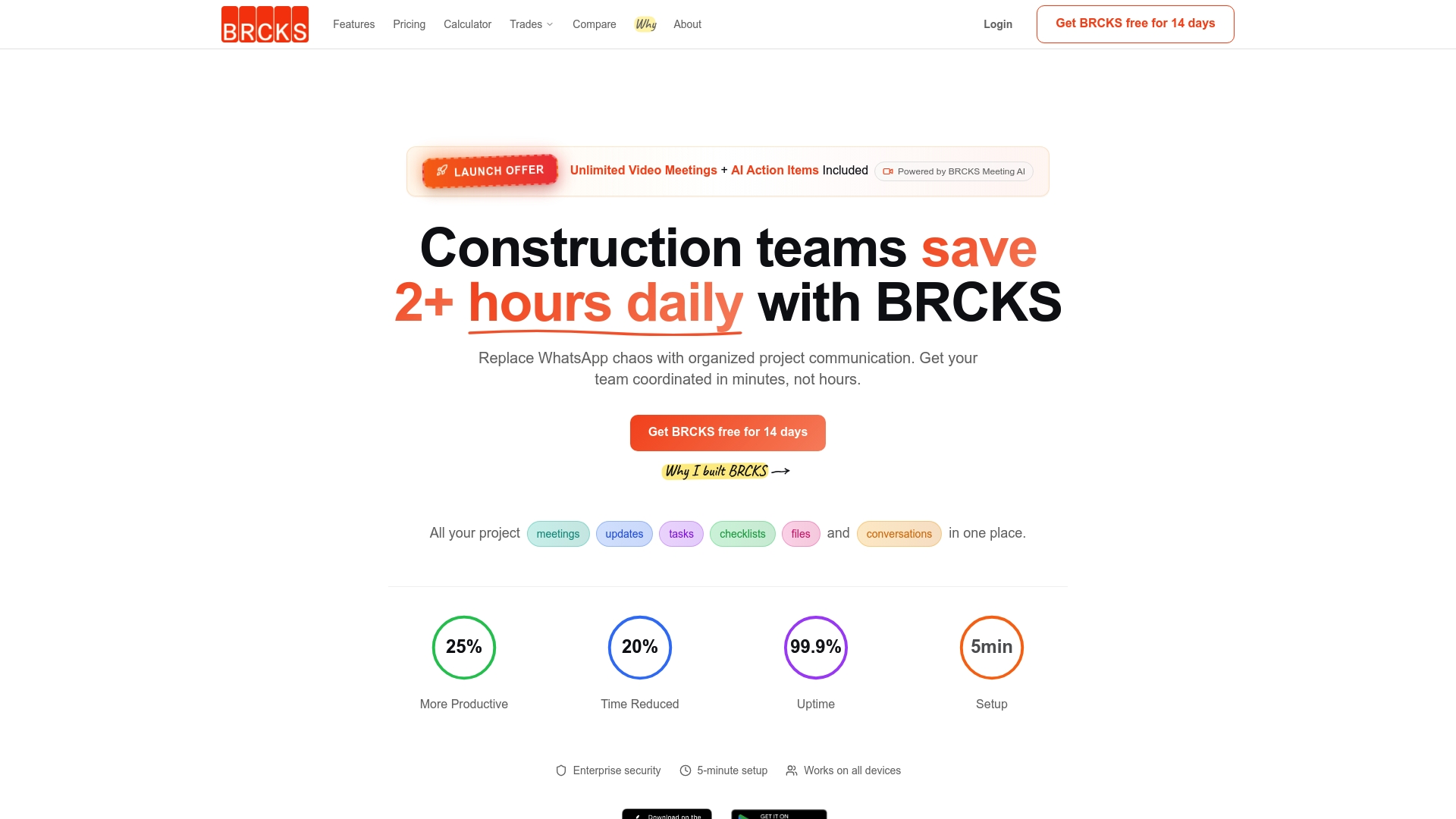
BRCKS is built specifically for UK construction teams who need to move fast without losing clarity. With project communication tools that bring checklists, task assignments, file sharing, and team chat into a single platform, you can embed your project terminology directly into the workflows your team uses every day. Every RFI, every snagging checklist, every handover document carries the same language because it all lives in one place. BRCKS also integrates with WhatsApp for project management, so your team communicates in the tools they already use, with the structure that keeps projects on track. Start your free 14-day trial and see how much clearer your projects can run.
Frequently asked questions
What is the difference between PRINCE2 and PMBOK terminology in construction?
PRINCE2 focuses on governance roles and documentation such as the Project Initiation Document (PID), while PMBOK structures delivery through process groups and tools like the Work Breakdown Structure. In UK construction, PRINCE2 is more common in public sector projects and PMBOK in larger private sector builds.
How can I improve terminology understanding on a construction site?
Share a concise on-site glossary from day one and include defined terms in digital task assignments, meeting notes, and checklists. The APM Glossary provides a strong starting point for UK-specific terminology that your team can adapt.
Why is acceptance criteria important in UK projects?
Acceptance criteria define the precise conditions under which a deliverable or project phase will be formally approved, preventing disputes about whether work meets the required standard. Without them, sign-off becomes subjective, and rework cycles escalate in both cost and time.
What are the top five project management terms all site teams should know?
PID, WBS, acceptance criteria, snag, and handover are the five terms most likely to cause confusion when misunderstood. The APM project management glossary offers clear, UK-relevant definitions for all of them and hundreds more.
Recommended
- Construction Software for Electricians | BRCKS
- Construction Handover Documentation: The Complete Guide for UK Project Managers | BRCKS
- UK Construction Project Coordination Best Practices 2026 | BRCKS
- BRCKS | Construction Project Communication Software
How BRCKS Can Help
Mastering these essential terms is the first step towards clearer communication, but managing complex UK building projects requires more than just a shared vocabulary. BRCKS simplifies this process by integrating these industry standards into an intuitive platform that keeps your team, timelines, and budgets aligned in real time. By centralising your project data, we help you eliminate misunderstandings and focus on delivering high-quality results. We invite you to explore how BRCKS can transform your site management and streamline your daily operations. Learn more at BRCKS and explore our full feature set.