What is a schedule of works? A practical UK guide
A practical guide to using a schedule of works in UK construction to manage project scope, sequencing, and variations without the complexity of a Bill of Quantities.
By James Shorter ·
What is a schedule of works? A practical UK guide

TL;DR:
- A schedule of works is a task-level list that defines project scope, sequence, and responsibilities without measured quantities. It helps with tender clarity, site coordination, and variation control, especially in smaller or faster projects. Maintaining it as a live document tied to site records minimises disputes and streamlines progress management.
A schedule of works is an itemised, task-level list of everything a contractor must carry out on a project, written without measured quantities. It tells each trade what to do, where, and in what sequence — and once signed, it becomes the contractual reference for pricing, progress tracking, and valuing variations. Three things make it indispensable on any UK project:
- Tender clarity: contractors price each task as a lump sum, giving the employer a clear scope to compare bids.
- Site sequencing: site managers use it to coordinate trades and track completion against the programme.
- Variation control: when scope changes, the schedule line is the baseline against which the additional cost is measured.
A detailed schedule of works limits disputes by giving every party a shared, written record of what was agreed.
Table of Contents
- What does a schedule of works actually cover?
- When should you use a schedule of works?
- Who prepares and uses the schedule?
- What should a schedule of works include?
- What does a schedule of works template look like?
- How do you create a robust schedule of works?
- How do you keep the schedule live on site?
- Key takeaways
- The document that does the most work is the one teams ignore
- BRCKS cuts the admin that kills schedule discipline
- Useful sources
- FAQ
What does a schedule of works actually cover?
The schedule of works sits between two other documents most UK construction professionals know well: the specification and the Bill of Quantities (BOQ). Understanding where it fits stops a lot of confusion.
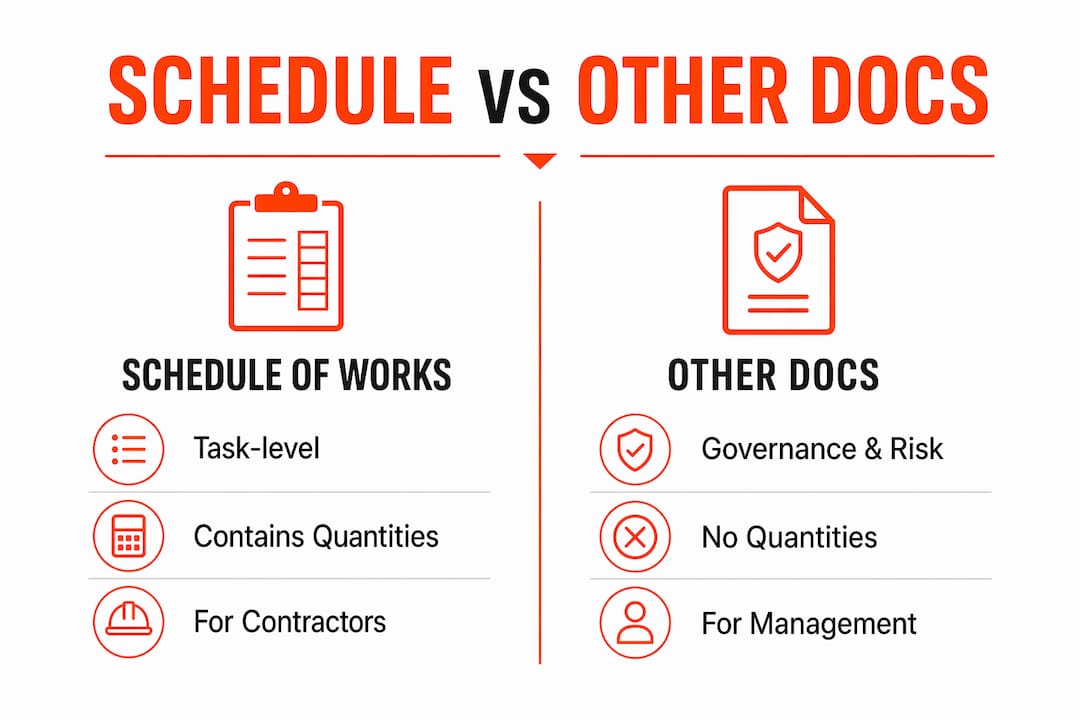
Formally, a schedule of works is a sequenced, trade-by-trade list of tasks. Each entry typically carries a trade label, a task description, a location reference, estimated duration, dependencies on preceding tasks, and a cross-reference to the relevant drawing or specification clause. What it deliberately omits is measured quantities. There are no cubic metres of concrete, no linear metres of skirting. The contractor reads the drawings, measures the work themselves, and prices each line as a single sum.

That omission has a direct consequence: measurement risk shifts to the contractor. If the contractor underestimates the volume of work, the employer is not liable for the shortfall. That is why tender instructions must be unambiguous and why cross-references to drawings and the specification are non-negotiable.
A schedule of works is also distinct from the project plan. The project plan covers governance, risk and objectives; the schedule is purely task-level and feeds the programme rather than replacing it.
How the three documents compare
| Document | Primary purpose | Contains quantities? | Main audience |
|---|---|---|---|
| Schedule of works | Task-level scope and sequencing | No | Contractor, site manager, QS |
| Bill of Quantities | Measured cost control and tender comparison | Yes | QS, employer, contractor |
| Specification | Technical standards and materials | No | Designer, contractor, clerk of works |
When should you use a schedule of works?
The schedule of works suits projects where the scope is clear enough to describe task by task but where producing a fully measured BOQ would take longer than the project warrants. Domestic refurbishments, small-to-medium alterations, fit-out works, and projects driven by drawings rather than engineer-designed structures are the natural home for this format.
Situations that favour a schedule of works:
- Domestic extensions, loft conversions, and refurbishments where the employer wants a clear scope without commissioning a full QS service.
- Alteration and fit-out projects where the design is largely complete and trade tasks are well-defined.
- Projects where speed of procurement matters and a BOQ would add weeks to the tender programme.
- Smaller commercial works where the employer accepts that contractors will carry measurement risk.
Situations where a Bill of Quantities is preferable:
- Large commercial or public-sector projects where objective tender comparison and cost certainty are required.
- Projects with complex engineering elements where unit rates matter for future variations.
- Contracts where the employer needs to benchmark individual rates for life-cycle cost planning.
The practical trade-off is speed versus comparability. A schedule is quicker to prepare and easier for a small contractor to price. A BOQ gives the employer more control over tender analysis but requires a quantity surveyor to measure and price every item — a cost and time commitment that is rarely justified below a certain project value.
Who prepares and uses the schedule?
Responsibility for drafting the schedule depends on the project type and the procurement route.
Who typically prepares it:
- Architect or designer: on most domestic and small commercial projects, the incumbent designer produces the schedule as part of the tender package, drawing directly from the drawings and specification.
- Employer or their agent: on simpler refurbishment projects, a knowledgeable client or project manager may draft the schedule themselves, particularly where the scope is straightforward.
- Quantity surveyor: when the employer wants pricing clarity or the project is complex enough to warrant professional input, a QS will structure the schedule to align with standard trade sections and ensure it is priceable.
Who uses it once the contract is live:
- The contractor uses it as the primary scope reference and prices variations against it.
- The site manager sequences trades and records completions against each line.
- Subcontractors rely on their relevant sections to understand scope and programme.
- The QS uses completed lines to value interim payments and agree the final account.
- The employer reviews it for approvals and uses it to track progress against milestones.
Version control sits with whoever prepared the document, but sign-off on any revision should involve both the employer (or their agent) and the contractor. Every revision needs a clear revision number, a date, and a record of what changed.
What should a schedule of works include?
A well-structured schedule covers the full scope from site setup to handover. The following checklist covers the standard entries.
Typical columns for each line item:
- Item number (for cross-referencing)
- Location or room reference
- Trade (groundworks, carpentry, electrical, plumbing, etc.)
- Task description (clear, unambiguous, active voice)
- Estimated duration
- Dependencies (which preceding tasks must be complete)
- Specification or drawing reference
- Responsible party (main contractor or named subcontractor)
- Provisional sum or allowance (where scope is not yet fully defined)
- Provisional start and finish dates
Sections the schedule should cover, in order:
- Preliminaries — site setup, welfare facilities, temporary works, protection of existing fabric, access arrangements.
- Facilitating works — demolition, strip-out, enabling works that must precede all other trades.
- Structural and groundworks — foundations, drainage, structural alterations.
- Building fabric — masonry, roofing, external envelope.
- First-fix trades — carpentry, electrical, plumbing, mechanical (in correct sequence).
- Plastering and screeds — always after first-fix, before second-fix.
- Second-fix trades — joinery, electrical, plumbing, tiling.
- Finishes — decoration, flooring, specialist finishes.
- External works — landscaping, drainage, paving.
- Snagging and handover — defects inspection, commissioning, documentation.
Provisional sums sit within the relevant trade section, clearly labelled as provisional so contractors know the scope is not yet fixed. Every provisional sum should carry a note explaining what triggers its instruction.
Pro Tip: Run a completeness check before issuing the tender pack: every task in the schedule should map to at least one drawing or specification clause. If a line has no cross-reference, the description is carrying all the risk — and that is where disputes start.
What does a schedule of works template look like?
The format is a simple table. Each column carries one piece of information; each row is one discrete task. Here is a compact example showing two contrasting entries — one new-build item and one refurbishment item with a provisional sum.
| Item | Trade | Location | Task description | Duration | Dependencies | Spec ref | Responsible | Provisional sum |
|---|---|---|---|---|---|---|---|---|
| — | Groundworks | Ground floor | Excavate and pour strip foundations to structural engineer’s detail | 5 days | Site setup complete | — | Main contractor | — |
| 2.04 | Electrical | Kitchen | First-fix wiring to new layout; allow provisional sum for additional circuits subject to client confirmation | 2 days | Structural alterations complete | Spec §9.1 | Named subcontractor | £1,200 |
The task description in item 2.04 does two things: it states the work clearly and flags that part of the scope is provisional, so the contractor knows to price the confirmed element and carry the allowance separately.

How the schedule feeds the programme: the schedule supplies the task list and dependencies; the programme (typically a Gantt chart) adds calendar dates and resource allocation. Neither document replaces the other. A well-maintained schedule connects every task to a deliverable and every dependency to a risk, making it the task-level backbone of the programme.
How do you create a robust schedule of works?
Follow these steps in order. Skipping any one of them is where most disputes originate.
- Define the full scope — list every element of work before writing a single line. Walk the site, review all drawings, and confirm what is and is not included.
- Align with drawings and specification — every task must reference the document that defines how it is to be done. No cross-reference means no standard.
- Break into trade sections — group tasks by trade in the sequence they will be carried out on site. Sequencing errors (electrician before plastering, for example) cause costly rework and delays.
- Add dependencies — state explicitly which tasks must be complete before the next can start. This is what allows the programme to be built from the schedule.
- Include preliminaries and provisional sums — site setup and undefined scope items must appear in the schedule, not be assumed.
- Review with a QS or experienced contractor — a pricing review before tender issue surfaces ambiguities that would otherwise inflate bids or generate post-contract claims.
- Issue with clear tender instructions — because the schedule omits quantities, contractors must know they are responsible for measurement; state this explicitly in the tender documents.
- Establish version control from day one — use a revision number and date on every issue. Record what changed and who approved it.
Version control in practice: every change to scope, whether driven by a design update or a client instruction, should generate a new revision of the affected schedule lines, not a separate email or a verbal agreement. The schedule revision is the variation instruction; everything else is noise.
Pro Tip: Hold a tender clarification meeting before bids close. Invite all tendering contractors to ask questions about the schedule simultaneously. Their questions will reveal every ambiguity you missed — and you only have to answer once.
How do you keep the schedule live on site?
A schedule issued at tender and never touched again is not a project management tool; it is a historical document. The biggest mistake clients and designers make is treating it as a one-off deliverable rather than a live reference.
Practical workflows that keep the schedule authoritative throughout delivery:
- Link schedule lines to site diary entries. When a task is completed, the site diary entry for that day should reference the schedule item number. This creates a dated, auditable record of progress.
- Attach photographs and snag records to specific task rows. A photo of completed first-fix wiring attached to item 2.04 is worth more than a verbal sign-off when a dispute arises six months later. A snag list app that ties defects to schedule lines makes this straightforward.
- Record variations against the originating schedule line. When scope changes, the variation instruction should reference the schedule item it modifies or replaces. This keeps the valuation trail clean.
- Use structured messaging workflows. Digital tools and structured WhatsApp workflows allow instant logging of work completion and automated snagging, reducing documentation drift and speeding interim payment approvals.
Pro Tip: Tie interim payment milestones to schedule line completions recorded in the site diary app. When the QS asks for evidence of progress at valuation date, you have a timestamped, photographed record — not a conversation to reconstruct.
The real-time updates approach to site management links the schedule to the site diary, snag lists, and variation logs through a single platform, so photographic evidence and sign-offs are attached to the same schedule line used for valuation.
Key takeaways
A schedule of works is only as useful as the discipline applied to keeping it current, cross-referenced, and tied to site records throughout delivery.
| Point | Details |
|---|---|
| Define scope before writing | Walk the site and confirm inclusions before drafting a single schedule line. |
| Choose BOQ for cost certainty | Use a Bill of Quantities when objective tender comparison or unit-rate control is required. |
| Version control every change | Every scope revision needs a revision number, date, and sign-off — not just an email. |
| Link to site records | Tie schedule line completions to dated site diary entries and photographs for clean interim valuations. |
| BRCKS keeps the schedule live | BRCKS automates site diary entries, snag capture, and variation logs so schedule lines stay current without the admin overhead. |
The document that does the most work is the one teams ignore
Most disputes on UK construction projects do not start with a rogue contractor or a difficult client. They start with a schedule of works that was clear enough to win the tender and vague enough to argue about on site. The task description that seemed obvious in the office becomes a £4,000 disagreement when the plasterer arrives before the electrician has finished first-fix.
The lesson worth taking from projects that run cleanly is not that they had better contractors. It is that they had a schedule with real cross-references, real dependencies, and a version-control discipline that meant every change was documented before the work started, not after the invoice arrived. Tying variation valuation to a specific schedule line, with photographic evidence attached, removes the ambiguity that makes disputes possible.
The other shift worth making is treating the schedule as a live document from day one. Designers who update the schedule when a drawing changes, and contractors who record completions against it daily, end up with a project record that practically writes the final account for them.
BRCKS cuts the admin that kills schedule discipline
Two hours of manual admin per day is what most site teams spend chasing sign-offs, logging progress, and reconciling variation instructions with the schedule. BRCKS removes that overhead by capturing site updates through WhatsApp, automatically generating site diary entries, and attaching photographs and snag records directly to the relevant schedule lines.

For UK builders and project managers, that means interim payment valuations backed by a timestamped, photographed audit trail rather than a spreadsheet reconstructed the night before the QS visit. Variation instructions are logged against the originating schedule line the moment they are issued, so the final account is built in real time rather than argued over at the end.
If you are managing a refurbishment, fit-out, or new-build project and want the schedule to stay authoritative from tender to handover, try BRCKS for builders free for 14 days and see how much admin disappears on day one.
Useful sources
- Bhangals: The role of schedule of works in construction — practical overview of how a schedule limits disputes and supports progress management.
- Derek Gough Associates: Schedule of work or Bill of Quantities — concise professional comparison of the two document types and when each is appropriate.
- Selfbuild Extend Renovate: Bills of Quantities vs Schedules of Works — client-facing explanation of cost control trade-offs; useful for domestic clients.
- CQSA: Procurement — Schedule of Works — procurement-focused guidance on tendering with a schedule and managing measurement risk.
- RenoCalc: What is a schedule of works? — covers digital integration, living-document discipline, and sequencing pitfalls.
- ProjectManagementFormula: Schedule of works — explains how the schedule feeds the programme and connects tasks to deliverables.
- CIOB (Chartered Institute of Building) — the UK’s leading professional body for construction management; consult for procurement standards and contract guidance.
- BRCKS: Schedule of works project manager guide — practical BRCKS-specific guidance on keeping a schedule live using digital workflows.
- BRCKS: Top construction schedule software for UK builders 2025 — comparison of scheduling tools available to UK builders.
This article is general information for UK construction professionals and clients. For procurement decisions, contract drafting, or cost advice specific to your project, consult a qualified quantity surveyor or construction solicitor and verify current RICS guidance.
FAQ
What is a schedule of works in construction?
A schedule of works is a task-level list of all work required on a construction project, typically written without measured quantities. It defines what each trade must do, in what sequence, and serves as the contractual scope reference for tendering, progress tracking, and valuing variations.
What is an example of a schedule of works?
A typical entry reads: Item 2.04 | Electrical | Kitchen | First-fix wiring to new layout; provisional sum for additional circuits subject to client confirmation | 2 days | Structural alterations complete | Spec §9.1 | Named subcontractor | £1,200. Each row covers one discrete task with its trade, location, description, duration, dependencies, and specification reference.
Who prepares a schedule of works?
On domestic and small commercial projects, the architect or designer usually prepares it as part of the tender package. A quantity surveyor takes over when pricing clarity or complex trade sequencing is required. On simpler refurbishments, a knowledgeable employer or project manager may draft it directly.
How do you create a schedule of works?
Define the full scope first, then align every task with a drawing or specification reference, break the work into trade sections in site sequence, add dependencies, include preliminaries and provisional sums, and review with a QS or contractor before issuing. Apply a revision number and date to every subsequent change.
How does a schedule of works differ from a Bill of Quantities?
A schedule of works lists tasks without measured quantities, shifting measurement risk to the contractor and making it quicker to prepare. A Bill of Quantities provides itemised measurements and unit rates, giving the employer greater cost certainty and easier like-for-like tender comparison — but requires a quantity surveyor to produce it.
Recommended
- BRCKS | Construction Project Communication Software
- Construction Scheduling Software for UK Builders | BRCKS
- Top Construction Schedule Software for UK Builders 2025 | BRCKS
- Plumber Job Scheduling Guide: Boost Site Efficiency
How BRCKS Can Help
Mastering a schedule of works is essential for keeping UK construction projects on track, but managing these complex documents manually often leads to costly oversights. BRCKS simplifies this process by integrating your scheduling data directly into a streamlined digital workflow, ensuring every task and timeline remains visible to the entire team. By centralising your project documentation, BRCKS helps you reduce administrative friction and focus on high-quality delivery. We invite you to explore how our platform can transform your project management by booking a demo today. Learn more at BRCKS and explore our full feature set.