Plumber job scheduling guide: Boost efficiency on site
Poor scheduling leads to costly rework and trade clashes. This guide explores how to master plumber job scheduling to keep your UK construction projects on track.
By James Shorter ·
Plumber job scheduling guide: Boost efficiency on site
 A purpose-built construction snagging software keeps these items tracked through to sign-off.
TL;DR:
- Poor job scheduling often causes costly delays and rework in UK construction projects. Using digital scheduling tools enhances accuracy, real-time updates, and overall project efficiency. Proper preparation, clear communication, and verification are essential to ensure successful plumbing project management.
Imagine a plumber arriving on site three days late because no one confirmed the booking. The screeding team has finished, the walls are plastered, and now the entire installation sequence needs reworking at significant cost. It happens more often than project managers care to admit, and it typically traces back to a single failure: poor job scheduling. This guide walks you through every practical step for mastering plumber job scheduling on UK construction projects, from the tools and data you need to the exact process for booking, dispatching, and tracking work without costly surprises.
Table of Contents
- Understanding plumber job scheduling challenges
- Preparing to schedule: Tools, data, and people you need
- Step-by-step job scheduling process for plumbers
- Troubleshooting, common mistakes, and how to verify your schedule
- A practical perspective: What really works (and what doesn’t) in plumber job scheduling
- Take the next step: Smarter plumber job scheduling with digital tools
- Frequently asked questions
Key Takeaways
| Point | Details |
|---|---|
| Digital tools matter | Using scheduling software leads to major efficiency and retention gains for plumbing jobs. |
| Tailor your approach | Solo plumbers and mid-sized firms benefit from different tools—choose according to team size and workflow needs. |
| Stepwise workflow | A careful job-by-job process, with verification, prevents errors and saves money on every project. |
| Avoid manual-only methods | Manual planning suits only small, static projects—scale up with integrated software to handle last-minute changes and team coordination. |
Understanding plumber job scheduling challenges
Plumbing sits at a critical point in almost every construction programme. It must follow structural work but precede plastering, tiling, and fixtures. Get the sequencing wrong and you face rework, trade clashes, and programme overruns that ripple across every discipline. These are not edge cases. They are the everyday reality of running live sites where conditions shift daily.
The most common scheduling problems for plumbing teams include:
- Trade overlaps: First fix plumbing clashing with electrical first fix when both are booked into the same space simultaneously
- Site delays feeding downstream: Concrete pours running late push back plumbing slots, which then push back plastering
- Compliance gaps: Gas Safe and Water Regulations inspections not accounted for in the schedule, causing permit delays
- Availability gaps: Subbies double-booked across multiple sites, leaving your project short-handed
- Scope changes: Last-minute design alterations requiring rerouting of pipework after other trades have completed their work
Manual scheduling using spreadsheets or paper-based planners can work on very small projects. A sole trader managing two residential jobs simultaneously can probably keep track on a whiteboard. But the moment you add a third project, a second plumber, and a client requesting daily updates, manual approaches become brittle. Information lives in different places, updates are communicated verbally and forgotten, and there is no audit trail when something goes wrong.
“A missed dependency in plumbing scheduling is rarely an isolated issue. It becomes a cascade failure touching every subsequent trade.” This is a problem recognised across UK construction, especially on multi-phase residential and commercial developments.
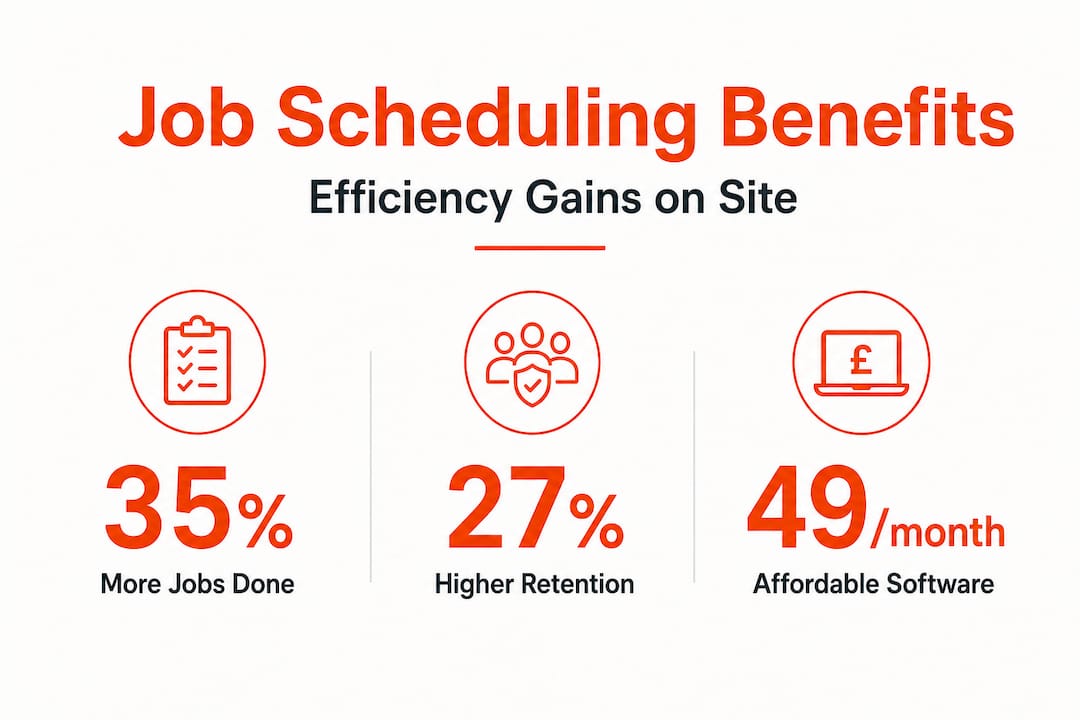
The financial case for getting this right is clear. Integrated CRM scheduling achieves up to 35% greater job completion efficiency and a 27% increase in customer retention. Those are not marginal gains. They represent real revenue and real client relationships. For context, this mirrors the kinds of efficiencies explored in construction snagging challenges, where small workflow improvements consistently translate to major time and cost savings on site.
The core lesson here is straightforward: scheduling is not an administrative task. It is a primary project management function that directly determines whether your project delivers on time and within budget.
Preparing to schedule: Tools, data, and people you need
Before you open any software or start filling in a Gantt chart, you need to gather the right inputs. Scheduling without complete information produces a plan that collapses at the first obstacle.
Essential data and documentation:
- Confirmed project drawings, including service routes and access points
- Plumber availability, including existing commitments across other sites
- Material lead times for pipework, boilers, cylinder units, and sanitary ware
- Permit and inspection requirements: Gas Safe, water bylaws, building control sign-offs
- Client access windows, particularly relevant for occupied residential works
- Site induction and safety requirements for each operative
Key roles involved in scheduling:
- Project manager: Owns the overall programme and resolves cross-trade dependencies
- Contracts manager or site manager: Manages day-to-day slot allocation and confirms access
- Lead plumber or plumbing subcontractor: Provides realistic durations and flags technical constraints
- Client or client representative: Approves key milestones and access arrangements
Once you have this information in hand, the right digital tools make the scheduling process considerably faster and more accurate. The market for plumber software options has matured significantly, with platforms now offering mobile dispatch, automated reminders, and client-facing portals. Here is a snapshot of leading tools and their pricing:
| Tool | Best for | Starting price |
|---|---|---|
| Powered Now | Solo plumbers | £15/month |
| Tradify | Small teams | £29/month |
| Jobber | Small to mid-size | £31/month |
| BigChange | Mid-size with fleet | £49/month |
| Commusoft | Maintenance-heavy | Custom pricing |
Top software pricing ranges from £15 to £49 per month for the leading platforms, making digital scheduling genuinely accessible even for smaller firms. When evaluating options, it is worth also reading a broader maintenance app guide to understand how these tools extend beyond initial scheduling into ongoing works. And if you want your team kitted out and organised from day one, getting the basics sorted, including work-ready gear for operatives, removes small friction points that add up over a long project.
Pro Tip: Look for software that integrates job scheduling with your CRM and communication tools. Platforms that combine quoting, booking, dispatch, and client notifications in a single dashboard eliminate the duplication that creates scheduling errors in the first place.
Step-by-step job scheduling process for plumbers
With the right data and tools in place, follow this sequence to build and manage a robust plumbing job schedule.
- Gather full project requirements. Confirm scope, drawings, and specification before touching the schedule. Any ambiguity at this stage creates knock-on disruptions later.
- Map all plumbing tasks and their dependencies. Identify what must happen before each task can begin. First fix cannot start until structural openings are complete. Second fix cannot begin until plastering is finished and dried.
- Confirm team and subcontractor availability. Cross-reference your plumbers’ existing commitments. Blocking out time before confirming availability is one of the most common and costly scheduling mistakes.
- Allocate time slots with realistic durations. Avoid optimistic estimates. Build in contingency, particularly for older buildings where concealed defects often emerge during first fix.
- Book and confirm all parties in writing. This means the plumber, the site manager, and where relevant, the client. Verbal confirmation is not sufficient for programme management.
- Set up dispatch and access logistics. Confirm parking, site access codes, induction requirements, and material deliveries are all aligned with the planned start date.
- Track progress in real time. Use your scheduling software to log job status updates as work proceeds. Do not rely on end-of-dayphone calls.
- Manage changes as they occur. When a delay arises, update the schedule immediately and notify all affected parties. Delayed communication about schedule changes is a primary driver of rework.
The decision between manual and automated scheduling deserves honest consideration. Manual critical path sequencing works adequately for small to mid-sized projects but scales poorly. Software excels for dynamic rescheduling, managing multiple teams, and providing real-time updates, making it the preferred approach for mid-sized firms. The comparison below illustrates this clearly:
| Aspect | Manual scheduling | Software scheduling |
|---|---|---|
| Setup speed | Fast for simple jobs | Slightly longer initial setup |
| Accuracy | Prone to human error | Automated conflict detection |
| Scalability | Poor beyond 3-4 jobs | Handles dozens simultaneously |
| Real-time updates | Slow, phone-dependent | Instant, push notifications |
| Audit trail | Minimal | Comprehensive logs |
| Cost | Low upfront | £15-£49/month ongoing |
For further context on how scheduling principles apply across trades, the approach used by builders scheduling tools follows the same logic, and similar parallels exist in HVAC scheduling, where dependency management is equally critical.
Pro Tip: Real-time updates are not a luxury feature. When a site delay occurs at 9am, a platform that immediately notifies your plumbing subcontractor prevents them from travelling to a site where they cannot work. That single notification can save half a day of wasted labour. Applying workflow best practices consistently across your scheduling process reduces reactive firefighting significantly.
Troubleshooting, common mistakes, and how to verify your schedule
Even a well-constructed schedule needs regular verification. The following red flags indicate that your plumbing schedule is at risk and needs immediate attention.
Warning signs to watch for:
- Overbooked operatives: The same plumber assigned to overlapping time slots on different sites
- Unresolved dependencies: Plumbing tasks scheduled before prerequisite structural or civil works are confirmed complete
- No named task owner: Every task on the schedule must have a specific person responsible, not just “plumbing team”
- No confirmation of material deliveries: Scheduling a boiler installation without confirming the boiler is on site is a guaranteed delay
- Absence of inspection hold points: Building control and compliance inspections must be explicitly scheduled, not added as an afterthought
Before any plumbing job goes live, run through a structured verification checklist:
- Are all preceding tasks confirmed complete or confirmed on track?
- Has the operative received written confirmation of the booking with access details?
- Are materials confirmed on site or on a confirmed delivery date before the planned start?
- Have compliance inspection windows been booked with the relevant authority?
- Has the client or site contact been notified of the planned works?
When mistakes do occur, the correction process matters. The key is transparent communication rather than silent rescheduling. Use your platform’s approval workflow to formally update affected parties, log the reason for the change, and confirm the new timeline. Silent changes that appear in the schedule without explanation cause confusion and erode trust.
“For small teams, prioritise simple mobile quoting and scheduling tools like Tradify or Powered Now. For mid-sized operations, advanced dispatch and route optimisation tools such as Jobber or BigChange deliver stronger returns.” This practical guidance for UK plumbers reflects the tiered approach that most experienced project managers arrive at after trial and error.
For complex builds, particularly high-rise residential or mixed-use commercial developments, the requirements increase considerably. BIM for clash detection and prefabricated modules with strict sequencing are essential on MEP-heavy projects to avoid costly rework. Prefab plumbing modules, for instance, require advance procurement and coordination with structural teams weeks ahead of installation, which places even greater demands on scheduling accuracy.
If you are managing ongoing works after handover, the principles covered in operation and maintenance scheduling extend naturally from the project scheduling approach described here. Reactive maintenance scheduling shares many of the same dependency and availability challenges as new-build plumbing programmes. For a broader view of how scheduling fits into overall project delivery, the general contracting guide provides useful cross-reference context.
A practical perspective: What really works (and what doesn’t) in plumber job scheduling
There is a persistent belief in UK construction that experienced site managers can hold a complex plumbing programme together through memory, phone calls, and intuition. And to be fair, many can, right up until the point where they cannot. A second project lands, a key operative falls ill, or a client starts asking for daily progress reports. That is where gut feel and spreadsheets stop working.
The uncomfortable truth is that manual scheduling does not fail because people are disorganised. It fails because the volume and speed of information on a live site exceeds what any individual can track reliably. A WhatsApp message confirming a booking gets buried under thirty other messages. A spreadsheet updated on Tuesday does not reflect what happened on Wednesday morning.
Small firms often resist digital scheduling platforms because they perceive them as complex or expensive. In reality, the hidden costs of construction software are almost always lower than the hidden costs of not using it. A single day of wasted labour from a miscommunicated schedule change typically costs more than several months of a mid-range software subscription.
The project managers who operate most efficiently are not necessarily those with the most elaborate systems. They are the ones who have chosen a platform that their whole team, including subbies, will actually use consistently. A simple, mobile-friendly scheduling tool used by everyone on site outperforms a sophisticated system that only the office manager understands. Integration matters too. When your scheduling platform connects directly with your client communication and task management tools, the information flows without anyone having to repeat themselves. That is where real efficiency is won.
Take the next step: Smarter plumber job scheduling with digital tools
Getting your plumbing schedule right consistently requires more than a one-time effort. It requires the right platform supporting your team every day. BRCKS brings together job scheduling, team communication, task checklists, file sharing, and client updates into a single platform built specifically for construction professionals.
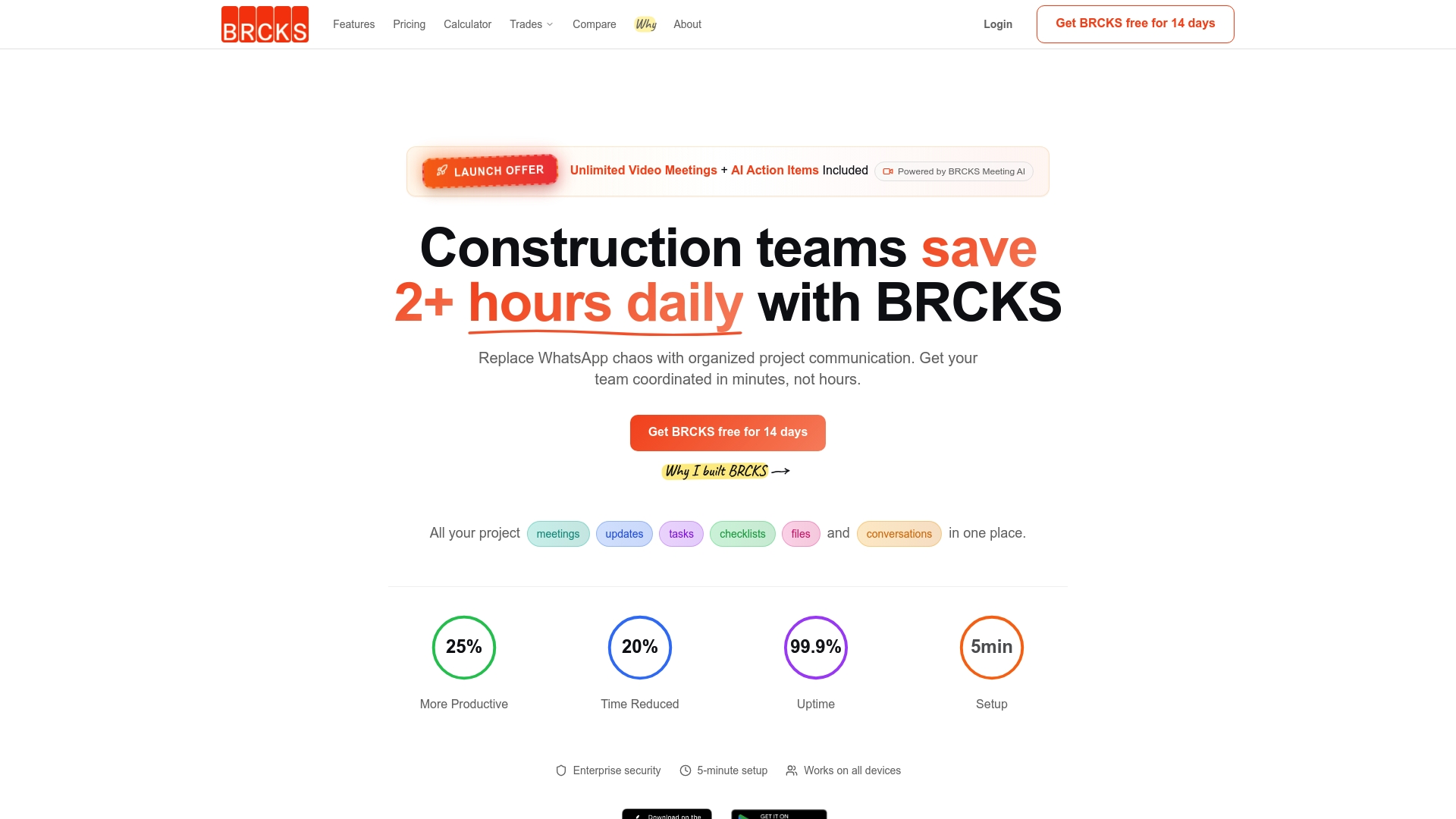
Whether you are a project manager running multiple construction scheduling projects simultaneously or a small plumbing firm ready to move beyond spreadsheets, BRCKS gives you the structure to plan confidently and the tools to adapt quickly. Explore how digital plumber job scheduling works in practice with a free 14-day trial. No lengthy setup, no hidden costs, and your subcontractors access it free from day one.
Frequently asked questions
What’s the main benefit of using plumber scheduling software over spreadsheets?
Integrated platforms increase job completion efficiency by up to 35% and improve customer retention rates by 27%, making them a measurably better option for growing firms.
What software is best for solo plumbers in the UK?
Tradify and Powered Now are both affordable, mobile-friendly choices, with pricing from £15 per month for solo operators, making them genuinely accessible options for individual plumbers.
How do I handle last-minute site changes in my plumbing schedule?
Look for platforms with dynamic rescheduling and real-time push notifications, as these allow you to update affected parties immediately when site conditions change.
Is BIM necessary for everyday plumbing projects or just high-rise construction?
BIM is most critical for high-rise and MEP-heavy projects where clash detection and strict sequencing are essential, but it is generally unnecessary for straightforward residential plumbing work.
Recommended
- Construction Software for Plumbers | BRCKS
- Top Construction Schedule Software for UK Builders 2025 | BRCKS
- Construction Software for HVAC Contractors | BRCKS
- The Ultimate Guide to Construction Time Tracking | BRCKS
How BRCKS Can Help
Effective job scheduling is the backbone of any successful plumbing business, ensuring your team stays productive and your projects remain on track. By integrating BRCKS into your daily operations, you can automate complex coordination tasks and gain real-time visibility over every site from a single dashboard. This streamlined approach reduces administrative headaches and allows your engineers to focus on delivering high-quality work without the usual logistical delays. We invite you to discover how BRCKS can transform your site management by exploring our platform today. Learn more at BRCKS and explore our full feature set.