Contractor efficiency checklists for UK project managers
Discover the seven core checklists every UK construction project manager needs to drive site efficiency, ensure compliance, and mitigate project risks.
By James Shorter ·
Contractor efficiency checklists for UK project managers

Every UK construction project needs seven core checklists: pre-qualification (PQQ), site induction, daily performance, inspection and test plan (ITP) hold points, health and safety/RAMS, insurance and financial checks, and handover. Start today by assigning a named signatory to your site induction checklist and running it for every operative on site this week.
The essential checklist types at a glance:
- Pre-qualification (PQQ): financial standing, insurance, references, key personnel — completed at procurement stage by the package manager
- Site induction: emergency procedures, welfare, site rules, PPE — completed on each operative’s first day by the site supervisor
- Daily performance: work completed, manpower, plant hours, defects, weather, RFIs raised — completed at shift end by the site manager
- ITP hold points: staged sign-offs with photographic evidence and witness signatures — completed by the quality manager or package manager at each hold point
- H&S/RAMS checks: risk assessments, method statements, permit-to-work records — completed before any new activity starts, signed by the supervisor
- Insurance and financial checks: insurance certificates, CIS registration, VAT status, bank details — completed at onboarding and renewed annually
- Handover checklist: snagging sign-off, O&M manuals, test certificates, warranties — completed by the project manager and client representative at practical completion
“Appointing suppliers solely on the basis of lowest cost is a recipe for projects going awry. Weighting bids by value for money, technical competency and quality should be the foundation for any procurement strategy.” — Construction Leadership Council, Trust and Productivity
The HSE, the Construction Leadership Council, and SafeContractor all underpin the compliance expectations these checklists address. The rest of this guide gives you the specific line items, implementation steps, KPIs, and copyable templates to put them into practice.
Table of Contents
- What checklist types does every UK construction project need?
- What specific items should each checklist contain?
- How do you implement these checklists on UK projects?
- Which KPIs should you track from checklist data?
- How do checklists need to align with programme sequencing and ITPs?
- Copyable one-page templates for site use
- What does the evidence say about digital checklist enforcement?
- Prioritised next steps: your 30/60/90 adoption plan
- Key takeaways
- What the checklists actually change on site
- BRCKS cuts the admin so your checklists actually get done
- Further reading and sources
- FAQ
What checklist types does every UK construction project need?
Each checklist serves a distinct stage of the project lifecycle. Using the wrong form at the wrong time, or skipping one entirely, is where compliance gaps and disputes begin.

| Checklist type | Purpose | Frequency | Typical signatory |
|---|---|---|---|
| Pre-qualification (PQQ) | Assess contractor suitability before award | Once per procurement | Package manager / commercial manager |
| Site induction | Confirm operative understands site rules and H&S | Each operative’s first day | Site supervisor |
| Daily performance | Record progress, manpower, plant, defects, RFIs | Daily (every shift) | Site manager |
| ITP hold point | Staged quality sign-off with evidence | At each programme hold point | Quality manager / package manager |
| H&S / RAMS check | Verify risk assessments and method statements are current | Before each new activity | Site supervisor |
| Insurance and financial | Confirm insurance, CIS, VAT, bank details | At onboarding; annually thereafter | Commercial manager |
| Handover | Confirm defects cleared, documents issued, warranties in place | At practical completion | Project manager + client rep |
| Post-contract evaluation | Score contractor performance for future procurement | — | Project manager |
The Construction Leadership Council recommends setting clear objectives and success measures at procurement stage, which means the PQQ checklist is not a box-ticking exercise — it is the first performance management tool on the project.
UK compliance items that must appear in the relevant checklists include:
- Risk assessments and method statements (RAMS) — required under the Construction (Design and Management) Regulations 2015
- PPE provision and inspection records
- Insurance certificates (employers’ liability, public liability, professional indemnity where applicable)
- CIS registration status and subcontractor verification
- CSCS card checks for all operatives on site
- Permit-to-work records for hot works, confined spaces, and working at height
The post-contract evaluation is the checklist most teams skip. It is also the one that feeds directly into future procurement decisions and supplier scorecards.
What specific items should each checklist contain?
Pre-qualification checklist
- Company financial accounts (last two years) and credit check reference
- Employers’ liability insurance (minimum £5m) and public liability insurance (minimum £5m)
- Professional indemnity insurance where design is involved
- CIS registration number and VAT number
- References from three comparable projects (value, scope, client contact)
- Key personnel CVs and relevant qualifications (CSCS, SMSTS, SSSTS)
- Health and safety policy and accident frequency rate
- Quality management system (ISO 9001 or equivalent)
- Plant and equipment schedule
Site induction checklist
- Emergency assembly point and evacuation procedure
- First aid arrangements and nearest hospital location
- Welfare facilities (toilets, canteen, drying room)
- Site rules (PPE requirements, smoking, mobile phone use)
- Permit-to-work system overview
- Reporting lines and who to contact for RFIs
- CSCS card check (photograph and card number recorded)
- Signature and date of operative
Daily performance checklist
- Date, weather conditions, and site location/plot reference
- Manpower on site by trade and employer
- Plant and equipment hours
- Work completed (location, element, quantity)
- Defects identified and by whom
- RFIs raised or responded to
- Variations instructed or notified
- Delays or disruptions (cause, duration, trades affected)
- Signature of site manager
Adjudicators routinely dismiss incomplete diaries; practitioners use gridlines and precise plot or floor identifiers so entries can be cross-referenced with RFIs and variation logs to establish cause and effect. A site diary app that captures this automatically removes the risk of a missing day undermining your record.
ITP hold-point checklist
CQIC guidance sets out minimum ITP requirements, including staged sign-offs tailored to each package. For each hold point, capture:
- Hold-point description and programme reference
- Inspection date and location (plot, floor, grid reference)
- Evidence attached (photographs, test certificates, material delivery notes)
- Witness signatures (contractor, employer’s representative, third-party inspector where required)
- Pass or fail result and any corrective action required
- Re-inspection date if applicable
H&S/RAMS and permit-to-work items
- RAMS reference number and revision date
- Activity covered and operatives briefed (names and signatures)
- PPE required and confirmed as available on site
- Permit-to-work number, issuer, and expiry time
- Isolation confirmation (electrical, gas, water) where applicable
- Rescue plan confirmed for confined space or working at height
Insurance and financial checklist
- Insurance certificate expiry dates (diarise renewal 60 days in advance)
- CIS verification status (matched or unmatched)
- VAT registration number confirmed
- Bank account details verified against company registration
- Retention terms confirmed in subcontract
Pro Tip: Link every insurance and financial checklist entry to the subcontract award record. When a certificate lapses mid-project, you need a clear audit trail showing when you last verified it and who was responsible for renewal.

How do you implement these checklists on UK projects?
Who signs what and when
The PQQ is completed at procurement, before any contract is placed. The site induction runs on each operative’s first day — no exceptions, no retrospective sign-offs. Daily performance checklists are completed at shift end by the site manager, not the following morning. ITP hold points are signed off in real time; a signature dated after the concrete has been poured is worthless as evidence.
Practical timings for busy site teams
- PQQ: a moderate amount of time per contractor at tender stage
- Site induction: usually about half an hour per operative
- Daily performance checklist: takes several minutes at shift end
- ITP hold-point sign-off: several minutes per hold point, plus evidence capture
- H&S/RAMS check: done shortly before each new activity
- Insurance and financial check: takes around half an hour at onboarding, shorter time for renewal
- Handover checklist: typically about an hour at practical completion
Integration with site diaries, RFIs and variation logs
Every daily performance entry should carry a cross-reference to any RFI or variation raised that day. When a delay is recorded, the diary entry, the RFI number, and the variation log reference should all point to the same event. This is what makes your records adjudication-grade rather than just administrative. Poor document management in UK construction is a well-documented problem; centralising checklist records with your RFI and variation logs closes the gap.
Common traps and how to avoid them
- Retrospective completion: checklists filled in at the end of the week rather than in real time. Mitigate by requiring digital submission at the point of activity.
- Missing dates and locations: an undated entry has no evidential value. Use a form that auto-stamps date, time, and location.
- No named signatory: “site team” is not a signatory. Every checklist needs a named individual.
- Checklists stored in isolation: a daily performance record that cannot be linked to the programme or RFI log is an administrative document, not a management tool.
30/60/90 rollout plan
- Days 1–30: Audit existing forms. Identify which of the seven checklist types you currently use and which are missing. Assign a named owner for each. Launch the site induction and daily performance checklists for one active package.
- Days 31–60: Introduce ITP hold-point checklists for the same package. Connect daily performance entries to your RFI and variation logs. Run the insurance and financial checklist for all active subcontractors.
- Days 61–90: Roll out PQQ checklists for the next procurement round. Introduce post-contract evaluation scoring for any package reaching completion. Review KPI data from the first 60 days and adjust thresholds.
Pro Tip: Assign the 30-day audit to your site supervisor and give them a two-hour slot. The output is a simple gap list — which checklists exist, which are missing, and who currently owns each one. That list is your implementation plan.
Which KPIs should you track from checklist data?
Checklist data is only useful if it feeds decisions. These are the five metrics worth tracking, drawn directly from the forms described above.
| KPI | Data source | Reporting cadence | Sample target |
|---|---|---|---|
| Labour productivity | Daily performance checklist (manpower vs. units completed) | Weekly | Agreed output rate per trade per day |
| Schedule adherence | Daily performance vs. programme look-ahead | Weekly | most planned tasks completed on time |
| Rework / defects rate | ITP hold-point checklist (fails and re-inspections) | Fortnightly | Fewer than 3 defects per handover |
| Hold-point pass rate | ITP checklist (pass vs. fail at first inspection) | Fortnightly | 90% first-time pass rate |
| RFI response time | Daily performance checklist (RFI raised vs. responded) | Weekly | Response within 5 working days |
Constructionline recommends using standardised supplier scorecards and digital tools to analyse feedback and spot negative trends early. Objective scorecards shift decision-making from subjective impressions to evidence-based supplier management.
For measuring supplier performance, the most useful KPIs combine delivery timeliness, safety outcomes, quality compliance, and responsiveness. Track these across projects, not just within a single contract, and the data reveals which subcontractors consistently perform and which carry repeat risk.
When a KPI breaches its threshold, the intervention should be proportionate and immediate:
- Labour productivity below target for two consecutive weeks: hold a performance meeting with the subcontractor’s site manager. Review programme, resource levels, and any outstanding RFIs that may be causing the shortfall.
- Hold-point pass rate below 90%: review the ITP with the quality manager. Identify whether the failure is a workmanship issue, a design ambiguity, or a sequencing problem.
- RFI response time exceeding five working days: escalate to the project manager. Unresolved RFIs are a leading indicator of future delay claims.
For transparent reporting of these metrics to clients and stakeholders, a shared dashboard that pulls from checklist data in real time is far more credible than a monthly narrative report assembled from memory.
How do checklists need to align with programme sequencing and ITPs?
ITPs fail when they are not integrated with trade sequencing. CQIC guidance recommends monthly quality meetings (more frequent near completion), tailored ITPs for each package, and sharing quality records with design and employer representatives. An ITP that exists as a standalone document, disconnected from the programme, is a compliance document rather than a management tool.
The process flow that works in practice:
- Four-week look-ahead: identify all hold points due in the next four weeks. Confirm which trades need to be present for witness signatures and notify them in writing.
- Pre-start meeting: before any new activity begins, confirm the RAMS are current, the ITP hold points are understood, and the preceding trade has signed off its handover.
- ITP sign-off at hold point: capture evidence (photographs, test certificates) at the point of inspection. Do not allow work to proceed past a hold point without a signed record.
- Trade handover: the completing trade signs a handover record confirming the area is ready for the next trade. This is the document that prevents out-of-sequence work.
The Construction Leadership Council’s early engagement guidance is clear: involving the supply chain before the formal tender process lets contractors and suppliers plan resources, raise buildability concerns, and align construction methods with the programme. Out-of-sequence work almost always traces back to a procurement process that did not engage the supply chain early enough.
Pro Tip: For integrated systems testing and commissioning packages, map every ITP hold point onto the programme as a constraint. If the programme shows concrete poured before the ITP sign-off is scheduled, the programme is wrong — fix it before work starts, not after.
Copyable one-page templates for site use
Site induction template
Fields: operative name, employer, trade, CSCS card number and expiry, date, site name and address. Sections: emergency procedures (assembly point, evacuation route, first aid contact), welfare (toilet, canteen, drying room locations), site rules (PPE, mobile phones, smoking, speed limit), permit-to-work overview, reporting lines. Signature: operative and site supervisor. Time to complete: 20–30 minutes. Evidence to attach: copy of CSCS card.
Daily performance report template
Fields: date, weather, site name, plot/floor/grid reference. Sections: manpower (name, employer, trade, hours), plant (type, hours, operator), work completed (location, element, quantity), defects (description, location, trade responsible), RFIs (number, subject, raised by, date), variations (instruction number, description), delays (cause, duration, trades affected). Signature: site manager. Time to complete: 10–15 minutes. Link to: RFI log, variation log, programme.
PQQ checklist fields
Financial standing, insurance certificates (employers’ liability, public liability, professional indemnity), CIS number, VAT number, three project references, key personnel CVs, H&S policy, accident frequency rate, quality management system, plant schedule. Signatory: package manager. Time to complete: 45–90 minutes. Evidence to attach: insurance certificates, accounts, references.
ITP hold-point checklist
Fields: hold-point reference, package, location (plot, floor, grid), programme date, actual inspection date. Sections: evidence attached (photographs, test certificates, delivery notes), witness signatures (contractor, employer’s representative, third-party inspector), result (pass/fail), corrective action required, re-inspection date. Signatory: quality manager and employer’s representative. Time to complete: 5–10 minutes per hold point.
Handover checklist
Fields: project name, package, date of practical completion. Sections: snagging (all items cleared and signed off), O&M manuals (issued and acknowledged), test certificates (all systems tested and certified), warranties (issued and registered), as-built drawings (issued), keys and access codes (transferred). Signatory: project manager and client representative. Time to complete: 60–90 minutes. Link to: snag list software for defect tracking through to close-out.
Templates should be adapted for each trade and package size. A groundworks package needs different ITP hold points than a mechanical and electrical package. The fields above are the minimum; add trade-specific items as required. All templates that feed into the audit trail — daily performance, ITP hold points, handover — should be integrated with your site diary and RFI log, not stored separately.
What does the evidence say about digital checklist enforcement?
The Construction Productivity Taskforce found that data collected on site is predominantly retrospective, providing lessons learned rather than real-time insight. The technology to move to near-real-time reporting exists; the barrier is adoption, not capability. Digital tools that capture checklist data at the point of activity — rather than at the end of the week — close this gap.
Centralising communication workflows and checklist enforcement in one platform reduces rework by 52%, according to BRCKS’s analysis of UK construction projects.
Subcontractor project management software consolidates schedules, compliance documents, and performance dashboards, directly reducing coordination failures and disputes. The benefit is not just efficiency — it is the quality of the evidence trail when things go wrong.
A practical 30/60/90 plan for digital adoption:
- Days 1–30: Select a digital tool that captures daily performance checklists and links entries to RFIs and variation logs. Run a pilot on one active package. Train the site manager and one package manager.
- Days 31–60: Extend to ITP hold-point capture. Set up automated reminders for hold points due in the next seven days. Connect checklist data to a KPI dashboard reviewed weekly.
- Days 61–90: Integrate the site diary with the RFI and variation log so every delay entry auto-references the relevant RFI. Run the post-contract evaluation for any package completing in this period. Review KPI trends and adjust targets for the next procurement round.
Digital workflows in construction reduce the manual effort of assembling compliance records and make it far harder for checklists to be completed retrospectively. BRCKS optimises site diaries, RFI tracking, and structured variation logs, and its WhatsApp integration means site teams can submit checklist updates without switching to a separate app.
Prioritised next steps: your 30/60/90 adoption plan
This week
- Audit your current forms against the seven checklist types listed in the opening section. Note which are missing.
- Assign a named signatory to your site induction checklist and run it for every operative currently on site.
- Require daily performance checklists for your highest-risk active package, starting at the next shift end.
Days 1–30
- Close the gaps identified in your audit. Create or adopt templates for any missing checklist type.
- Assign ownership: one named person responsible for each checklist type, with a deputy.
- Connect daily performance entries to your RFI and variation logs — even if this is a manual cross-reference to start with.
Days 31–60
- Introduce ITP hold-point checklists for all active packages. Map hold points onto the programme as constraints.
- Run the insurance and financial checklist for all active subcontractors. Diarise certificate renewal dates.
- Set up five KPIs from the table in the measuring efficiency section and review them weekly.
Days 61–90
- Adopt a digital tool to automate daily performance capture and checklist reminders.
- Run post-contract evaluations for any packages completing in this period.
- Use KPI data from the first 60 days to set performance thresholds for the next procurement round.
Key actions to assign:
- Site supervisor: induction checklist ownership, daily performance sign-off
- Package manager: PQQ, ITP hold points, insurance and financial checks
- Project manager: KPI review, post-contract evaluation, digital tool selection
- Commercial manager: CIS verification, VAT checks, bank detail confirmation
Key takeaways
Contractor efficiency checklists work when each type is assigned to a named owner, completed in real time, and connected to the RFI and variation log — not stored as standalone documents.
| Point | Details |
|---|---|
| Use all seven checklist types | PQQ, induction, daily performance, ITP, H&S/RAMS, insurance, and handover each serve a distinct stage. |
| Assign named signatories | Every checklist needs a named individual; “site team” is not a signatory and carries no evidential weight. |
| Connect to RFIs and variation logs | Checklist entries linked to RFIs and variation records are adjudication-grade; isolated entries are not. |
| Track five core KPIs | Labour productivity, schedule adherence, defects rate, hold-point pass rate, and RFI response time. |
| Sequence ITPs with the programme | Map every hold point as a programme constraint; work must not proceed past a hold point without a signed record. |
| BRCKS automates the admin | BRCKS captures site diaries, RFIs, and variation logs automatically, saving over two hours of manual effort daily. |
What the checklists actually change on site
The conventional wisdom is that checklists slow teams down. In practice, the opposite is true — but only when they are implemented correctly. The resistance you will encounter from trades is almost always about the format, not the principle. A 15-question paper form that duplicates information already captured elsewhere will be ignored. A five-field digital entry submitted via WhatsApp at shift end will be completed.
The more interesting problem is what happens to the data after it is collected. Most sites generate checklist data and then do nothing with it until something goes wrong. The KPI framework in this guide is designed to change that: weekly review of labour productivity and RFI response times turns checklist data into an early warning system rather than a retrospective record.
The honest caveat: trades will resist scorecards if they feel they are being monitored rather than supported. The Construction Productivity Taskforce is explicit that trust and transparent communication across the supply chain are prerequisites for productive data sharing. Share the KPI dashboard with your subcontractors, not just your client. When a subcontractor can see their own hold-point pass rate improving, the checklist becomes a tool they want to use.
BRCKS cuts the admin so your checklists actually get done
Two hours of manual admin saved every day is the difference between a site manager who has time to walk the job and one who is stuck at a desk assembling records. BRCKS gives UK construction teams automated site diaries, RFI tracking, and structured variation logs that capture checklist data in real time through WhatsApp — the tool your trades are already using.
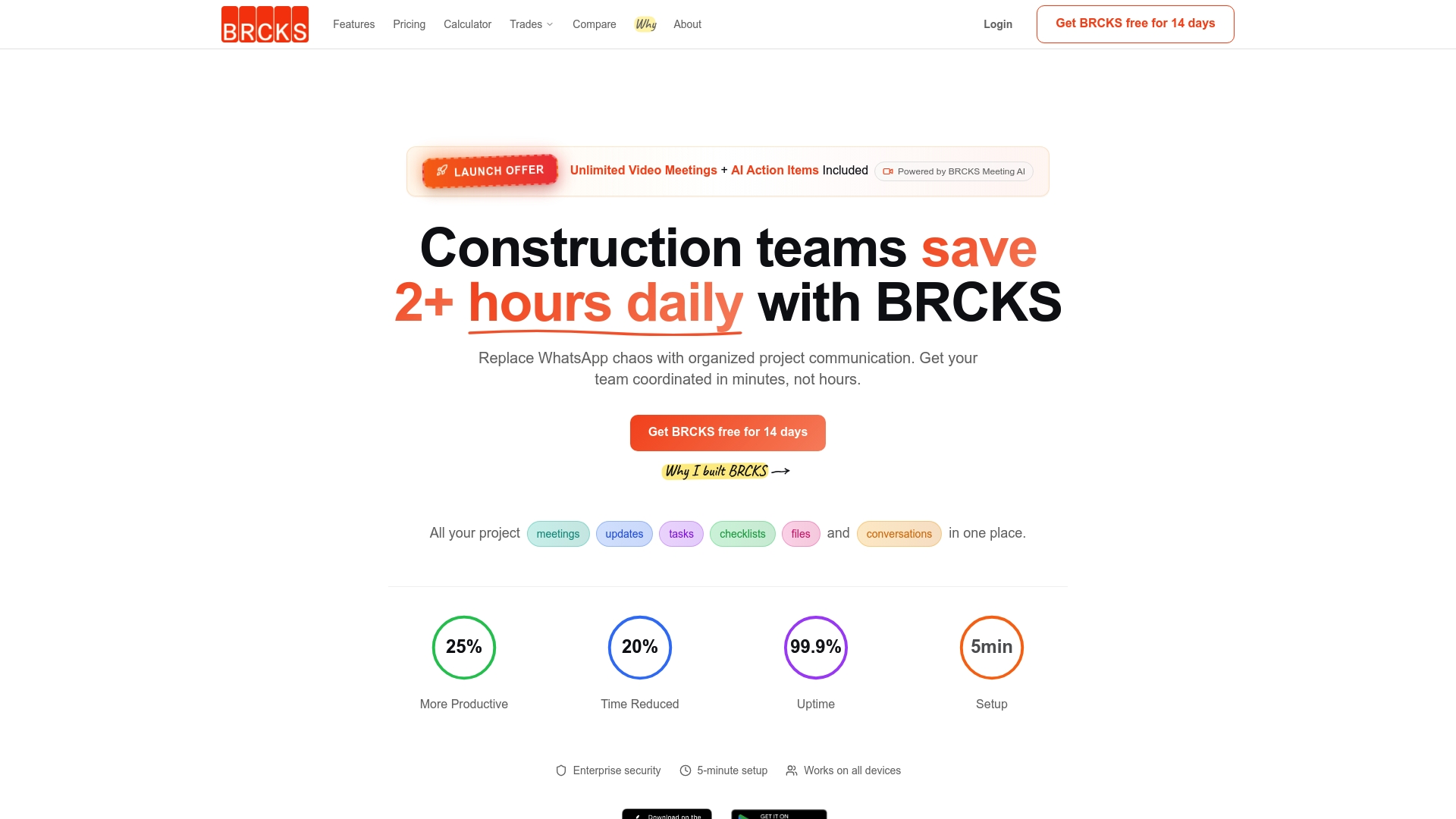
Every daily performance entry, every RFI, every variation is logged automatically and linked to the relevant record. Your audit trail builds itself. Client portals keep stakeholders informed without interrupting the site team. And when a package manager needs to review ITP hold-point evidence or check an insurance certificate, it is in one place, not spread across email threads and shared drives.
For UK builders and project managers who want checklists that are actually completed and connected to the programme, try BRCKS free for 14 days — no commitment required.
Further reading and sources
Use these resources to validate the checklist library, download ITP samples, and extend your supplier performance framework:
- HSE — Construction (Design and Management) Regulations 2015 guidance — the primary reference for RAMS, permit-to-work, and CDM compliance requirements
- Construction Leadership Council — Trust and Productivity — procurement strategy, early engagement, and KPI frameworks for UK projects
- CQIC — Site Guide 2A: Inspection and Test Plans — minimum ITP requirements, staged sign-offs, and quality meeting guidance
- Constructionline — supplier performance management — standardised scorecards and digital tools for subcontractor performance tracking
- Construction Productivity Taskforce — pilot site findings — data-driven recommendations for measuring labour productivity and equipment utilisation
- BRCKS — construction workflow management guide — practical guidance on integrating checklists with digital workflows and site diaries
- BRCKS — task tracking for UK project managers — methods for measuring labour volumes and reporting KPIs from checklist data
Download ITP samples from the CQIC site guide and supplier scorecards from Constructionline to use as starting points for your own templates.
FAQ
What are the most important contractor efficiency checklists for UK projects?
The seven essential types are: pre-qualification (PQQ), site induction, daily performance, ITP hold points, H&S/RAMS, insurance and financial checks, and handover. Each serves a distinct project stage and requires a named signatory.
How often should daily performance checklists be completed?
Every shift, at shift end — not the following morning and never retrospectively. Missing days undermine the evidential value of the record and are a red flag for adjudicators reviewing delay claims.
Which KPIs can you track from checklist data?
Five core metrics: labour productivity (units per labour-hour), schedule adherence (percentage of planned tasks completed on time), defects rate (defects per handover), ITP hold-point pass rate, and RFI response time. Review them weekly.
How does BRCKS support contractor efficiency checklists?
BRCKS automates site diaries, RFI tracking, and variation logs through WhatsApp integration, capturing checklist data in real time and linking every entry to the relevant programme record. This removes the risk of retrospective completion and builds an audit trail automatically.
What is a SafeContractor accreditation and when does it apply?
SafeContractor is a third-party health and safety accreditation scheme widely recognised by UK principal contractors. It verifies that a subcontractor’s H&S policies, risk assessments, and insurance meet a defined standard — making it a useful pre-qualification filter before the full PQQ process begins.
Recommended
- BRCKS | Construction Project Communication Software
- Meeting Management Tips for UK Contractors | BRCKS
- Construction Project Management Software for UK Small Builders | BRCKS
- Construction Team Onboarding Checklist: 2026 UK Guide
How BRCKS Can Help
Implementing these checklists ensures your site remains organised and your subcontractors stay productive, but managing these moving parts manually can still lead to oversight. BRCKS simplifies this process by digitising your workflows and providing real-time visibility into project progress across your entire portfolio. By centralising your documentation and communication, our platform empowers UK project managers to eliminate bottlenecks and maintain high standards effortlessly. We invite you to discover how BRCKS can transform your operational efficiency by exploring our features today. Learn more at BRCKS and explore our full feature set.