Human resources in construction: the 2026 UK guide
A comprehensive guide for UK construction managers on navigating HR compliance, workforce planning, and digital automation in 2026.
By James Shorter ·
Human resources in construction: the 2026 UK guide

What does effective HR in construction actually cover?
Managing human resources in construction goes well beyond contracts and payroll. In 2026, it spans legal compliance, workforce planning, health and safety, and the digital tools that hold it all together on site. Here is what every project manager needs to have in place:
- Legal compliance under CDM 2015: principal contractors must plan, manage, and monitor the construction phase, provide site inductions, and verify every worker holds the skills and training their role demands.
- Employment status management: distinguishing PAYE employees from CIS subcontractors is a financial and legal necessity. HMRC and tribunals look at the day-to-day working relationship, not just the contract label.
- Recruitment, retention, and training: the CITB estimates the industry needs over 41,000 additional workers every year until 2030.
- Digital automation: tools like BRCKS automate site diaries, RFI tracking, and client communications, saving teams over two hours of admin daily.
- Health and safety training: mandatory inductions, toolbox talks, and competency records are HR responsibilities, not just site management tasks.
- Diversity and inclusion: fair pay commitments and social value policies now feature in tender scoring criteria.
- Performance management: appraisal systems must account for project-based work patterns and mixed workforce structures.
- Labour relations and dispute resolution: clear grievance procedures and Working Time Regulations compliance reduce costly tribunal claims.
What UK regulations shape your HR obligations on site?
CDM 2015 Part 3 places direct duties on principal contractors to coordinate health and safety, run site inductions, and confirm every worker has the competency their tasks require. Get this wrong and you carry personal liability for delays and incidents.
Since 27 January 2026, the Building Safety Regulator operates as a fully independent body. Audit-ready training records for every duty holder are now a legal requirement, not a best practice. Digital record-keeping is the only realistic way to meet that standard at pace.
Compliance extends further. Working Time Regulations, National Minimum Wage rules, and Right to Work checks all sit within your HR remit. From October 2026, Right to Work verification covers a broader range of site workers beyond direct PAYE staff. SMEs that rely on manual processes are disproportionately exposed when inspectors arrive.
The CITB’s Construction Workforce Outlook reports that the industry must recruit over 41,000 extra workers annually until 2030, at a time when recruitment difficulties are already acute.
How does automating site communication improve your HR records?
Scattered WhatsApp threads and paper-based site diaries create the same problem: when an audit or dispute arrives, the evidence trail is incomplete. BRCKS solves this by capturing site communications in real time through WhatsApp integration, then converting them into structured records automatically. Your site diary app entries, RFI logs, and variation records are timestamped and searchable without any extra admin from your team.
Digital workflows deliver measurable gains in residential construction, with documented savings of 5–8% through error reduction and faster reporting. For HR specifically, that means induction records, training logs, and workforce attendance data are always current and audit-ready. BRCKS users report saving over two hours daily on administrative tasks, time that goes back into managing the site rather than chasing paperwork.

Pro Tip: Link your BRCKS WhatsApp project management workflow to your onboarding process so new starters are added to the correct project channels and their induction confirmation is logged automatically.
Why diversity and inclusion now affect your ability to win work
Construction’s skills shortage makes workforce diversity a practical necessity, not just a policy commitment. The CITB’s Industry Picture is clear: recruitment, retention, training, and workforce diversity all have a role to play in closing the gap. No single lever is enough.
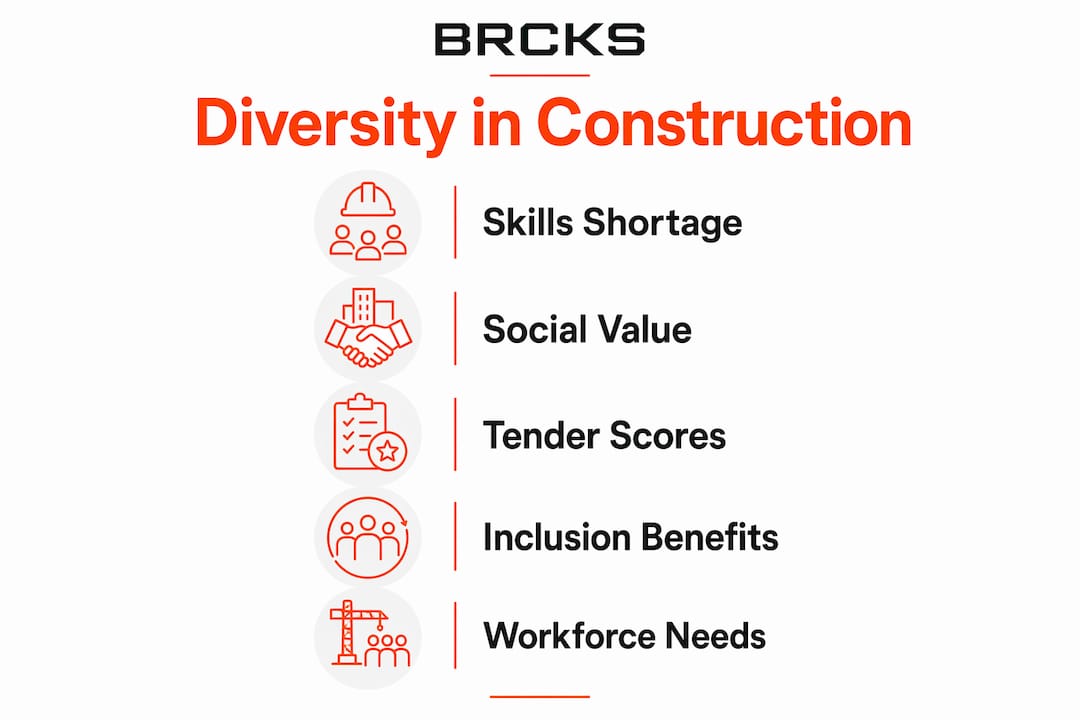
Public sector tenders and Tier 1 contractors now allocate 10–20% of total tender scores to social value criteria, which includes local employment, fair pay, and training commitments. A firm without documented diversity policies and measurable outcomes will lose marks before the technical evaluation even begins. Building a construction onboarding checklist that captures equality monitoring data from day one gives you the evidence base these tenders require.
How should you run performance appraisals for a project-based workforce?
Standard annual appraisal cycles do not fit construction. Workers move between sites, subcontractors rotate with contracts, and performance is often tied to a specific project phase rather than a calendar year. Appraisals need to be tied to project milestones and tied to the specific role the worker held during that phase.
Effective construction HR management uses short review cycles, typically at project completion or at key handover stages, combined with ongoing feedback captured through site supervisors. Digital tools that log daily site activity give managers a factual record to draw on rather than relying on memory. Linking appraisal outcomes to training needs also feeds directly into your competency records under Building Safety Regulator requirements.
How do you handle labour disputes and keep projects moving?
Disputes on construction sites most commonly arise from payment disagreements, employment status misclassification, or health and safety grievances. The mixed economy of PAYE staff and CIS subcontractors makes this more complex: a subcontractor who is treated as an employee in practice can bring a tribunal claim for backdated holiday pay or pension contributions.
Clear written procedures for grievances, a documented escalation path, and accurate time and attendance records are your first line of defence, as outlined in this tips for vastgoedprojecten: gids voor professionals resource. Good project coordination practices reduce the communication breakdowns that cause disputes in the first place. When records are complete and accessible, resolution is faster and the risk of a claim succeeding is lower.
Key takeaways
Effective human resources in construction requires legal compliance, digital record-keeping, and workforce planning to work together, not in isolation.
| Point | Details |
|---|---|
| CDM 2015 compliance | Principal contractors must verify worker competency and provide site inductions on every UK project. |
| BSR documentation | Since January 2026, audit-ready training records for all duty holders are a legal requirement. |
| Skills shortage scale | The industry needs over 41,000 additional workers every year until 2030, per CITB estimates. |
| Digital efficiency | BRCKS users save over two hours daily by automating site diaries, RFIs, and communication records. |
| Tender scoring | Social value criteria, including fair pay and training, account for 10–20% of public sector tender scores. |
FAQ
What are the main HR duties under CDM 2015?
Principal contractors must plan and monitor the construction phase, deliver site inductions, and confirm every worker has the skills and training their role requires, as set out in CDM 2015 Part 3.
How do you manage PAYE staff and CIS subcontractors to
gether?HMRC and employment tribunals assess the actual working relationship, not just contract labels, so misclassification carries real financial risk. Keeping clear, separate records for each status group is the practical safeguard.
Why does the construction industry struggle to recruit?
The CITB estimates the sector needs over 41,000 extra workers annually until 2030, while employers already report recruitment difficulties and experienced workers continue to leave.
How does BRCKS help with HR compliance on site?
BRCKS automates site diary entries, RFI tracking, and communication records through WhatsApp integration, giving project managers timestamped, audit-ready documentation without additional admin overhead.
What is the fastest way to improve site communication records?
Capturing updates through a tool your team already uses, such as WhatsApp via BRCKS, means records are created in real time rather than reconstructed after the fact, which is the point at which gaps appear.
Recommended
- Construction Team Onboarding Checklist: 2026 UK Guide
- UK Construction Project Coordination Best Practices 2026 | BRCKS
- Best Construction Apps UK: 2026 Guide for Builders
- Construction Project Leads UK: Guide to Winning More Work
How BRCKS Can Help
Navigating the complexities of human resources in the UK construction sector requires a strategic balance between managing skilled labour and maintaining operational efficiency. BRCKS simplifies this challenge by providing a centralised platform that streamlines workforce coordination and project oversight, ensuring your team remains productive and compliant. By integrating these essential HR insights with our robust management tools, you can focus on building the future while we handle the logistical heavy lifting. We invite you to explore how BRCKS can transform your site management and support your workforce growth today. Learn more at BRCKS and explore our full feature set.