Reduce information fragmentation in construction projects
UK construction sites waste 13 hours weekly searching for data. Discover how to centralise your project information to reduce errors and improve site safety.
By James Shorter ·
Reduce information fragmentation in construction projects

TL;DR:
- Most UK construction sites waste an average of 13 hours weekly searching for information, risking delays and safety issues. Fragmentation occurs when project data is scattered across unconnected tools and communications, leading to errors, rework, and compliance risks. Effective solutions include establishing a centralised data platform, standardising data practices, and fostering a culture of proactive documentation and communication.
Project managers on UK construction sites spend an average of 13 hours each week hunting for information that should already be at their fingertips. That is not an unavoidable consequence of complex projects. It is a fixable problem, and one with real financial and safety consequences. This guide explains what information fragmentation is, why it persists on so many sites, and what your team can do right now to stop it from undermining your projects.
Table of Contents
- Understanding information fragmentation in construction
- The main causes and warning signs of fragmentation
- How to reduce fragmentation: Effective strategies for project teams
- Digital tools, culture shift and the role of AI
- Our take: Why most teams struggle and how we’d actually fix fragmentation
- Practical next steps: How BRCKS helps you build with clarity
- Frequently asked questions
Key Takeaways
| Point | Details |
|---|---|
| Fragmentation wastes time | On average 13 hours per week are lost hunting for information, driving up delays and costs. |
| Root causes are people and tech | Fragmentation stems from siloed systems, outdated processes, and misaligned team incentives—not just technical failings. |
| Unified platforms cut errors | Centralising communication and documentation in a shared hub drastically reduces errors and rework. |
| Culture change is essential | Sustainable improvement combines better tools with real changes to communication and workflows. |
Understanding information fragmentation in construction
Information fragmentation happens when project data, decisions, drawings, specifications and communications are scattered across multiple tools, people and locations with no reliable way to connect them. On a typical UK construction site, you might find design files stored in one system, cost data locked in a spreadsheet, site instructions passed by phone call, and RFI responses buried in someone’s email inbox. Nobody has the full picture. Errors follow.
The practical consequences are well documented. Fragmented preconstruction handoffs are a persistent source of information loss, and the downstream effects include scope creep, programme delays, and costly rework. Consider a subcontractor who starts groundworks based on a drawing that was superseded three weeks earlier. Nobody told them. The revised version was uploaded to a platform they rarely check. This kind of scenario plays out daily across the UK, and it is entirely preventable.
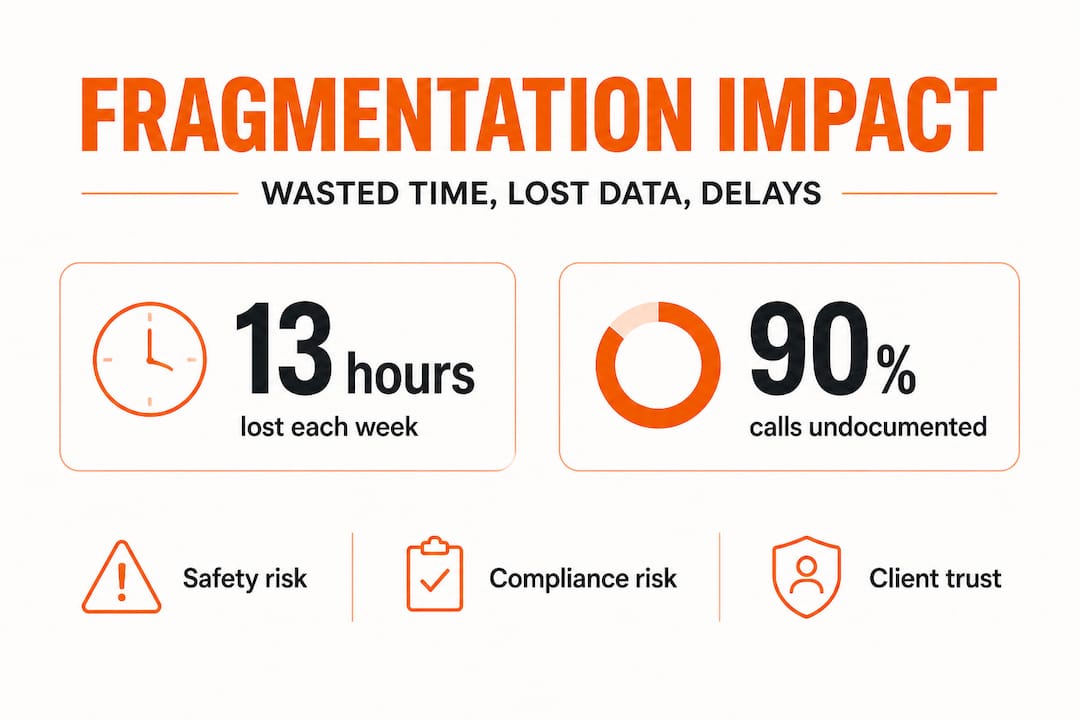
The scale of the issue becomes clearer when you consider voice communication. 90% of undocumented phone calls result in lost information, which amplifies project risks significantly. A verbal instruction to change a specification, a verbal approval of a variation, a quick call confirming revised access arrangements: none of these are captured, and all of them become liabilities.
| Impact area | Fragmentation risk | Common consequence |
|---|---|---|
| Programme | Delays in information transfer | Missed milestones |
| Cost | Duplicated or contradictory data | Budget overruns |
| Quality | Outdated drawings in use | Defects and rework |
| Compliance | Missing audit trail | Regulatory exposure |
| Handoff | Incomplete project records | Operational problems |
Beyond cost and time, fragmented information creates real compliance risk. Building safety regulations increasingly require a clear, documented golden thread of information from design through construction and into occupation. When that thread is broken at any point, your exposure increases. Cutting construction errors by even a modest percentage through better information sharing has a measurable impact on both margins and reputation.
Fragmented information also damages client relationships. Clients who cannot get clear answers about project status lose confidence quickly. That lack of transparency often leads to disputes that could have been avoided entirely. If you recognise this pattern, you are experiencing what many describe as the communication crisis in construction, and it is more widespread than most teams acknowledge.
The main causes and warning signs of fragmentation
Once you understand how fragmentation presents itself, it is vital to know why it happens and what to watch for before it affects your projects. The causes are rarely a single failure. They accumulate.
Outdated systems and siloed platforms are the most common culprits. Many construction businesses run multiple software tools that do not integrate with each other. Finance uses one system, the design team uses another, and site managers track progress in a spreadsheet. Each platform becomes an information silo. Legacy integration obstacles and cultural resistance to replacing familiar tools make this worse over time.

Misaligned incentives between stakeholders also drive fragmentation. A subcontractor who benefits from ambiguity has little reason to document everything clearly. A main contractor under commercial pressure may not invest time in structured handoffs. When accountability is diffuse, information quality suffers.
The warning signs are easy to recognise once you know what to look for:
- Multiple versions of the same drawing in circulation
- Team members regularly asking where to find a document
- Decisions made in meetings that never get formally recorded
- Information held by individuals rather than accessible to the team
- Clients asking questions that your team cannot answer quickly
- Regular rework traced back to contradictory or outdated instructions
There is also a counterintuitive finding worth noting here. Digital leaders in construction use five times more tools than average teams, but their advantage comes from better information sharing between those tools, not simply having more technology. More software without integration makes fragmentation worse.
Pro Tip: Conduct a simple information audit at the start of your next project. Ask every team member where they currently store and find project information. The answers will almost certainly reveal fragmentation you were not aware of.
Fixing communication breakdowns requires identifying these root causes first. Without that diagnosis, any solution risks addressing symptoms rather than the underlying problem.
How to reduce fragmentation: Effective strategies for project teams
After recognising fragmentation, construction teams need practical strategies they can put into place straight away. The good news is that several proven approaches exist, and you do not need to overhaul everything at once.
-
Establish a Common Data Environment (CDE) from day one. A CDE is a single, agreed location for all project information. Every drawing, specification, RFI and instruction lives there, with version control. No more searching across inboxes and shared drives. Centralising data in unified platforms using open standards such as IFC and BCF significantly reduces information loss across the project lifecycle.
-
Standardise naming conventions and data classification early. Agree on document naming formats, cost code structures and folder hierarchies before the project starts. This sounds basic, but it is one of the most impactful steps you can take. Using consistent unique IDs and standardised data entry from the outset prevents the duplication and confusion that builds up over months.
-
Integrate your platforms wherever possible. If your site management tool, finance system and communication platform share data, your team spends less time re-entering information and more time acting on it. Look for tools that support open standards and offer API connections to your existing systems.
-
Introduce real-time and voice-capture communication tools. Because so much construction communication happens verbally, capturing those conversations matters. Tools that record and transcribe site walk-throughs, team meetings and client calls turn verbal agreements into searchable records instantly.
-
Pilot your changes on a single project before rolling out. Test your chosen approach on one project, measure the time saved, the reduction in rework requests and the improvement in document retrieval speed. Use that data to build internal support for wider adoption. Stakeholder collaboration at this stage is critical to getting the pilot right.
| Approach | Effort to implement | Impact on fragmentation | Best suited for |
|---|---|---|---|
| CDE adoption | Medium | Very high | All project sizes |
| Naming standardisation | Low | High | New projects |
| Platform integration | High | Very high | Repeat workflows |
| Voice capture tools | Low | Medium to high | Site teams |
| Pilot and measure | Low | High (long-term) | Change management |
Best practices for team coordination consistently point to the CDE and standardisation as the foundation. Everything else builds on top of that base. Once your team has reliable access to accurate, current information, better document control becomes far easier to sustain throughout the project.
Pro Tip: Before selecting any new digital tool, map the journey a piece of information takes from creation to the person who needs it on site. Identify every step where it could be lost, delayed or distorted. That map tells you exactly where your technology or process gaps are.
When teams take a structured approach, the results are significant. Those looking at digital solutions for collaboration will find that the return on investment from reduced rework alone typically justifies the investment in centralised platforms within the first few months of a project.
Digital tools, culture shift and the role of AI
With practical actions covered, it is time to address technology’s real role and how human factors underpin any sustainable solution. Digital tools are only as effective as the data and behaviours behind them.
The most common mistake teams make is adopting new software and expecting fragmentation to resolve itself. Technology does not fix a culture problem. AI and digital solutions only work if you first unify your project data. If your underlying data is incomplete, inconsistent or inaccessible, AI tools will surface unreliable outputs. Garbage in, garbage out applies as sharply to construction AI as it does to any other context.
That said, when deployed on well-governed data, the benefits of smart technology are substantial. IoT devices such as helmet sensors can reduce lost time on site from 3.84 hours per day to 1.6 hours when embedded within a structured data platform. That is more than two hours of productive time recovered, per worker, per day.
A shared digital platform creates what regulators and industry bodies call the golden thread, a continuous, documented record of decisions, changes and actions across the full lifecycle of a project. This matters for compliance, for dispute resolution, and for the smooth transition of a completed building to its owner and operator.
The cultural dimension is equally important. Teams need to feel safe raising concerns about missing information rather than proceeding and hoping for the best. A culture of proactive, penalty-free communication means problems surface earlier, when they are cheaper and easier to fix.
- Reward team members who flag information gaps rather than ignore them
- Build brief daily check-ins around information status, not just physical progress
- Make the CDE genuinely easy to use, so compliance is not a burden
- Ensure senior leaders demonstrate the behaviours they expect from the wider team
- Treat undocumented verbal instructions as an unacceptable risk, not standard practice
“The biggest barrier to fixing fragmentation is not the technology. It is the assumption that documentation is someone else’s job.”
Avoiding collaboration failure pitfalls requires this honest assessment of both systems and people. Teams that address culture alongside technology consistently outperform those that focus on tools alone. The evidence is clear: workflow improvements deliver measurable results when both process and people are aligned. Investigating smart technology in construction further demonstrates how purposeful technology adoption, combined with cultural change, drives lasting results.
Our take: Why most teams struggle and how we’d actually fix fragmentation
Here is the honest assessment that most articles in this space avoid. Most fragmentation fixes fail not because teams choose the wrong software, but because they skip the work that has to happen before the software goes live.
We see this pattern repeatedly. A project manager decides that a new digital platform will solve the communication chaos on their sites. They purchase licences, run a quick training session, and launch it on their most complex active project. Within six weeks, adoption has stalled. Half the team is still using WhatsApp, the other half have reverted to email, and the new platform is generating a third stream of unread notifications.
The failure is not the tool. It is the sequence. You cannot drop a new system into an existing chaotic workflow and expect order to emerge. The workflow has to be mapped, agreed and simplified before the technology is introduced.
What actually works is the benchmarking step most teams skip. Before any tool goes live, spend one week measuring how long it takes to find a current drawing, how many calls it takes to confirm a site instruction, and how many rework incidents trace back to information failure. These become your baseline metrics. When your new system is running, you measure again. That comparison, and the financial value it represents, is the business case that saves money and keeps leadership committed to the change.
Pilot projects also matter more than any grand roll-out strategy. A single well-run pilot, with clear metrics and genuine team buy-in, does more for adoption than a company-wide mandate ever will. Let the results speak. Share them internally. Build momentum from evidence rather than authority.
Finally, start documenting decisions immediately. Not next week. Today. Every meeting decision, every verbal instruction, every specification change should be captured in writing within the hour. Voice notes fed into a searchable system work just as well as typed records. The habit of documentation is what makes every other fix sustainable.
Practical next steps: How BRCKS helps you build with clarity
Ready to bring these strategies to your own projects? Here is how BRCKS can help.
BRCKS for builders is designed specifically to address the fragmentation problems this article describes. Every feature, from project updates and checklists to file sharing and team chat, sits within a single platform so your team always knows where to look.
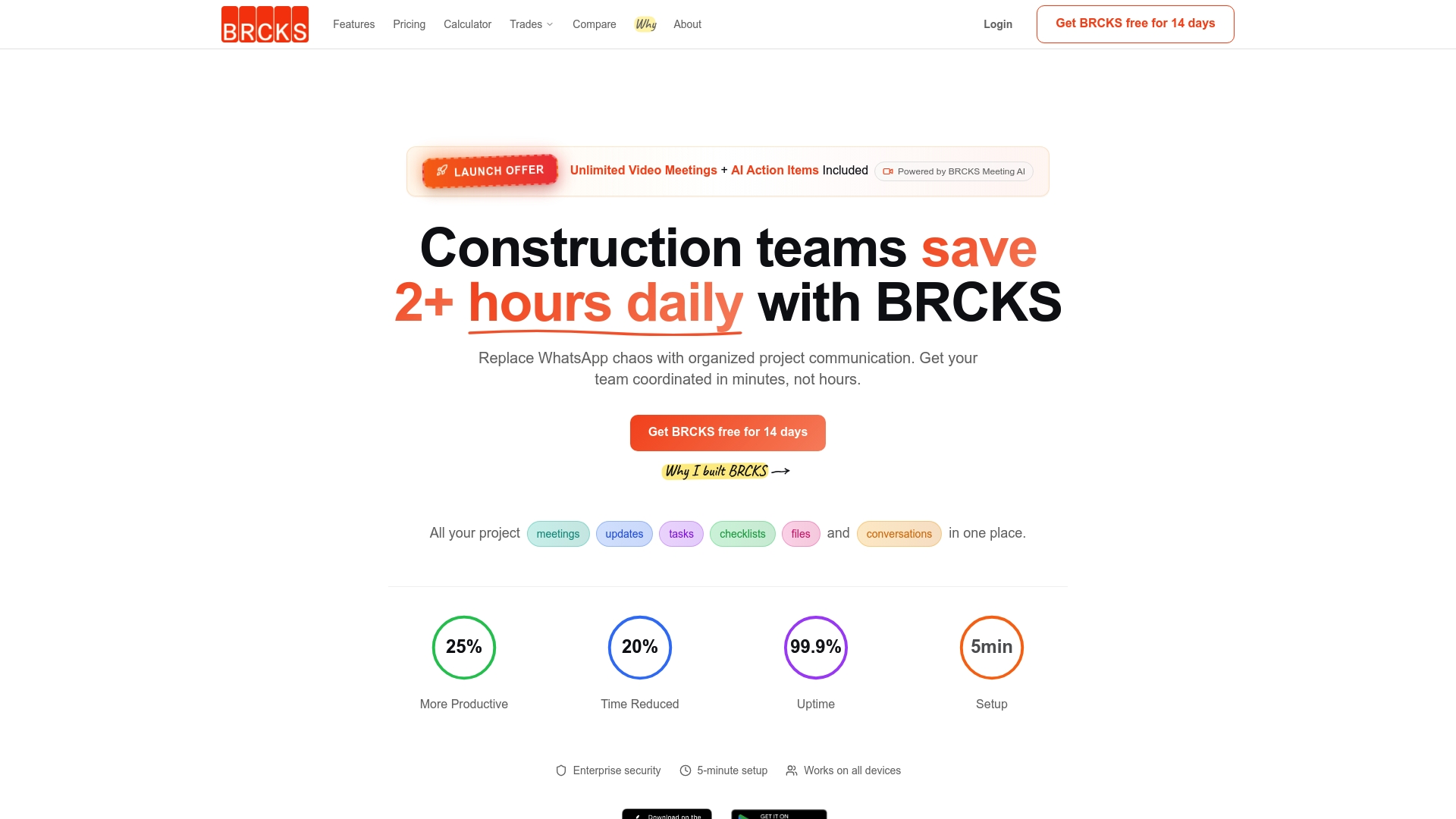
With construction communication tools that integrate WhatsApp, AI-powered search and automated workflows, BRCKS reduces the manual effort of keeping information current and accessible. Teams save over two hours daily on average, and clients get a transparent view of project progress through dedicated client portals. Subcontractors access the platform for free, so there is no barrier to getting your full supply chain onto one system. If you want to see why teams choose BRCKS, the 14-day free trial gives you a hands-on answer without any commitment.
Frequently asked questions
How does information fragmentation affect construction safety?
Fragmented information can lead to undocumented hazards and missed safety updates, directly increasing accident risk on site. Most preconstruction handoffs are vulnerable to information loss, which means safety-critical data may never reach the people who need it.
What are some first steps to reduce information fragmentation?
Begin by centralising documents and communications in a common platform and standardise data entry from the start of each project. Centralising data in unified platforms using open standards such as IFC and BCF reliably reduces information loss across the project lifecycle.
Why does resistance to digital tools persist in construction?
Many teams face change fatigue, concerns about legacy systems, and fear of making costly errors with unfamiliar software. Resistance to change and legacy integration obstacles are among the most persistent contributors to ongoing data fragmentation in the sector.
How can project managers measure the impact of information fragmentation?
Track the time your team spends searching for project information and the frequency of duplicated or inconsistent data, then benchmark improvements after any process change. Project managers already lose an average of 13 hours weekly to information hunting, which gives you a clear starting point for measurement.
Recommended
- Construction Mobile Apps: Reduce Material Waste by 25% | BRCKS
- The Hidden 11% Cost: How Poor Communication Between Trades Is Destroying Your Construction Budget | BRCKS
- Construction Software for Builders | BRCKS
- BRCKS | Construction Project Communication Software
- Streamline Project Bidding for Better Texas Home Renovations | BidWolf Blog
How BRCKS Can Help
Eliminating information fragmentation is essential for maintaining project momentum and protecting your bottom line. By centralising communication and documentation within BRCKS, teams can finally bridge the gap between the office and the site to ensure everyone works from a single source of truth. This unified approach reduces costly errors and keeps your projects moving forward with total clarity. We invite you to discover how BRCKS can streamline your workflows and bring much-needed cohesion to your next development. Learn more at BRCKS and explore our full feature set.