Make Your 4–6 Week Lookahead Actually Hold for Site Supervisors
Learn how to build a reliable 4–6 week lookahead plan that actually holds, ensuring your site supervisors can manage constraints and trade coordination effectively.
By James Shorter ·
Make Your 4–6 Week Lookahead Actually Hold for Site Supervisors
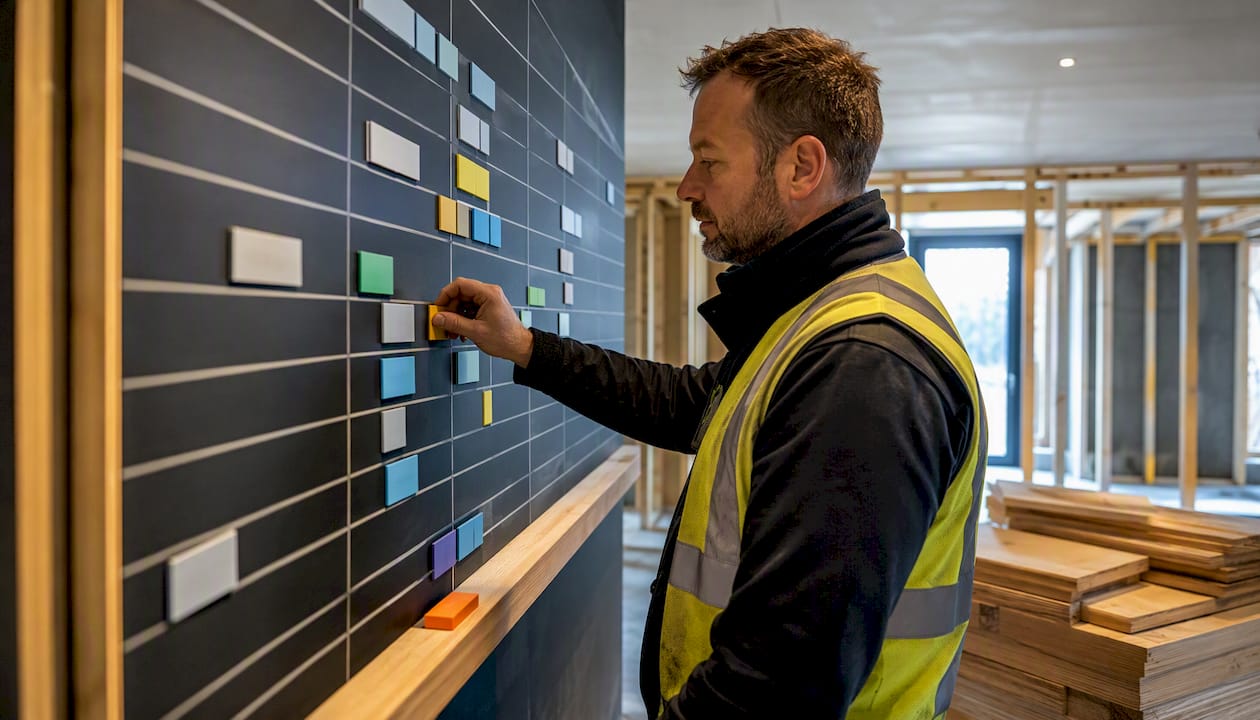
Lookahead planning is the rolling short-term schedule that turns master programme logic into activities a crew can start tomorrow. It runs on a 2 to 6 week window for most trades, longer for complex programmes, and its whole job is to make tasks ready before anyone commits to them. Done properly, using commitment-based planning drawn from the Last Planner System, it cuts idle crews and stops constraints surfacing on the day work was meant to start.
TL;DR:
- A lookahead planning window varies from 2 weeks for quick tasks to 12 weeks for complex projects, depending on lead times and project pace.
- Building a reliable lookahead involves anchoring to the master schedule, breaking activities into clear packages, and verifying constraints with owned, actionable checklists.
- Proper constraints identification, particularly for materials, approvals, or site access, is crucial to avoid delivery delays and activity slips.
- Attendees must include trade leads, procurement, and inspectors who have authority to make decisions and resolve constraints during weekly workshops.
- Digital tools like BRCKS automate constraint tracking and site updates, reducing admin time and keeping the plan current through real-time evidence and role-based notifications.
Table of Contents
- What is lookahead planning and how long should the window be?
- Why bother with a lookahead at all?
- How do you build, validate and roll a lookahead?
- What constraints actually block a lookahead activity?
- Who attends lookahead meetings and what should they decide?
- How do teams keep a lookahead live on site?
- How does lookahead planning work in practice across different builds?
- A short field perspective: common mistakes and simple fixes
- How BRCKS keeps your lookahead plan honest
- Key guidance and standards to consult next
- Sources
- FAQ
What is lookahead planning and how long should the window be?
A lookahead plan is a rolling view of the next few weeks, broken down day by day or week by week, pulled directly from the master schedule. Some sites call it a weekly work plan, a phase plan, or the make-ready process. The names differ; the job is the same: strip out the activities due next and check they can actually happen.
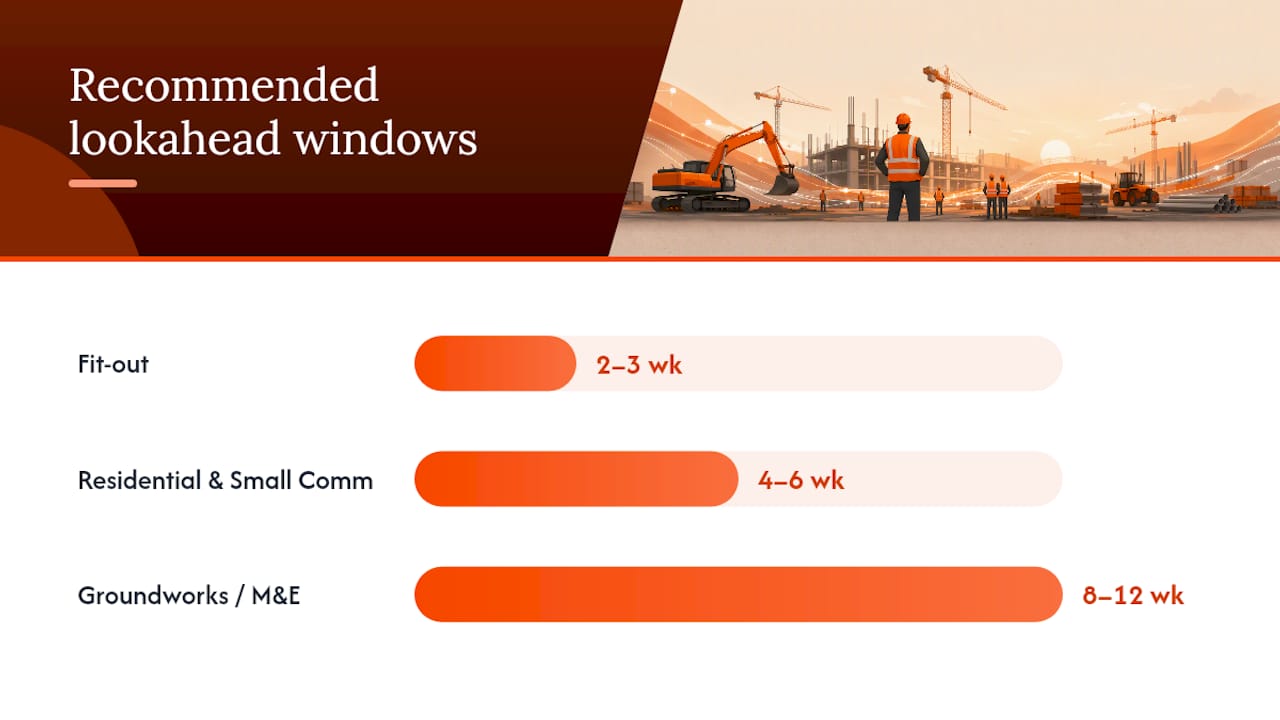
Window length depends on lead times and project tempo. A fit-out with short material lead times might run a 2 to 3 week lookahead. Groundworks or M&E, where you are chasing approvals and long-lead kit, often need 8 to 12 weeks. Most residential and small commercial builds settle on 4 to 6 weeks. Pick a window long enough to spot a constraint before it bites, short enough that the detail stays accurate.
Why bother with a lookahead at all?
A lookahead earns its place the moment two trades need the same space in the same week. It forces someone to decide who goes first, before both foremen turn up with their own plan.
The benefits are concrete: activities arrive ready to start, crews stop standing around waiting on a delivery or a sign-off, long-lead items get flagged weeks before they become urgent, and handovers between trades get agreed rather than assumed. Run one whenever you spot trade overlap on a floor, a long-lead item on order, an inspection dependency, or when the programme has already slipped and you need a recovery plan that people trust.
The metric that tells you if it is working is Percent Plan Complete, or PPC. It is simply the number of committed activities finished on time, divided by the number promised. A crew hitting 60% PPC week after week has a planning problem, not a labour problem, and the reason codes behind those misses usually point straight at unresolved constraints.
How do you build, validate and roll a lookahead?
Building a reliable lookahead is a repeatable process, not a one-off exercise. Follow it the same way every week and the schedule earns trust; skip steps and it becomes another spreadsheet nobody checks.
- Anchor to the master schedule. Pull the activities due in your chosen window straight from the programme, not from memory.
- Break activities into executable packages. Each line needs a clear location, a realistic duration, and a named owner. “First floor blockwork, east elevation, 3 days, Dave” beats “blockwork” every time.
- Run a constraint checklist on every activity. Ask what needs to be true before this can start: materials on site, RFI answered, inspection booked, access clear.
- Assign one owner per constraint. Shared ownership means nobody chases it.
- Hold the lookahead workshop. Bring trade leads into the room and test every activity against the commitment test: can this genuinely start, with no open constraint, in the week promised?
- Convert week one into the weekly work plan. Commit only to activities that passed the make-ready test, then measure PPC at the end of the week.
- Capture reason codes for anything missed, and roll the plan forward. Add a fresh week at the end and repeat.
The commitment-based approach matters because it separates what should happen from what genuinely can happen this week. A lookahead that skips the constraint check is just a shorter Gantt chart with better fonts.
Pro Tip: Never let a foreman commit to an activity “if the delivery turns up.” If a constraint is still open, it does not go in the weekly work plan, no matter how confident anyone sounds in the meeting.
What constraints actually block a lookahead activity?
Constraints fall into five recurring categories: information (unanswered RFIs, missing drawings), materials, resources (plant, labour, specialist subbies), approvals and inspections, and site access. A constraint register with a named owner and a deadline against each line is the difference between a list people read and a list people act on.
- 3 to 4 weeks out: chase long-lead materials, submit RFIs, book inspections that need to notice, confirm specialist subbie availability.
- 1 to 2 weeks out: confirm delivery dates, check RAMS are signed off, verify access and permits are in place.
- The week before execution: walk the location, confirm the previous trade has actually finished, check the constraint list shows nothing outstanding.
Reason codes matter here too. Research into lookahead performance found that poor constraint identification and slow constraint removal are the most common causes of low PPC, more so than weather or labour shortages. Track why activities slip week after week, and the same three or four causes tend to repeat, which is exactly what a constraint register is meant to expose.
Who attends lookahead meetings and what should they decide?
Get the wrong people in the room and a lookahead workshop turns into a status update. Get the right people in, with authority to commit, and it produces decisions.
- Site manager chairs and owns the master schedule view.
- Foremen and trade leads confirm durations and flag sequencing clashes.
- Procurement reports on material lead times and confirms delivery dates.
- QA or the inspector confirms inspection windows and outstanding sign-offs.
A 12-week lookahead workshop typically runs 4 to 6 hours; weekly production control is shorter, usually 1 to 3 hours. Three rules keep both useful: apply the commitment test to every line, use durations the crew leader has actually verified in the field, and give every constraint a single named owner. Review PPC and the week’s reason codes at the start of each meeting, before adding new activities.
How do teams keep a lookahead live on site?
A lookahead dies the moment updating it becomes a chore nobody has time for. Photo-led checklists let a foreman mark an activity ready from the phone in his hand, and an automatic site diary means nobody has to reconstruct what happened after the fact.
- Photo checklists confirm make-ready status without a trip back to the office.
- RFI tracking with an audit trail shows exactly when a query went out and when it was answered, which shortens the argument about who caused a delay.
- Role-based notifications put the constraint in front of the person who owns it, not the whole team.
- Searchable project history means a foreman can find last week’s decision on tiling levels in seconds, not by scrolling WhatsApp.
Automated data capture from site appearance and photo evidence can surface constraints earlier, but it only works alongside named ownership and a decision-maker willing to act on what it flags.
Pro Tip: Pilot any new digital workflow with one team and one project first. Roll it out site-wide only once foremen are updating constraints from the field during the workshop itself, not typing notes up afterwards.
How does lookahead planning work in practice across different builds?
A residential fit-out with six trades on a tight floor plate lives or dies on sequencing. One contractor running a two-week lookahead for a kitchen and bathroom refurbishment programme found the biggest recurring reason code was not materials, it was access: the electrician and the tiler both needed the same room on the same day. Once that clash showed up as a constraint on the register rather than a surprise on site, the fix was simple: stagger the trades by half a day and confirm it in the weekly work plan.
On a commercial fit-out with a longer procurement chain, the constraint that mattered most was different again. Specialist mechanical plant had a six-week lead time, but the original programme only flagged it two weeks out. Running an 8-week lookahead instead of a 4-week one gave procurement enough runway to order early and avoid a hold-up on the whole M&E sequence.
Highways and infrastructure programmes tend to lean on the 8 to 12 week collaborative mapping cycle recommended by National Highways, because approvals and access permits take that long to clear. A residential job rarely needs that horizon. A motorway junction usually does.
What links all three is not the trade or the sector. It is the discipline of checking every activity against a constraint list before committing to it, and rolling the plan forward every week rather than redrawing it from scratch.
A short field perspective: common mistakes and simple fixes
The biggest failure is treating a lookahead as a reporting exercise. It should drive make-ready action, not just describe the week ahead. Break long tasks by location, get crew leaders to verify durations themselves, and track why activities miss. The same two or three reason codes usually explain most of your slippage.
— James
How BRCKS keeps your lookahead plan honest
BRCKS is built for the admin that sinks a lookahead plan: chasing RFI answers, rebuilding site diaries from memory, and hunting for the photo that proves a constraint was cleared. Site teams already message the way they always have, including through WhatsApp with a dedicated business number, but BRCKS automatically files that update against the right project, logs the variation, and keeps an audit trail on every RFI.
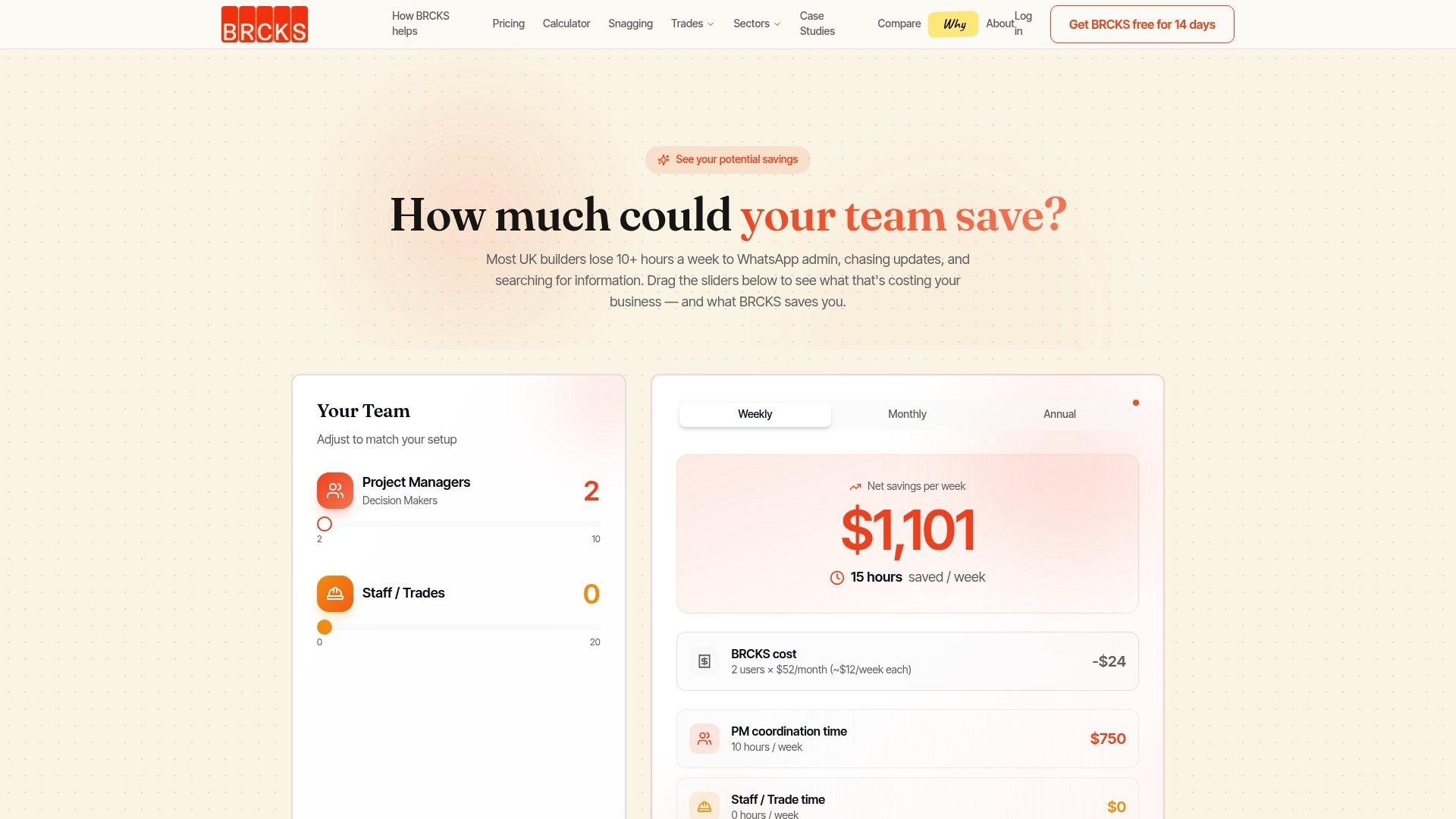
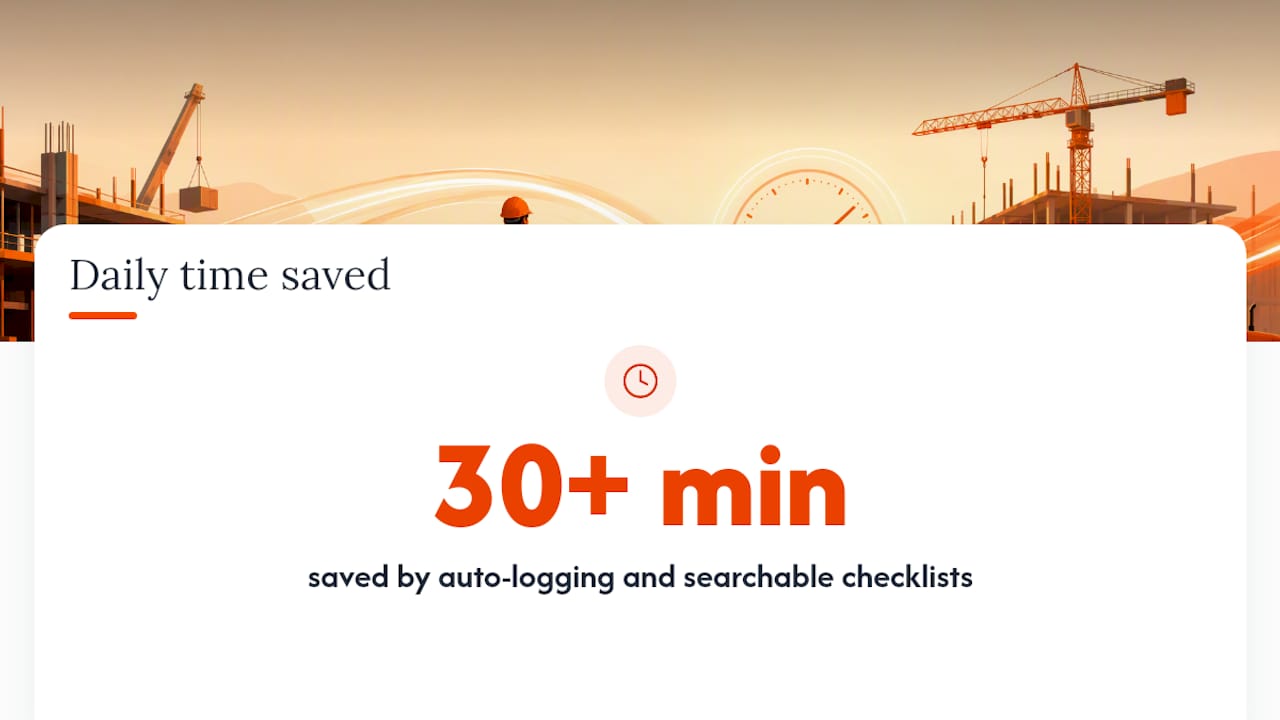
That means the make-ready checklist a foreman ticks off on his phone this morning is searchable by the whole team this afternoon, saving 30 or more minutes a day that would otherwise go on writing things up twice. Photo-led checklists and snagging feed straight into the project record, and role-based notifications put an open constraint in front of the person who owns it rather than buried in a chat thread. Subcontractors and clients join free; pricing details for the core team running the schedule are available on the BRCKS website.
If your lookahead keeps stalling on the same admin, start with the site diary app to see how automatic logging works day to day, or check BRCKS pricing for small builders and try it free for 14 days.
Key guidance and standards to consult next
For agendas and a 12-week mapping cadence, see National Highways’ lean collaborative planning standards. For automating constraint detection, see the research on lookahead automation.
Sources
- Lean collaborative planning minimum standards (National Highways)
- Last Planner System for design (Lean Construction Institute)
- Automating lookahead planning using site appearance (ArXiv)
FAQ
What is a lookahead plan?
A lookahead plan is a rolling short-term schedule, usually 2 to 12 weeks out, that breaks the master programme into activities a crew can start once every constraint is cleared.
Is it “look ahead” or “lookahead”?
Both appear in practice, but “lookahead” is the standard single-word form in construction planning documents and Last Planner System literature.
What is a lookahead schedule in construction?
It is the bridge between the master schedule and the weekly work plan, pulling near-term activities out for detailed checking, constraint removal, and trade coordination before crews commit to them.
What is a two-week lookahead schedule?
A two-week lookahead lists activities due to start in the next fortnight, broken down by location and duration, each checked against a constraint register before it appears on a weekly work plan. Teams can pull this view straight from logged variations and RFI status rather than rebuilding it from separate spreadsheets.
Recommended
- Site Communication Workflow: UK Project Manager’s Guide
- Plumber Job Scheduling Guide: Boost Site Efficiency
- Construction Team Onboarding Checklist: 2026 UK Guide
How BRCKS Can Help
Bridging the gap between high-level planning and daily site reality requires a shift from static spreadsheets to dynamic, collaborative tools. BRCKS simplifies this process by ensuring your 4–6 week lookaheads are always accurate, accessible, and aligned with the actual progress on the ground. By centralising communication and automating updates, BRCKS empowers site supervisors to manage their schedules with confidence rather than constantly firefighting delays. We invite you to explore how BRCKS can transform your project delivery and bring lasting stability to your site operations. Learn more at BRCKS and explore our full feature set.