Construction project estimator: the UK builder's guide for 2026
Discover why modern UK builders are replacing spreadsheets with site-first construction project estimators to manage variations and audit trails effectively.
By James Shorter ·
Construction project estimator: the UK builder’s guide for 2026

For UK builders replacing spreadsheets and WhatsApp, the right construction project estimator is a purpose-built site management platform, not a cost-calculation tool. BRCKS is the practical choice: £40 per seat per month billed annually, with subbies and clients invited free. Start with a 14-day free trial or run the BRCKS savings calculator before your next demo. The rest of this guide explains why spreadsheets and WhatsApp fail under pressure, what to insist on during demos, and how to build a simple ROI case for your directors.
Key takeaways
For UK builders, the right construction project estimator is a site-first platform with a searchable audit trail, structured variation logs and free subcontractor access.
| Point | Details |
|---|---|
| Spreadsheets fail at scale | Version drift, missing audit trails and GDPR exposure make spreadsheets unworkable beyond one project. |
| 30+ minutes saved daily | Plain-English search across project history recovers over 1,000 team hours per year on a five-person team. |
| ROI in under two months | A four-seat BRCKS subscription costs £1,920 per year against — in recovered labour value. |
| ISO 19650-ready handover | Structured records built during the project export directly into client handover packs. |
| BRCKS for UK builders | £40 per seat per month annually; subbies and clients free; WhatsApp integration included. |
Table of Contents
- Why spreadsheets and WhatsApp stop working as projects grow
- What must a construction project estimator actually do?
- How the right tool saves time, reduces disputes and improves handover
- How do you evaluate options quickly before buying?
- Slim rollout plan for a small-to-medium building firm
- Who benefits most from replacing spreadsheets?
- How BRCKS maps to the must-have checklist
- Pricing and a worked ROI example for a small team
- An honest view from the builder’s side
- Try BRCKS: free trial, demo and savings calculator
- Sources
- FAQ
Why spreadsheets and WhatsApp stop working as projects grow
The problem is not that spreadsheets are bad tools. They are fine for a single project with one person updating them. Add three subbies, a client, a site manager and a commercial lead, and the wheels come off fast.
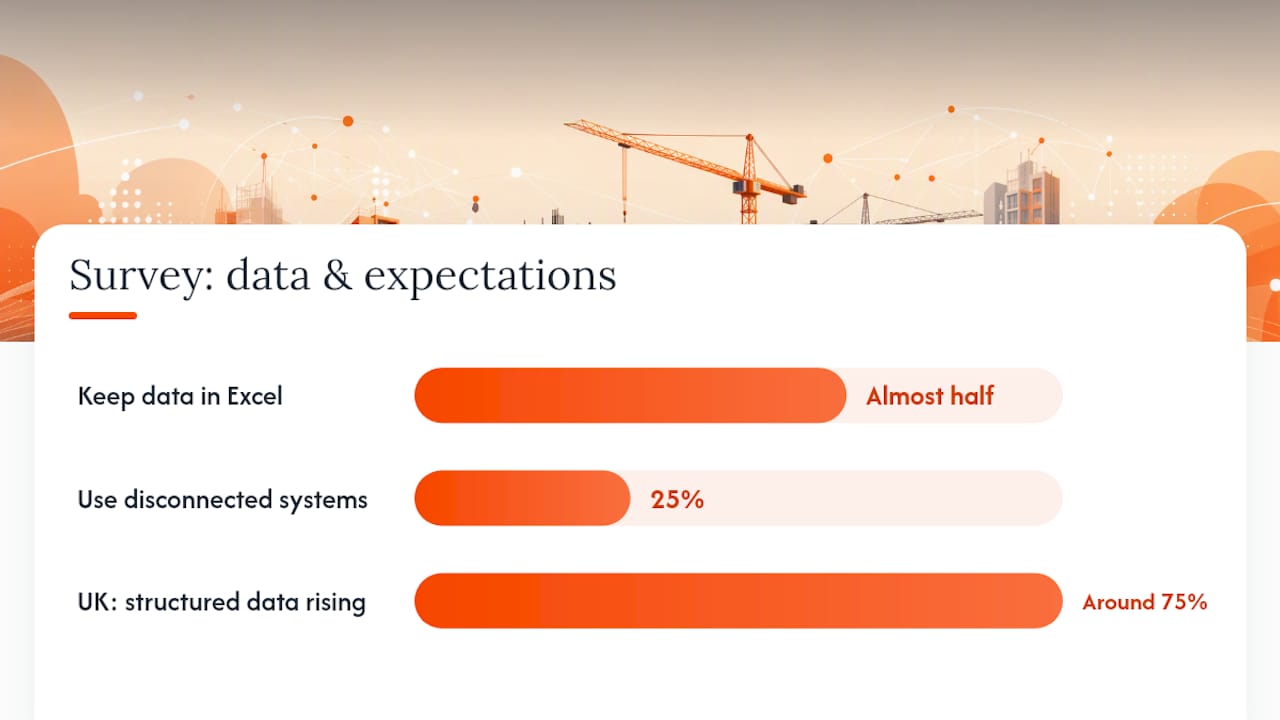
Industry polling of nearly 200 construction professionals found that almost half still keep project data in Excel, and a quarter use disconnected systems. The same webinar identified handover as the point where spreadsheets become a scramble: no single version of truth, no audit trail, no structured data to hand to the client.
WhatsApp compounds the problem. Decisions made in group chats create traceability and accountability gaps and block any future analysis that requires structured records. The common failure modes:
- Version drift: multiple people editing different copies of the same sheet
- No audit trail: no record of who approved a variation or when
- GDPR exposure: personal data in consumer messaging apps with no data-processing agreement
- Buried instructions: a critical RFI answer lost 200 messages up a WhatsApp thread
- Orphaned variations: a scope change agreed verbally, never logged, disputed at final account
- Lost photos: site evidence saved to personal phones, not the project record
ISO 19650 and growing client expectations are pushing UK firms toward structured, accountable data at handover. That pressure is only increasing: Turner & Townsend’s GCMI notes the UK leads digital adoption in construction, with around 75% of UK respondents say structured, data-ready capabilities are becoming more important in tenders.
Pro Tip: Run a quick risk audit on one live project today. Count how many variations were agreed by WhatsApp message in the last four weeks, then check how many have a written, dated record with client acknowledgement. The gap between those two numbers is your dispute exposure.
What must a construction project estimator actually do?
A site-first project management platform must capture, store and surface every decision, instruction and piece of evidence in a searchable, structured record. Here are the non-negotiables to test in every demo:
- Site diary: automatic daily records with weather, attendance and progress notes
- Variation logs: structured entries with scope, cost, approval status and client sign-off
- RFI tracking: numbered, dated, with response deadlines and a full audit trail
- Photo-led checklists: timestamped, geotagged images filed against the right project and task
- Approvals and acknowledgements: a record of who saw what and when, not just who sent it
- Subcontractor access: subbies must be able to log work and receive instructions without a paid seat
- Plain-English search: find any decision, photo or instruction in seconds without knowing the exact date
- WhatsApp integration: messages captured automatically into the project record without changing how the team communicates
On compliance, structured handover documentation is increasingly demanded by clients and expected under ISO 19650-style frameworks. Your platform must export structured data, not just PDFs.
For integrations, insist on CSV export for accounting reconciliation, a clear API or webhook for ERP connections, and a WhatsApp bridge that converts everyday messages into project records automatically.
How the right tool saves time, reduces disputes and improves handover
A single, searchable project record cuts the time spent hunting for information and the money lost to disputed variations. BRCKS reports that users save 30+ minutes per day through plain-English search across project history alone. Scaled across a team of five over a year, that is more than 1,000 hours recovered.
The savings go beyond admin time. Digital tools in residential construction deliver conservative 5–8% savings when they replace manual workflows. On a typical residential project, those savings could represent substantial recovered value.
Three specific mechanisms drive those gains:
- A timestamped site diary prevents “we never agreed that” disputes by giving both parties a contemporaneous record.
- Structured variation logs with client acknowledgement remove the ambiguity that turns scope changes into unpaid work.
- Projects with fragmented records struggle at handover; structured documentation reduces snagging rounds and speeds final payment.
Keeping decisions in WhatsApp also creates GDPR exposure and weakens your evidence position in any payment dispute. Purpose-built platforms convert those same messages into structured, searchable records without asking the team to change how they communicate.
How do you evaluate options quickly before buying?
Run a 30–45 minute demo focused on five practical tasks. If the vendor cannot walk you through all five cleanly, move on.
Demo checklist:
- Capture a variation from a WhatsApp message and show the audit trail
- Search for a decision made three weeks ago using plain English
- Onboard a subcontractor and show what they can and cannot see
- Log a photo against a specific task with a timestamp
- Export a variation log to CSV for accounts
Questions to ask vendors:
- What happens to project data if we cancel
- Can we export everything?
- Is subcontractor access genuinely free, or does it require a paid seat?
- How does the WhatsApp integration work, and who owns the business number?
- What is the response SLA for support, and is it UK-based?
- How does the platform handle GDPR for messages and photos?
Red flags to walk away from:
- Poor mobile UX on Android (most site teams do not use iPhones)
- No audit trail on variations or RFIs
- Subcontractor access behind a paywall
- No clear data-export option at contract end
- Vague answers on GDPR and data residency
Evaluation dimension What good looks like Best for Small-to-medium residential and fit-out teams Core features Site diary, variation logs, RFI, photo checklists, audit trail Ease of use / WhatsApp integration Works from existing WhatsApp; no app install required for subbies Pricing model Per seat for core team; subbies and clients free UK compliance / auditability Structured export, ISO 19650-ready handover pack, GDPR-compliant
Slim rollout plan for a small-to-medium building firm
Pilot one live project for 4–6 weeks, then scale. That is the fastest path to adoption without disrupting live work.
Week-by-week milestones:
- Week 1: Audit current workflows. Export one active spreadsheet. Screenshot the last 30 days of your main WhatsApp project thread.
- Week 2: Set up the pilot project. Assign roles: site manager, commercial lead, accounts, and two subbies.
- Week 3: Go live on the pilot. Log every variation, RFI and site visit through the platform.
- Week 4: Review. Count variations logged, photos filed, and time spent searching for information versus week one.
- Weeks 5–6: Onboard remaining projects. Brief all subbies on their free access.
Week 1 onboarding checklist by role:
- Site manager: set up the project, connect WhatsApp, log the first site diary entry
- Commercial lead: import the variation log from the existing spreadsheet, set up RFI numbering
- Accounts: confirm CSV export format matches your accounting software
- Subbies: accept the free invitation, log one photo and one task update
For data migration, export your spreadsheet tabs as CSV and import them as the opening project record. For WhatsApp history, export the chat thread (Settings > Export Chat in WhatsApp) and file it as a project document. Industry guidance consistently ranks people and behaviour above technology as the biggest adoption opportunity, so brief the team on why the change matters before week three.
Stipulate in your vendor contract: 48-hour support response SLA, at least two onboarding sessions, and full admin access to export all data at any time.
Who benefits most from replacing spreadsheets?
Small residential builders, fit-out teams and trade-led projects typically gain fastest, because their variation and RFI volumes are high relative to their admin resource.
Trade-specific use cases:
- Bricklayers and groundworkers: site diaries and daily photo logs replace handwritten notebooks; variations agreed on site get logged before the client forgets
- Electricians and plumbers: RFIs and RAMS filed against the project; no more hunting for the version of the drawing the sparky was working from
- Fit-out teams: photo-led snagging checklists replace spreadsheet snag lists emailed back and forth; client sign-off captured in the portal
- HVAC and solar installers: commissioning checklists and handover packs built automatically from site records
Contract models that see the quickest ROI:
Two-stage design-and-build and management contracting both generate high variation volumes. A structured variation log with client acknowledgement at each stage prevents the “that was always in scope” argument at final account. Construction-management models benefit most from the audit trail, because the PM is accountable to the client for every instruction issued to subbies.
Common scenarios replaced: a variation agreed verbally on site, logged with a photo and client acknowledgement the same day; a payment dispute resolved by pulling the timestamped site diary entry; a handover pack assembled in hours rather than days because every document was filed against the project as the job progressed.

How BRCKS maps to the must-have checklist
BRCKS was built by a founder with 20 years in construction, specifically for UK builders who have outgrown spreadsheets and WhatsApp. Every feature maps directly to the checklist above.
Feature mapping:
- Site diary app: automatic daily records, weather, attendance, photos
- Variation logs: structured entries with scope, cost, status and client acknowledgement
- RFI tracking: numbered, dated, with full audit trail and response deadlines
- Photo-led checklists: timestamped, geotagged, filed against the right task
- WhatsApp integration: dedicated business number; messages become project records automatically
- Subcontractor access: subbies, trades and clients invited free
- Plain-English search: find any decision or photo across the full project history
On compliance: BRCKS exports structured data for ISO 19650-style handover packs and maintains a full audit trail for GDPR and dispute purposes.
Pricing: £40 per seat per month billed annually. Subcontractors, trades and clients are free. No hidden seat charges for the people who do the work on site.
BRCKS reports users save significant time per day through searchable project history. Onboarding typically takes one session per role, and UK-based support is available throughout the pilot.
Pricing and a worked ROI example for a small team
For a core team of four (site manager, project manager, commercial lead, one office admin), the annual cost is £1,920 (4 seats × £40 × 12 months). Subbies and clients are free.
When presenting this to directors, add three further lines: risk reduction (fewer disputed variations at final account), faster handover (structured packs reduce snagging rounds), and reduced budget overruns from better variation control. The subscription cost is a rounding error against those risks.
An honest view from the builder’s side
The tools that actually get used on site are the ones that do not ask the team to change how they work. The biggest mistake firms make when rolling out new software is picking a platform that looks good in a boardroom demo but falls apart when a site manager tries to log a variation from a muddy scaffold with one bar of signal.
The second mistake is treating the technology as the hard part. Industry evidence consistently shows that people and behaviour account for the biggest adoption opportunity, ahead of the platform itself. Protect your first 30 days for learning. Insist on subcontractor-free access during the trial so you can test the full workflow without a cost commitment. Pilot one project, measure the variation log and the time saved, then scale with confidence.
Try BRCKS: free trial, demo and savings calculator
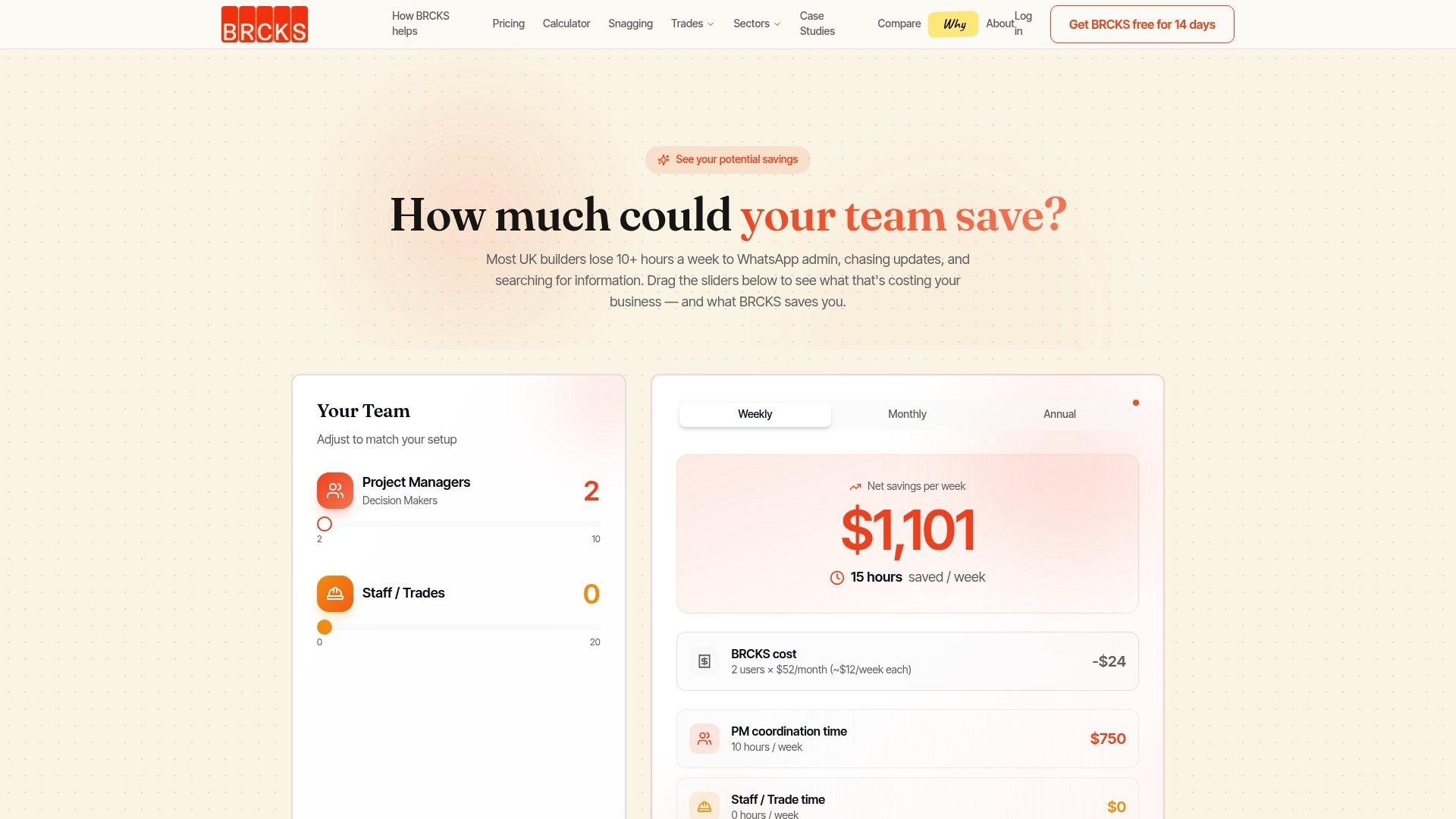
Fewer disputed variations and 30+ minutes saved per user per day are the numbers BRCKS is built around. The fastest way to test both claims against your own projects is a 14-day free trial with no card required.
Before your demo, bring one project spreadsheet, a WhatsApp thread containing at least one variation, and a set of photo evidence from a recent site visit. Those three inputs let you test the five demo tasks in the checklist above against real data. If the platform cannot handle them cleanly, you will know within 20 minutes.
Expect to see measurable results within the first month: a complete variation log, a searchable site diary, and subbies logging work without a paid seat. Start your free trial or book a demo at BRCKS, or run the savings calculator first to sketch your own numbers.
Sources
- Excel ‘a starting point, not the destination’ – rethinking data management - Construction Management
- Cij
- Why WhatsApp Is Costing Your Construction Business Money
FAQ
What does a construction project estimator do for UK builders?
In a site-management context, a construction project estimator is a platform that captures variations, RFIs, site diaries and photo evidence in a single searchable record, replacing spreadsheets and WhatsApp threads.
How much does BRCKS cost, and do subbies pay?
BRCKS costs £40 per seat per month billed annually for core team members. Subcontractors, trades and clients are invited free.
How long does it take to roll out on a live project?
Most small firms complete a working pilot within four to six weeks, with the first variation logged and site diary running by the end of week three.
Does BRCKS work with WhatsApp, or does the team need a new app?
BRCKS provides a dedicated business WhatsApp number. The team keeps messaging as normal, and BRCKS automatically files those messages as structured project records.
How does a site-management platform help with ISO 19650 handover?
Structured records built throughout the project, including timestamped photos, variation logs and RFI responses, export directly into the handover pack, meeting the structured-data expectations that clients and ISO 19650 frameworks require.
Recommended
- BRCKS Blog | Page 2
- BRCKS Blog | Page 4
- UK Construction Trends 2026: Industry Outlook & Forecasts
- Construction Contingency: 2026 UK Management Guide
How BRCKS Can Help
Navigating the complexities of project estimation in 2026 requires a balance of local expertise and modern efficiency. BRCKS simplifies this process by integrating real-time cost data and automated workflows directly into your project management suite, ensuring your quotes remain both competitive and profitable. By centralising your estimating tools, you can reduce manual errors and focus on delivering high-quality builds across the UK. We invite you to discover how BRCKS can transform your pre-construction phase by exploring our platform today. Learn more at BRCKS and explore our full feature set.
Sources