
Progress Tracking in Construction: A Guide for UK Builders
Learn how to track construction progress against your programme effectively, using site diaries and digital tools to spot delays before they impact your margins.
By James Shorter ·
Progress Tracking in Construction: A Guide for UK Builders

The best way to track construction progress is to record it where the work is already being discussed, check it against the programme every week, and keep one list per job. Most delays are not a surprise on the day. They show up days or weeks earlier as a late delivery, a snag nobody logged or a subbie who has not turned up. If those signals sit in a WhatsApp group, nobody sees the pattern. BRCKS is built so that a site message becomes a logged snag, order, visit or checklist item in one tap, which means progress is recorded as the job runs rather than written up at night.
TL;DR
- Track what was done, where, when, by whom, what stage it reached, what got in the way and what remains.
- Compare actual progress with the programme at least weekly, and record the reason for every slip.
- Photos, site diaries, snag lists and variations are the evidence that protects your programme and your money.
- Manual, document-heavy reporting is slow and error-prone, so pick a method the whole site team will actually use.
- Once a delay shows, act on the cause: resequence, chase the supply, agree the variation and tell the client early.
Table of Contents
- What progress tracking actually involves
- Why the purpose matters: time and money
- Measuring actual progress against the programme
- How often to check
- Choosing a progress-tracking method
- A weekly routine that works on a real site
- Reducing delays once progress tracking shows a problem
- Records that protect you
- Our view
- Try it on your next job
- FAQ
- Sources
What progress tracking actually involves
Progress tracking is checking site activity against the plan and writing it down clearly enough that someone else can follow it. CCM’s guidance on monitoring and recording site progress lists the usual elements: observing activities, recording completed and incomplete work, keeping site diaries, taking suitable progress photographs, noting labour, plant and materials where relevant, logging significant site events and reporting back to the office.
The same source says a good record should normally establish six things:
- What work was done.
- Where it was done.
- When it was done.
- Who did it, where that matters.
- What stage it reached.
- What issues or events affected it, and what remains.
That is a useful test for any system you use. If a record cannot answer those questions, it will not help you in a progress meeting or a dispute.
What goes in a daily site diary entry
The site diary is the backbone of day-to-day tracking. CCM suggests a daily entry might include the date and location, weather and site conditions, activities and areas worked, labour and subcontractor attendance, plant used, material deliveries, inspections and tests, significant instructions, access restrictions, issues affecting planned work and the progress achieved that day.
You do not need every field on every job. CCM is clear that exact requirements depend on the project, the organisation and the contract procedures, and that the aim is reliable information, not admin for its own sake. On a domestic extension, attendance, deliveries, weather, instructions and issues will cover most of it. On a larger fit-out you will add inspections and access restrictions.
What a formal progress report captures
On contracted work you may be asked for something more formal. The CQIC site guide for contractors describes a Contractor’s Progress Report that captures progress against programme (evidenced with a programme mark-up), delays with reasons and mitigations, health and safety compliance evidenced with inspection reports, and variations with the dates of decisions and authorisations plus the forecast cost of instructed and pending variations.

If you work under NEC4, our guide to construction progress reports for UK compliance covers what to include.
Why the purpose matters: time and money
Ramskill Martin describes the purpose of progress monitoring as measuring current status in terms of time and commercial position, then reacting to deficiencies so future performance improves. That is a good way to frame it for a small builder. Progress tracking answers two questions every week:
- Are we where the programme says we should be?
- Is what we have done, and what we have been instructed to do, reflected in what we can invoice?
The second question is the one that gets missed. Work that was added on site by verbal instruction and never logged as a variation is progress you will struggle to get paid for. Tracking progress and tracking variations belong in the same record.
Measuring actual progress against the programme
To know whether you are behind, you need a baseline. Programme tools make this explicit: in Microsoft Project, if you have saved a baseline you can compare planned work with current scheduled work, and the variance field shows the difference. You do not need a scheduling package to use the idea. A bar chart, a spreadsheet or a simple list of stages with planned dates does the same job, as long as you do not overwrite the original dates when things move.
A practical way to score progress
For residential and small commercial work, keep it simple:
- Break the job into stages that mean something on site: strip-out, first fix, plaster, second fix, decoration, snagging.
- Give each stage a planned start and finish date and leave those dates alone.
- Each week, record the actual start, expected finish and percentage complete for each live stage.
- Record the reason for any gap in a sentence: late materials, access, weather, design change, labour.
Percentage complete is always a judgement. Use physical evidence, not feel: rooms boarded, circuits tested, units fitted. Two photos of the same area a week apart settle most arguments about whether anything moved.
How to recognise a job falling behind
The programme rarely slips all at once. Watch for these signs:
- A stage starts late and nobody changes the following dates.
- Snags are logged faster than they are closed.
- Orders are placed late or chased more than once.
- The same subcontractor is rescheduled twice.
- Unlogged instructions from the client begin to stack up.
- Your site diary keeps recording the same issue.
Any one of these is normal. Three in the same week on the same job is a trend, and that is the point to act.
How often to check
Ramskill Martin recommends a weekly progress review as a minimum, with the planner reviewing at least monthly so senior management hears about risks and opportunities as they emerge. For contracted work, the CQIC guidance suggests a minimum fortnightly frequency for certain communications tied to the progress report, with progress meetings at least monthly or as the employer’s decisions and issues require.
For most UK builders a sensible pattern is:
| Frequency | What you check | Who |
|---|---|---|
| Daily | Site diary, deliveries, attendance, issues, photos | Site lead |
| Weekly | Progress against programme, open snags, orders due, variations pending | Contracts manager and site lead |
| Fortnightly or monthly | Progress report, client or employer meeting, cost forecast | Director or project manager |
If you need a structure for those meetings, our checklist for effective construction meetings is a practical agenda to start from.
Choosing a progress-tracking method
There is no single best tool. A 2022 IAARC paper on evaluating progress-monitoring technology suggests weighing time efficiency, range, accuracy and cost, together with automation, preparation and training needed, susceptibility to bad weather, compatibility, statutory requirements, mobility and the characteristics of the project. For a small builder, three of those matter most: how much training it needs, how well it fits the way your team already communicates, and what it costs per head.
The main types of approach
Paper and spreadsheets. Cheap and familiar. The problem is that they depend on someone typing things up later. A Heriot-Watt critical appraisal found that traditional monitoring practices mandated by standard contracts are often manual, document-centric and labour-intensive, leading to slow and erroneous reporting and project delays.
Programme software. Good for planners and larger projects. It tells you what the plan is, but it relies on someone feeding it accurate progress data from site.
Automated capture, such as scanning and drones. Useful on big or complex sites where survey-grade data is needed. On a house refurbishment they are usually more than the job calls for.
Photo and 360° records. A dated visual record is the easiest evidence to produce and the hardest to argue with. Our piece on construction progress photos and rework explains how to file them so they are useful later. BRCKS also offers 360° site tours for a walkable record of the job.
Chat-based tracking. Site teams already communicate by message. The weakness of a plain group chat is that nothing is filed, so progress is buried in photos and voice notes. A chat app that turns messages into logged actions closes that gap without asking people to learn a new system.
For a wider look at the options, see our comparison of construction reporting tools for UK sites.

A weekly routine that works on a real site
This is the routine we would give a builder running three or four jobs. Each step shows where it goes wrong and what BRCKS takes off your hands.
1. Capture on site, as it happens
Take photos and short notes as work finishes, not at the end of the day. Where it goes wrong: by 6pm, half of it is forgotten, and the other half is typed up at the kitchen table.
In BRCKS, the team posts in the job chat as normal. One tap on a message files it as a snag, a materials order, a booked site visit or a checklist item, all landing in one list per job. Photos and actions go to the right job, so there is nothing to write up at night.
2. Keep a daily diary
Record attendance, deliveries, weather, instructions and issues. Where it goes wrong: diaries get skipped on busy days, which are exactly the days you will need them. BRCKS includes site diaries as part of the job record, so the day’s entries sit alongside the chat and photos for that job.
3. Log every instruction as a variation
Anything the client asks for that changes scope, cost or time gets recorded when it is said. Where it goes wrong: a verbal “while you’re there” becomes a disagreement at final account. BRCKS holds variations and RFIs with audit trails, so the date, the request and the response are on record. We use the word variation first and change order second, because that is how most UK trades say it.
4. Review progress against the programme once a week
Open the job list and compare it with your baseline. For each live stage, ask whether it is on time, what is blocking it and who needs to act. Where it goes wrong: the review turns into a hunt for information spread across WhatsApp, email and notebooks. With one list per job, the review is a read-through, not a search.
5. Close snags as you go
Leaving every defect to the end creates a long, stressful snagging period. Log snags during the job, assign them and tick them off. BRCKS handles snagging and checklists in the same list as everything else.
6. Tell the client and subcontractors what has changed
Subcontractors and clients can stay in WhatsApp and install nothing, and they are free. They get updates and respond in the app they already use, and the response lands in the same job record. The client portal gives clients a view of progress without you sending a weekly summary by hand.
Reducing delays once progress tracking shows a problem
Tracking only pays off if it changes what you do. Ramskill Martin says progress reports should identify activities falling behind so the project can be managed proactively, with problems rectified or risks managed, and with issues highlighted promptly and delays disclosed to employers. The same source points out that progress records provide the raw data to demonstrate the impact of change or delay on the works.
So the first rule is to tell people early and with evidence. After that, the response depends on the cause. Research on weekly progress reports sorted delay causes into groups such as material shortages, labour constraints, design modifications and planning issues, which is a handy way to think about the fix.
| Cause | What to do |
|---|---|
| Material shortage | Check the order log, chase the supplier, agree a substitute with the client, resequence work that does not need the item |
| Labour constraints | Rebook the trade, split the task, bring forward work another trade can do |
| Design change | Record it as a variation, state the time effect, get written approval before proceeding |
| Planning or sequencing | Re-plan the next two weeks, fix the dependency, update the baseline note with the reason |
| Access or weather | Log it in the diary on the day, reschedule internal work, notify the client |
Two habits prevent most repeat delays. First, resequence rather than wait: if the kitchen is late, move the decorating forward. Second, never let an RFI sit unanswered. An open question about a detail is a delay in waiting, so chase it with a date. Our guides on task tracking and site communication workflow go into this further.
Records that protect you
Progress records matter beyond the programme. On notifiable projects, your health and safety paperwork is part of the same picture, and our guide to CDM paperwork lists the core documents. Drawings, RAMS and quotes also need to be the current version when you refer to them, which is why versioned project files are part of the job record. If you want the full picture of how this fits together, our guide to construction site monitoring for UK builders is a good next read.
Our view
We built BRCKS because the tracking tools that exist ask a site team to change how it works, and site teams do not. They use WhatsApp because it is quick. The trouble is that a group chat is a pile of messages, not a record.
Our view is that progress tracking should be a by-product of talking. A snag photographed on Tuesday should be a logged snag by Tuesday lunchtime. A materials request in the chat should be on the order list. If it takes extra effort, it will be skipped on the busy days, and those are the days that cause delays.
That is why BRCKS works like a simple chat. The core team uses the app on iPhone or Android, the office uses the web view, and subbies and clients carry on in WhatsApp for free. It is one job and one record, however the update arrives. We designed it to save site teams 30 minutes or more a day that would otherwise go on writing things up.
The founder spent 20 years in construction, and the design reflects it: variations, RFIs, RAMS, snags and site diaries are named the way UK trades name them.
James
Try it on your next job
BRCKS is construction project management software for UK builders and contractors, with project chat, snagging, site diaries, variations and RFIs, versioned files, a client portal and 360° site tours. Solo is £20 a month. Teams is £40 per seat a month billed annually, or £50 monthly. Subcontractors and clients are free, and there is a 14-day free trial. See the full pricing, or look at construction software for builders to see how it fits a small firm.
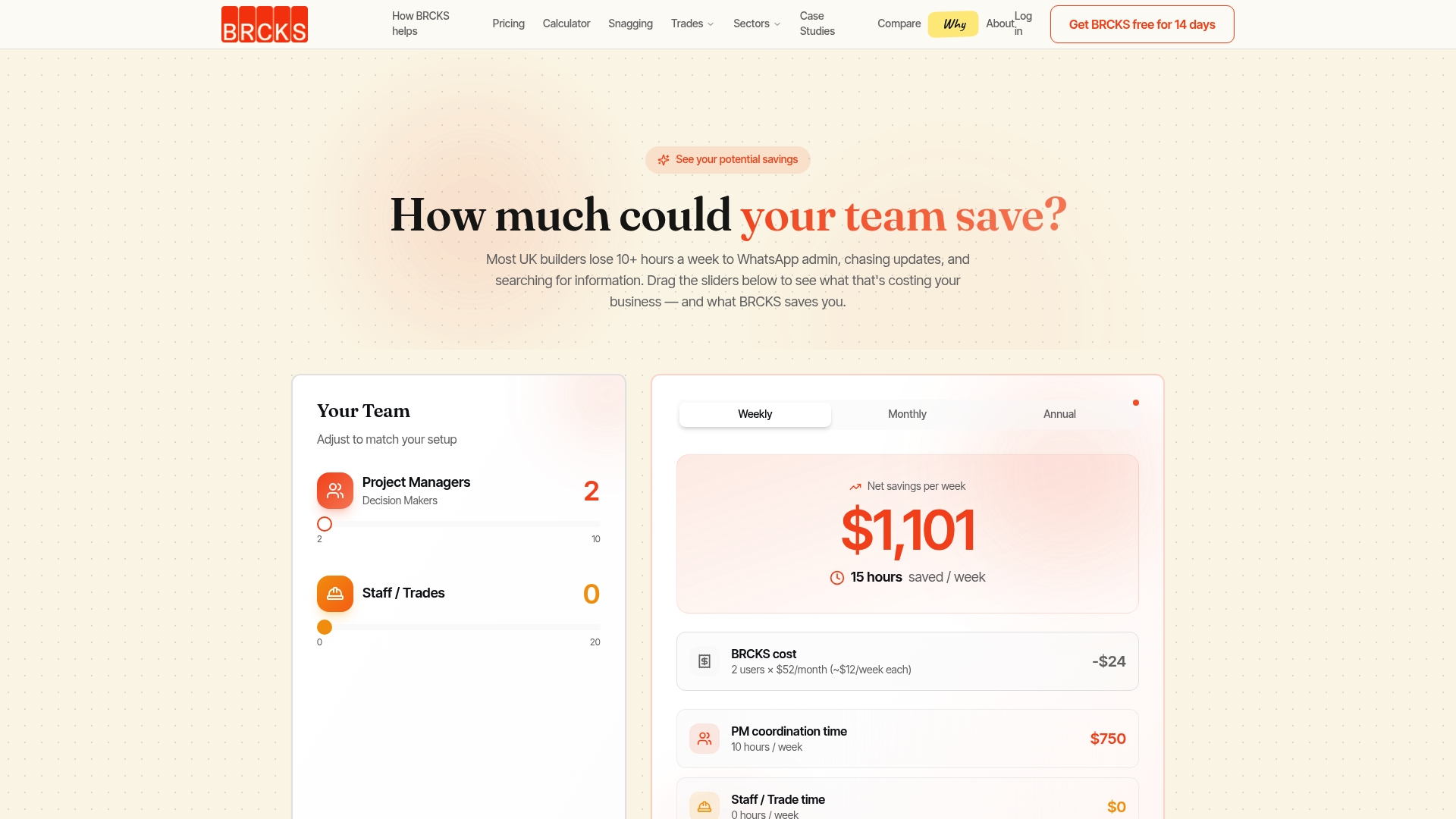
If you would rather see it first, you can book a BRCKS demo and we will walk you through a job from first message to final snag.
FAQ
What is the best way to track construction progress?
Combine a daily site diary, dated photos and a weekly comparison against the programme, all kept in one record per job. The method matters less than whether the team uses it every day. A chat-based tool such as BRCKS suits small and mid-sized UK builders because logging takes one tap.
How do I know if my project is falling behind?
Compare actual stage dates with a baseline you have not altered. Warning signs include late starts, rising open snags, repeated chasing of orders and unlogged client instructions. If several appear in the same week on one job, review the next fortnight’s programme straight away.
How often should I review progress?
Check the diary daily and review progress against the programme at least weekly. Ramskill Martin recommends a weekly review as a minimum, and contract guidance such as the CQIC guide suggests progress meetings at least monthly, or more often as the project requires.
How can I prevent project delays?
Log issues the day they occur, chase orders and RFIs against dates, and record every instruction as a variation with its time effect. Resequence work around blockers rather than waiting, and tell the client early with photos and diary entries as evidence.
Do subcontractors and clients need to install anything?
Not with BRCKS. They can stay in WhatsApp and take part for free, and their messages land in the same job record as the core team’s. Only core team members take a paid seat.
Sources
- Monitoring and Recording Site Progress, CCM
- Construction Quality Guidance for Contractors, CQIC
- Back to Basics: The Principles of Measuring Progress, Ramskill Martin
- Review the progress of your schedule, Microsoft Support
- A critical appraisal of traditional methods of construction progress monitoring, Heriot-Watt Research Portal
- A Systematic Classification and Evaluation of Automated Progress Monitoring, IAARC
- Automatic Inference of Construction Delays through Analysis of Weekly Progress Reports
Recommended
- Construction Task Tracking: A UK Project Manager’s Guide
- Gantt Charts for Construction: A Practical UK Guide
- Design Change Tracking in Construction: UK Guide
How BRCKS Can Help
Effective progress tracking is the cornerstone of any successful build, ensuring projects remain on schedule and within budget across the UK’s demanding construction landscape. BRCKS simplifies this process by providing intuitive tools that centralise your site data and streamline communication between the office and the field. By integrating these digital solutions into your daily workflow, you can eliminate guesswork and focus on delivering high-quality results for your clients. We invite you to explore how BRCKS can transform your project management and help your business thrive in an increasingly competitive industry. Learn more at BRCKS and explore our full feature set.